Feeds:
Posts
Comments

Posts Tagged ‘ICTs’

If you happen to be in New York City and have a couple of hours to spare, come on by to this panel today from 12-2 at UNICEF’s Danny Kaye Center. I’ll be doing an overview of some research that Keshet Bachan and I worked on late last year for UNICEF.

There will be some fantastic examples from Tostan, Equal Access, New School and UNICEF on creative ways that new technologies can be used when working directly with marginalized adolescent girls. We’ll also discuss how ICTs and communication for development (C4D) can be used in broader outreach aimed at changing mindsets and behaviors to look more favorably on girls and their capacities and improve their access to new technologies.

Update:  Here’s an article and short video about the panel.

Read Full Post »

Last October, UNICEF West Africa wrote up a nice briefing note on mobile tech and its relevance in child protection programming. You can download it here.

According to the document, pulled together by Mirkka Mattila, ‘This is an area of rapid innovation and new applications are being developed all the time. Telecommunications is one of the fastest growing sectors in Africa and the relevance and reach of mobile technologies for development and humanitarian work is only going to increase over the coming years. Many technical, legal and security aspects of these new technologies remain to be fully addressed and worked out. The dependence on technology, network coverage and electricity supply also mean that mobile technologies cannot be used everywhere.’

The paper includes examples on the use of mobile technologies for:

  • gathering and transmitting data by child protection service providers; including surveys, rapid assessments, case management, family tracing and reunification of separated children, and birth registration
  • self-protection and complaints mechanisms; such as child helplines, violence reporting and community mapping for violence prevention
  • transmitting information and money via mobile; eg, SMS campaigns and cash transfers.
Some of the examples and tools highlighted include: RapidSMS, RapidFTR, Nokia Data Gathering, Child HelpLines, FrontlineSMS, Ushahidi, OSM and Map Kibera, and M-PESA.

It pulls out challenges and advantages of the different use cases and offers some guiding questions to assist in the selection of the most appropriate applications, such as:

  • Is there a need to create new applications or can existing solutions be used?
  • What are the characteristics of the user group and the environment (urban – rural, existing networks and coverage etc.)?
  • What technical expertise is required for installing and maintaining the system?
  • How well will investments in equipment and capacity meet the needs, expected impact, benefits and outcomes in terms of results delivery?
  • What are the potential partnerships for sustainable capacity-building and service delivery? What are the roles of public and private service providers?
  • What are the financial resources needed in the short, medium and long-term to establish and maintain the system?

The document ends with some arguments and counter arguments around the use of mobiles in child protection work. It’s nice to see this paper as there is not a whole lot of research and/or documentation on use of mobiles and ICTs specifically in child protection work.

Download it here.

****

Other child protection resources/posts on Wait… What?:

Child Protection: From emergency response to a sustainable mechanism

Community Based Child Protection

Child Protection, the media and youth media programs

Children in Emergencies: Applying what we already know to the crisis in Haiti

Read Full Post »

One of the great panels at last week’s Making Cents International’s Global Youth Economic Opportunities Conference was on technology and youth economic opportunities. (See my previous posts on seeing youth as assets and barriers girls face to economic opportunities, and my next post on soft skills and enabling environments).

In addition to the specific panel, I paid special attention throughout the conference for any mention of technology, and I asked some questions in panels that were not related to technology to see if people thought technology was an enabler for adolescent  girls or if my perception is biased because it’s my area of focus.

What I heard is that in regard to girls and technology, there are large gaps as well as areas where technology can serve as a bridge for girls to achieve economic opportunities. As Wayan Vota from Inveneo noted, globally, women are 20% less likely to have a mobile phone than men and in Asia, that number rises to 37%. How can we address the ‘girl gap’ especially in terms of the poor and disadvantaged 10% of adolescent girls who are the most marginalized of all? How can we help bring economic opportunities to this group?

Girl-focused programs. In terms of helping girls feel more comfortable accessing and learning about technology, Peter Broffman from Intel brought up the importance of safe spaces. Intel’s Learn program creates spaces that are ‘girls only, where they are not competing with boys,’ he said. ‘It takes a concerted effort to construct comfortable environments where girls can explore technology.’ We have special days for girls and girls only projects. Girls tend to be more comfortable creating and using technology in that kind of environment,’ he said. Vota agreed, saying that one simple way of making spaces more amenable to girls is by having all the computer screens in a computer lab or cafe facing the public, so that it’s easy to monitor what is being done on them (eg., so that accessing ‘adult’ content is impossible to hide). Katherine Lucey from Solar Sister, in a separate panel, also referred to the need for programs that are specifically designed for girls and women. She described a microfinance program operating in one of the same communities as Solar Sister where 90% of the participants are male. ‘Solar Sister is a program aimed at women because the existing programs are biased towards men.’

Girls and women in rural areas. David Mukaru from Kenya’s Equity Bank said that the bank reaches more women and girls simply because  the majority of rural population in Kenya is made up of women. Many men have migrated to urban areas. ‘Through the financial education which the bank embarked on 3 years ago, we addressed technology fears. We were able to train the women, create awareness on bank services, train them how to use technology, how to interact with bank officials. We also introduced technology to the rural agency. The agency uses a mobile. The agency in the rural area is the normal shop keeper and he has become an agent of training and penetrating in the rural areas. This guy is in the rural shop and he trains the woman how to use these technologies to do banking.’

Mobility.  Mobile tech can really be the great leveler, according to Jacob Korenblum from Souktel. It can really help to close gender gap.  ‘Many of the young women who use our services come from traditional families that would not allow them to go door to door to find employment. They are not allowed to go around town to find job opportunities. So their ability to find jobs is limited. But since many young women have mobile phones, within the household, as a young woman via Souktel you can start looking for work and even secure a job interview from home. Your family is comfortable with how you are doing this but you are still asserting yourself, you are taking that step to get a job.’

Another program that Souktel offers is support for women entrepreneurs via mobile phone groups. ‘Through a closed mobile phone peer network, women can ask questions to each other. In Iraq for example, women cannot travel, but they want to consult with other women on a business they are starting – they can send a question out to peers who can respond with advice. It’s like a list-serve via mobile phone. For female business owners, being able to consult peers via mobile is tremendous. It’s safe for them, it’s empowering. Our studies have shown this. We’ve been able to help women play catch up and access the same resources that men have, just through a different channel.’

Access is not enough. Raquel Barros from Lua Nova, a program that trains marginalized girls in Brasil to do construction work, said that in Brazil mobile phones are very expensive and they are a high status asset for the girls she works with. But ‘access is not sufficient for the phone to be used for something good or useful,’ she said. ‘It’s important to access the mobile phone but also important to do more education about how you can use the mobile phone. All our girls have Orkut but they don’t know their email. They have computers that they can use and we started to take some photos and that kind of thing, but the girls don’t always access and use mobiles and Internet in a good way. Access and education are both important.’ [Plan did some interesting research on girls use of technology in Brazil that confirms this also – see the Annex to Chapter 4.]

Technology as an economic enabler. Technology is everywhere according to Manjula Pradeep from Navsarjan, a trust that works with low-caste girls in India, “In Gujarat we have maximum mobile owners. The mobile is a status symbol, yes. In a family you can have 3-4 people owning a phone. And it does mean a lot when young women have mobiles, you can do your marketing, you have access to people, people can reach you on your mobile, you can put it on your shop board so people can reach you on mobile.’ In addition, computer training can allow girls to replicate and train others on computer skills. ‘A lot of girls have done computers; they are running classes for the children because children are not taught computers in schools. So the girls can teach this.’ However, as David Mukaru from Equity Bank in Kenya had noted earlier during the technology panel, ‘the challenge is access to a power supply.’ Not to mention other infrastructure. ‘When we work with the tribal populations, they have no access to transport, so how can you ever get a computer repaired?’ Some young people who Pradeep works with have started their own studios. ‘They start by buying a camera — it’s not cheap but they save and buy it. We have a lot of wedding ceremonies and rituals that happen that people can do a lot of video projects.’

Wearing pants. But as Pradeep said, technology can also bring about other personal changes. ‘Ultimately, your entire outlook changes with tech. Women with computers or cameras tend to wear trousers and shirts. I’ve seen women — if you get married you only have to wear saris, you can’t get out of a sari, you struggle with that identity — but these women are wearing trousers and using a camera. Sometimes they even cut their hair! Even just using a camera or cell phone,  you will see women changing. Technology really changes their role. To bring change, mobilizing the community is important but technology itself can also change the role of women.”

Interesting indeed!

Read Full Post »


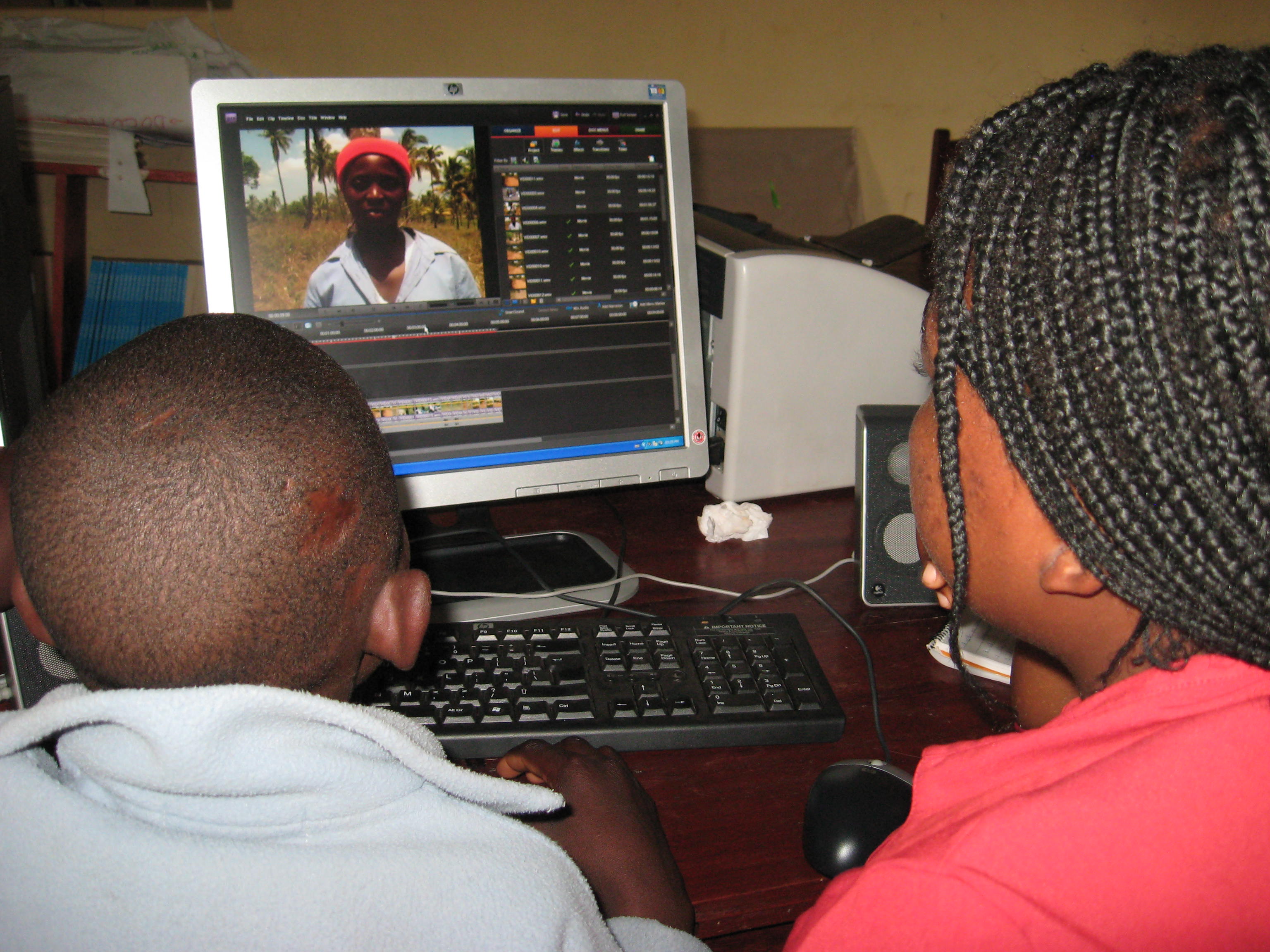
Ernest training youth in Okola.


In  Garoua, Cameroon last week at a Training of Trainers meeting for the Youth Empowerment through Arts and Media (YETAM) Project, Ernest Kunbega Gwanvoma from GIMAC (Geographic Information and Management Center) took us through the youth digital mapping process that he and Plan staff and other partners facilitated this past year.

Ernest’s presentation is posted below (with his permission), along with some comments from the rest of the group.


Why Digital Mapping?

In line with YETAM’s emphasis on use of new technology in youth and community development work, Plan introduced the use of GPS and digital mapping. Training the youths in the use of GPS and digital mapping permitted them to map out their council areas and create an information system, including the road network and other socio-economic infrastructure of their area. This exercise exposed the youths to the realities of their environment, for it took them to all the nooks and corners of their area. This way they could easily identify the problems of their communities and share with their peers all over the world. And what better way than to indicate all this than on a map? Eventually the digital maps produced will be used to track cases of violence, gender discrimination and community development planning issues. They will be used locally and shared on Open Street Map to a wider world community.

Mapping in Ndop Council Area

Objectives

The general objective of the exercise was to produce digital maps for 3 council areas; Ndop, Pitoa and Okola, where YETAM projects are being implemented. To accomplish this, participating youth were trained on the use of GPS for field data collection. They created way points of socio-economic infrastructures for their areas. A data base on all the socioeconomic infrastructures mentioned above was created. The youth also tracked the road network of their council and put it on the digital maps. This information was all uploaded into Open Street Map.

Methodology

We used the following working methodology:


  • Training of students /community youths in the use of GPS for field data collection, its potential uses and practical sessions
  • Elaboration of data codification sheets and production of waypoint forms/tracking sheets and data collection sheets for schools and health centers
  • Collection of field data
  • Analysis of data and production of digital maps
  • Uploading of digital map into Open Street Map


Data codification sheet, way point forms and data sheets


Training youth to use way point forms.

During the theoretical sessions, the youth worked in small groups to brainstorm the data that they wanted to collect about their communities. Community members and Plan staff with experience in data collection, advocacy, research and development programs gave input as well. A final set of data to collect was agreed upon, including schools and health centres in all 3 council areas.  Each group (from Ndop, Pitoa and Okola) also had its own particular aspects that it wanted to map out, based on local context.

To enable the youths collect field data in an organised manner field documents were created and made available to them, including:

  • General codification sheet
  • Waypoint form
  • School data information sheets
  • Nursery school information sheet
  • Primary school information sheet
  • Secondary school information sheet-General Education
  • Secondary school information sheet-Technical Education
  • High school information sheet
  • Health centre information sheets
  • Tracking sheet


GPS practice in Pitoa

Collection of field data

In each locality, the start off was at the District officer’s office where a cover letter or letter of introduction explaining the rationale for the field exercise was collected. This letter was presented in the communities as the need arose to avoid any form of embarrassment from the community.

The data collection exercise in was carried out by community youths, students, resource persons and the consultant’s team. In Ndop and Okola, the Partner Vision (PAVIS) and IRONDEL staff (respectively) and all resource persons were involved in the data collection. The student youth population was not available due to classes, so the out-of-school community youth who were involved in the training did the data collection. In Pitoa the staff of Solutions Technologiques Alternatives (STA) and all the resource persons were involved in the data collection. The community youths and the student population participated intensely in the exercise for they had just finished with their examinations and their principal gave them permission to participate in the field exercise during school period.

Formation of Groups

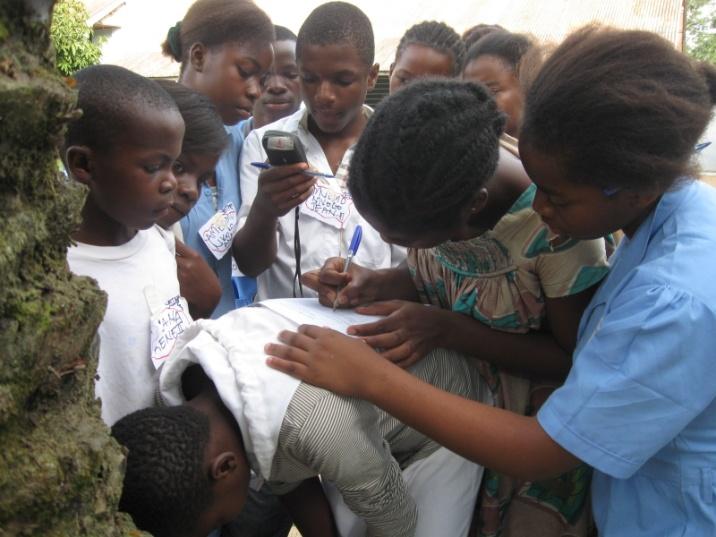
Youth filling out way point forms in Okola

To facilitate field data collection in each of the council areas, field groups were created, headed by a resource person or a staff of the consultant. The groups were allocated an area of work. One group was in-charge of tracking all the road networks and the rest of the groups collected waypoints and data on socio-economic infrastructures.

In places where the information sheet (data collecting forms) could not be filled instantly, the forms were dropped off to be filled by the competent authorities and to be collected later, this was the case especially with schools. Cars and motor bikes were hired to transport data collectors to the field in each locality.

At the end of each day, a review of the day was done; problems, lapses and wrongly collected information were pointed to the different groups for corrective measures to be taken.

Downloading /converting  GPS  Data

To be able to analyze the GPS data the waypoints and tracks were downloaded and saved in appropriate formats that could be visualized in JOSM. (Waypoints-GPX and text format, Tracklogs-GPX and DXF formats)

Attributing waypoint types

Students collected data to link with the way points, for example at this school in Pitoa

Based on the field data collected attribute tables were built for schools and hospitals etc. The data collected on schools and other aspects were triangulated for accuracy (when possible) with data previously collected by Plan or available from local government offices.


Production of digital maps

To produce the digital maps of the three council areas the JOSM offline editor was used. The waypoints and tracks were loaded into JOSM. The waypoints were digitized and appropriate attribute information assigned to them as tags. The tracks representing the road network were also digitized using JOSM.

Uploading and visualization of the digital maps

The produced maps were uploaded using JOSM to the Open Street Map site with online connection as soon as they were finished. The maps can be seen at the Open Street Map site.

Challenges and constraints

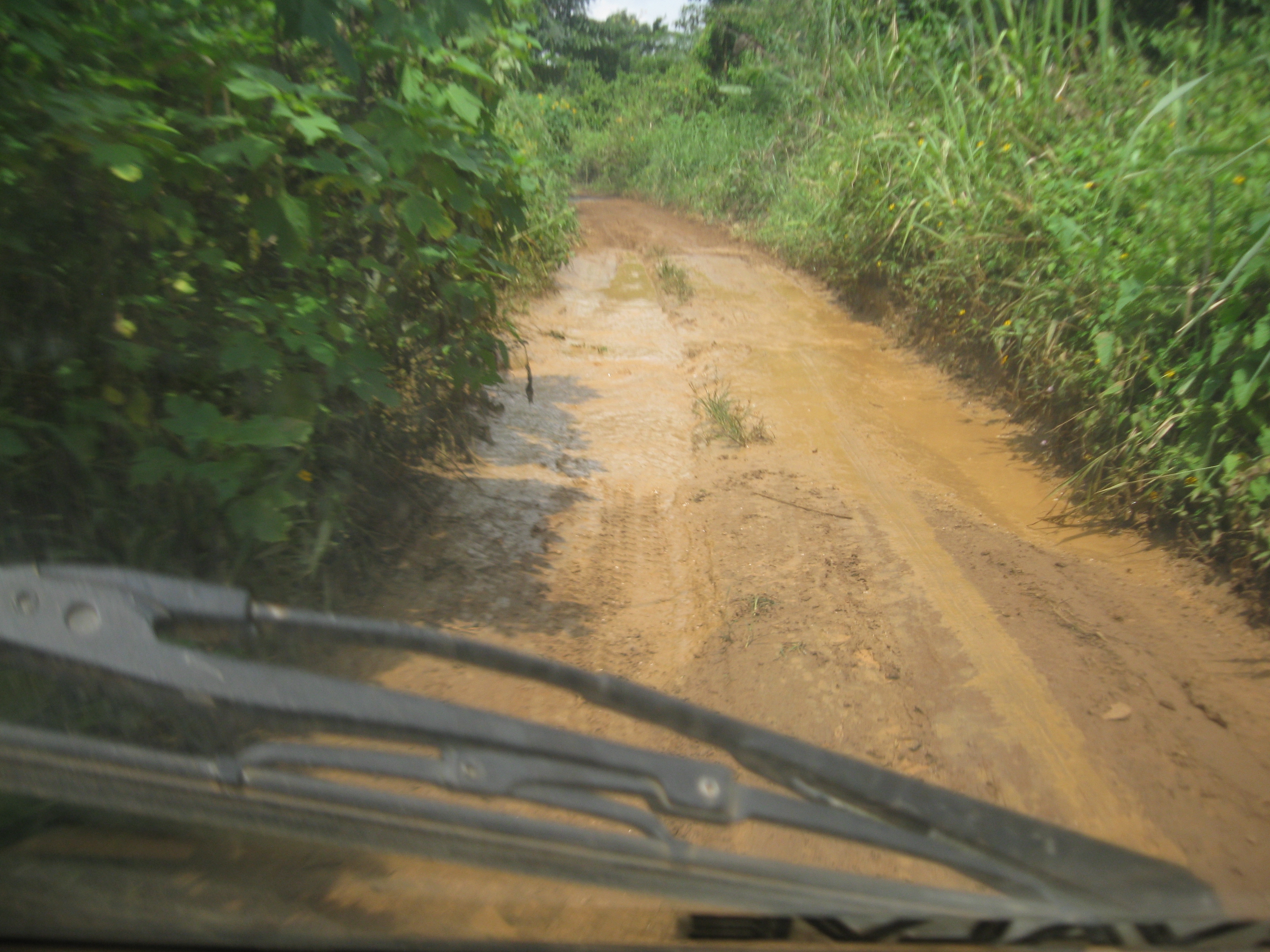
Bad roads made the mapping difficult in areas where vehicles and motorbikes couldn't pass after a certain point.

  • The student population was not fully involved in the actual field data collection in some communities because they had to be in class, so we worked only with the out-of-school youth population.
  • In Ndop and Okola, rain disrupted field activities and work had to slow down given the bad nature of the roads, which became very impracticable to vehicles and bikes, making the whole exercise difficult, strenous and time-consuming.
  • It was not always easy to arrange for transportation.
  • Most of the students and drivers did not know their full community areas well, so local community guides were recruited to take teams around.
  • In some of the areas the data sheets of schools could not be filled because the head teachers were not available.
  • In one particular area, a head teacher deliberately refused to fill the forms demanding bribe from the youths.
  • In some of the schools the head teachers had no information about the student enrolment and as such the youths had to go to each class and count the students themselves which was time-consuming.
  • Youths had to trek long distances in some of the inaccessible villages by vehicles because roads were very narrow.

Discussion

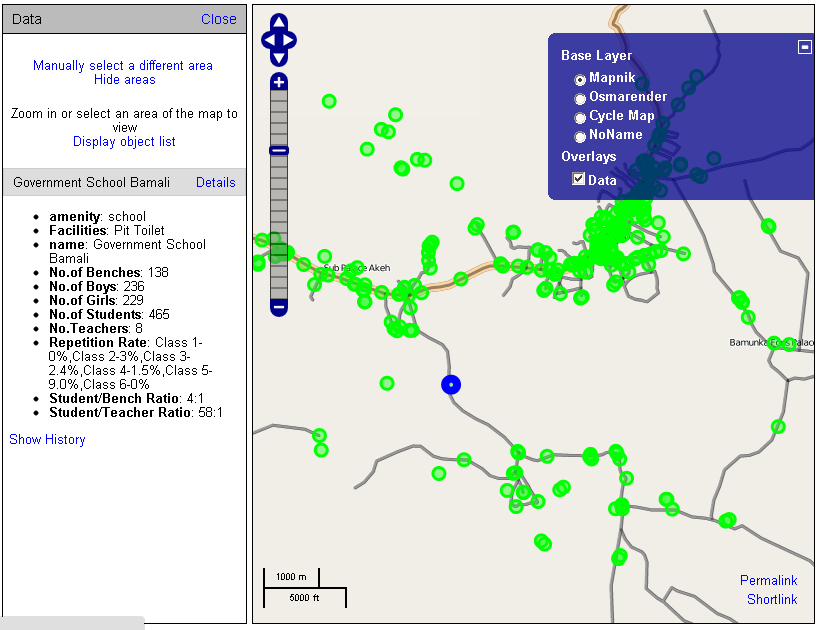
Despite the challenges faced during the field data collection the mapping exercise was quite successful. Having the digital maps is a real achievement. Having a solid data base attached to geographic location will be a powerful tool to support the youth’s local advocacy work. (Live version of the map is here. To see data, turn on the data layer as shown in the image below by clicking on the blue tab on the right side of the map.)

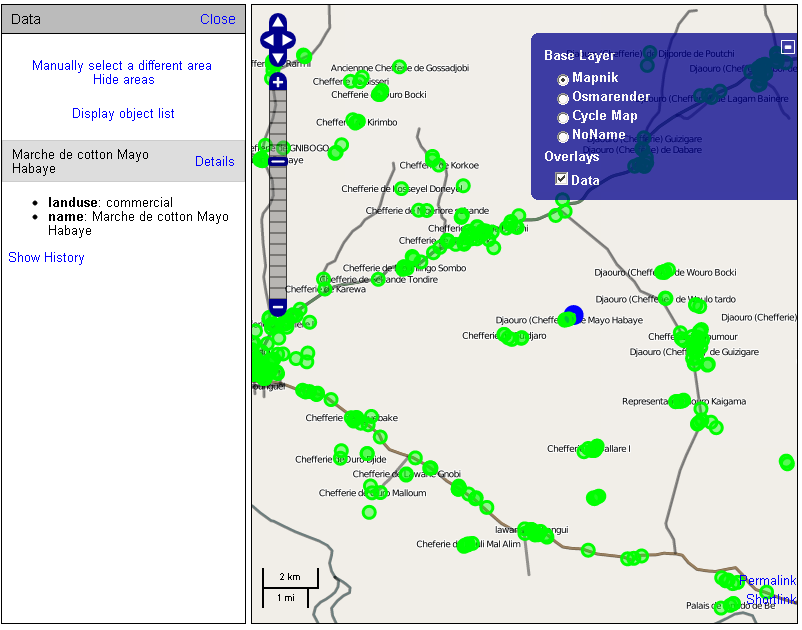
Open Street Map image of Ndop with data layer turned on. Data to the left belongs to the blue dot near the center of the map.

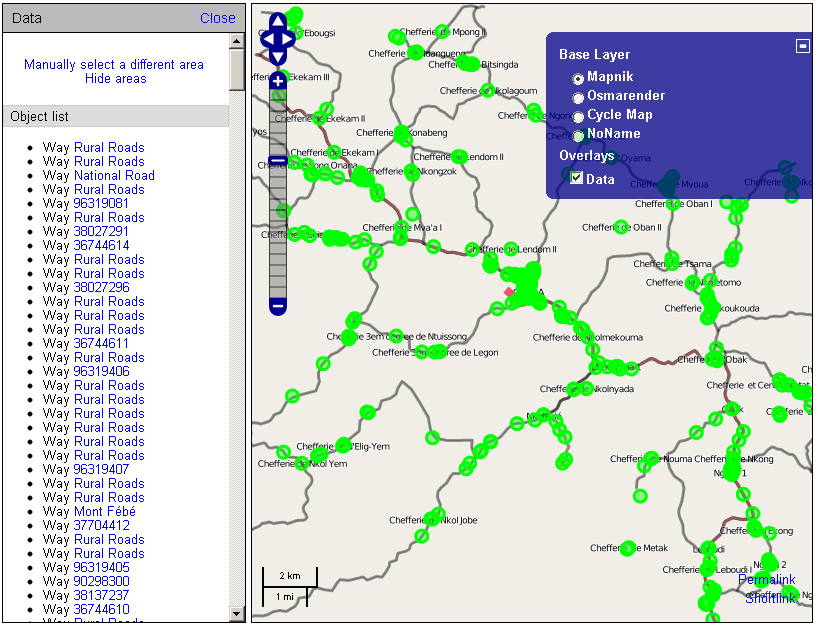
Pitoa Council Area with data layer. (Visit Open Street Map for interactive view).

Okola Council Area with data points. (See Open Street Map for interactive map).

The group at the workshop (PAVIS, IRONDEL and STA partners, Plan staff and Ernest himself) concluded that digital mapping was a good exercise. One participant commented that the heads of the school hadn’t been aware of the importance of collecting data about their own schools, and the mapping exercise motivated the youth and the head teachers to begin to collect and track data, to look at the status of their building structures and to count their students.

Others commented that the mapping exercise is a tool that really takes the youth around to their environment. Many of the youth only knew specific parts of their communities, but the digital mapping exercise brought them around to the entire expanse of their community. It gave them a reason and an opportunity to get to know the realities of their environment.

The group agreed that in the future, it would be advisable for hand-drawn mapping followed by digital mapping to take place as the very first step of the project, before other project activities (arts, media and advocacy efforts) happen, because the mapping provides the youth with a deeper awareness of their communities and the main issues therein. It also allows them to collect solid data as well as a visual tool that they can use to then carry out their advocacy activities with local councils. (Note: This year, hand drawn mapping was done as a first step, then the arts and media activities followed. Because it was a new activity requiring additional training and preparation for staff and partners, the digital mapping was done in as third step).

One question the group will explore is how to train and support the local councils (who have responsibility for decentralized community development in Cameroon) with IT equipment so that they can keep the maps updated and/or create new digital maps on their own.

These same maps will serve as a base for an additional phase of the project that will involve tracking and mapping cases of violence against children and gender based violence and working with local communities and local government social services to raise awareness about violence and to prevent and respond to cases of abuse. (Similar to the VAC Benin project).

Read Full Post »

In my last 2 posts, I wrote about reality (how rural youth in Africa are currently harnessing ICTs to generate income), and possibilitysome new technology uses and concepts that I learned about at the “Can youth find economic empowerment via apps, m-payments and social media?” Tech Salon, hosted by ICT Works and the UN Foundation Technology Partnership.

This third and last post of the series explores some of the broader aspects that need to be in place or considered when looking at youth economic empowerment and the role of ICTs.

During our Tech Salon conversations, someone reminded the room that a large population of well-educated youth with no prospective jobs (think Tunisia or Egypt) is one thing. A large population of (rural) youth with low education levels is another.

Francis Fukuyama kind of sums this up based on Samuel Huntington’s ‘Political Order in Changing Societies,’ written some 40 years ago: ‘increasing levels of economic and social development often led to coups, revolutions and military takeovers rather than a smooth transition to modern liberal democracy. The reason, he pointed out, was the gap that appeared between the hopes and expectations of newly mobilized, educated and economically empowered people on the one hand, and the existing political system, which did not offer them an institutionalized mechanism for political participation, on the other. He might have added that such poorly institutionalized regimes are also often subject to crony capitalism, which fails to provide jobs and incomes to the newly educated middle class. Attacks against the existing political order, he noted, are seldom driven by the poorest of the poor; they instead tend to be led by rising middle classes who are frustrated by the lack of political and economic opportunity….’

So if the behaviors of these two basic groups (for simplicity’s sake let’s assume there are only 2 basic groups) are quite different, also the approaches to supporting the two groups are quite different, and their views of and reactions to economic crises also tend to be quite different. The first group (the newly educated middle class) is in a better position to access ICT-fueled economic opportunities, whereas the second group likely needs to strengthen its knowledge of things like savings, basic skills, and assets. Context, as always, is critical, and there will not be one single recipe that addresses the economic and development needs of the ‘youth bulge’.

Youth bulge. Image courtesy of Wikipedia.

Some would say that economic opportunities created for the newly educated middle class will mean eventual trickle down opportunity to the rural poor — in which scenario app development, Facebook, microtasking and such might be seen as key enablers for economic empowerment for certain youth. But how can we more immediately support those who are not part of this newly educated middle class. And what about the countries that don’t have a large population of well-educated middle class tech-savvy youth? What are some key things for supporting economically disadvantaged rural youth?

Financial Literacy

Financial literacy for both children and adolescents is one key element. Financial literacy helps drive reasoning, conceptual skills, and leads to better engagement later with formal and informal sectors.  At an early age, say around 8 years, financial literacy should include basic skills like counting, math, logical reasoning, value. Later on, financial literacy needs to move into understanding loans, down payments, interest rates, credit. In terms of ICTs, yes, mobiles could offer tools for youth to save and to build assets, but youth need to know the importance of building assets in the first place. Aflatoun is one example of programs that focus on financial literacy and the importance of saving. The educational children’s program Sesame Street also does its part. As background, this very interesting mPesa report says that around 21% of mPesa customers use the service for saving/storing money.

Life skills

A colleague at the Tech Salon noted that financial literacy and financial education need to be wrapped up into youth life skills education, also covering aspects like reproductive health, hygiene, emotional health. Youth need financial literacy but they also need basic literacy and increasingly media literacy. They need to know more about career development and to get help making good career choices; help understanding: What is real? What are their realistic expectations for a career? What does the current labor market look like? What do they need to do to prepare for a particular career or job? What are their real options? ICTs could be educational tools here, and not necessarily new ICTs. Television or radio can be just as, or more, effective.

Local Context

It’s also critical that program designers and implementers who want to improve the economic outlook for youth ensure that their program designs and interventions fit with the reality on the ground. Eg, what are the language, literacy, connectivity and gender considerations? What tools are readily accessible to the population they are working with? Who is left out? What tools and information channels do people trust? (Radio is still probably the most widespread ICT for educational purposes in rural areas). We need front-end research, participatory user input, and contextual analysis. We need to talk to actual rural youth where we are planning programs, and incorporate their thoughts, aspirations, realities and suggestions into program design.  We need to consider long-term sustainability and local partnerships. We need to think about how the different approaches support the building up of sustainable local economies. All this hard work up front is the most important in program design. And, as several people noted, often agencies only have 30 days or so to design a good proposal for funding.

Opportunities

Preparing up individual youth is still only one side of the coin, as another colleague added. At the end of the day youth need jobs to go into. So yes, there need to be programs that help youth develop (skills, assets, access) but there also needs to be economic development at a broader scale that allows youth to either become entrepreneurs or to work for others, formally or informally. What are the broader job markets or the financial systems and services that youth can access?

There is also the question of whether youth want to be self-employed. A Tech Salon participant commented that informal employment and entrepreneurship are not always the most desirable future for youth. Many youth would prefer a steady job with benefits and security — this is still the measure for success and prestige in many countries. The issue however, as another participant pointed out, is that there are simply not enough steady jobs for youth, so they are forced to be entrepreneurs.

Forbes refers to this with reference to Haiti: ‘In countries with high structural unemployment, entrepreneurship has less of an impact on growth than development economists previously thought. In Haiti, where 75% of the population is unemployed, people turn to entrepreneurship as a last resort. In Port-au-Prince and throughout the country, the term “entrepreneur” has a different meaning than it does in the developed world. Entrepreneurship is borne out of necessity, not the desire to act on business opportunities.

In the absence of a formal economy, Haitians become “necessity” entrepreneurs and must take to the streets and markets to earn their living. The road outside of Port-au-Prince’s Toussaint Louverture airport is lined with salesmen pushing a variety of products, from loaves of bread to toiletries. Children sell sugar cane, produce, and potable water while women walk from market to market selling products along the way. According to the Global Entrepreneurship Monitor, a non-profit research organization, economic growth is not driven by these “necessity” entrepreneurs, who decrease in number as the economy develops. The key to fostering growth is to support “opportunity” entrepreneurs, who choose to start new enterprises in response to market needs.

Barriers

Urban and rural conditions and access to technology and employment in the two contexts are drastically different; this needs to be remembered in the ICT and youth economic empowerment discussion. It often gets overlooked amidst all the tech hype and tech incubator excitement. The difference between the fast-paced urban tech scene and a more remote rural community is vast. And not all countries possess a fast-paced urban tech scene. In addition, it can’t be assumed that just because a developer is from Nairobi, he or she knows the context well enough to develop applications or create opportunities that are fitting for youth in, say, Kilifi. Co-design and participant input are still critical. Urban developers could better understand rural contexts by spending time there.

Girls’ access to opportunities. We know that girls have less access to technology and typically less access to education. How can we support STEM (Science, Technology, Engineering and Math Education) and other opportunities for girls? How can we convince parents to allow girls to participate in programs and access technologies and other opportunities? How do we find more women role models for girls, both in technology and in work and other areas that take girls outside of the home and allow them access to income, which will also allow them to have more power? How do we create safe spaces for women and girls to access technologies? Often they do not feel safe in Internet cafés or are not permitted to frequent them. In addition, less girls and women own their own mobile phones than men. How can we work to help overcome all the barriers that girls face?

Access to information about existing opportunities. In some countries, Kenya for example, there are government-supported initiatives for youth employment and entrepreneurship, but many youth don’t know about them or how to access them. ICTs can play a role in connecting youth to information about opportunities for jobs, financial services and further education. Different media (radio, television, print, SMS and other) can be used for public education and financial literacy. In addition, media can help inform the population of what governments have promised by way of programs and opportunities for youth employment, and in this way support governance and accountability around youth employment.

4 basic ways…

By the end of our hour-long conversation at the Tech Salon, we mostly agreed that there are 4 basic ways to think about the intersection of youth, technology and economic empowerment:

  1. Technology as a job unto itself
  2. Technology to facilitate asset building
  3. Technology for learning and skill building
  4. Technology to access info about employment opportunities
We agreed that if they are to support youth economic empowerment, ICTs need to be contextualized and they need to be one part of a broader, holistic, and sustainable system. And I think that about sums it up. In case you missed them, check post 1 on ways that rural youth are currently generating income through ICTs and post 2 on some of the newer ways that ICTs could enable economic empowerment. If this topic is of interest, check out the Making Cents conference this September.
.

Read Full Post »

Last week’s Tech Salon, hosted by ICT Works and the UN Foundation Technology Partnership, asked “Can youth find economic empowerment via apps, m-payments and social media?” I did a bit of reality checking and wrote in my last post about some of the ways that youth in African countries are harnessing ICTs to generate income. And it’s not really through apps, Facebook and mPayments.

So if developing apps isn’t the key to unlocking youth’s economic potential, is there another way that ICTs can support youth economic empowerment? At the Tech Salon we discussed a few other options.

Microtasking

Samasource’s work with “microtasking’ looks pretty interesting. TxtEagle, another microtasking initiative, just raised 8.5 million in start-up funding.

Txteagle is a commercial corporation that enables people to earn small amounts of money on their mobile phones by completing simple tasks for our corporate clients.

The types of tasks Txteagle’s African workers have done are:

  • enter details of local road signs for creating satellite navigation systems
  • translate mobile-phone menu functions into the 62 African dialects (for Nokia)
  • collect address data for business directories
  • fill out surveys for international agencies

Txteagle seems similar to Amazon’s Mechanical Turk, except that workers only need a simple mobile phone – no computer or Internet access is needed.’

I hadn’t been paying attention to the microtasking phenomenon, so I did a little digging after the Tech Salon. Microsoft Research did an interesting study called Evaluating and Improving the Usability of Mechanical Turk for Low-Income Workers in India. They found some issues with the interface and make up of Mechanical Turk that made it difficult for low-income workers to benefit and provided some suggestions to improve micro tasking and make it accessible for low-income workers or those with lower education levels. When they improved the interface and instructions (in local language), test subjects’ ability to complete a task rose dramatically. “The most striking result of our study is that there exist tasks on MTurk for which the primary barrier to low-income workers is not the cognitive load of the work itself;  rather, workers are unable to understand and navigate the tasks due to shortcomings in the user interface, the task instructions, and the language utilized.”

I’m sure we’ll be hearing lots more about microtasking (and I’m probably really late to the party here). It seems more reasonable that rural youth could access microtasking work than that they would develop their own apps.

De-skilling

Others at the Technology Salon talked about de-skilling and the job potential that can open up for youth when technology or better access to information allows them to take on roles formerly reserved for more skilled professionals. It seems this is going on quite a bit in the health sector, for example. The de-skilling phenomenon has been around for awhile but I hadn’t seen it as a way for youth in rural areas to access jobs and income, so I thought this was quite interesting.

I’m not sure how much de-skilling is being seriously looked at as a way to connect youth to jobs, or how many youth it’s employing in the rural areas, but it is something I’ll be keeping an eye on and learning more about. I’m thinking that many of us have been looking at de-skilling as a way to engage community volunteers in improving other aspects of community development, eg., allowing community health workers to do their volunteer work more efficiently; but not so much as an income generator for youth.

Job matching and mobile marketplaces

My Finnish colleagues sent me some other examples of mobile (SMS) initiatives that could support economic empowerment and that are good for pushing thinking on how rural youth could tap into opportunities. I think the key is that for now, anything aimed at rural populations needs to be SMS based, as mobile internet is still very uncommon in most rural areas. There’s no harm in planning for the day when most people have Internet-enabled phones, but for now, we’ll probably want to work with what people have, not what we wish they had….

  • Google SMS Applications allow you to use some Google services via SMS text message.
  • Esoko consists of mobile updates for farmers and traders delivered by SMS that include market prices and buy/sell offers, bulk SMS functionality, websites for small businesses and associations, and SMS polling technology. Their blog (which I spent some time on today) is great for sharing how they are going about getting Esoko to function well. Again it’s clear that the technology is the tip of the iceberg….
  • Tradenet is a fully mobile integrated buy and sell portal in Sri Lanka. It has agricultural prices as well.
  • Babajob is a job matching service from India that is fully mobile integrated.
  • Cellbazaar is an SMS marketplace in Bangladesh.
  • Tagattitude is a service that allows international mobile money transfers and purchases; eg., remittances.
  • Souktel’s JobMatch uses SMS to connect employers with youth looking for jobs.

What else?

In addition to micro tasking and mobile applications, there are some more formal technology education programs such as the CISCO Networking Academies, not to mention plenty of locally created computer and technology academies and schools that formally train youth on ICTs with the aim of generating employment. I wonder though how many of the local training academies are focused on more traditional aspects of technology (eg., if you walk into one of these, do you see a room of oldish desktop computers?) and how many are also combining computer education with mobile, and advancing their education and training curricula as technology advances? Colleagues in Egypt told me that some initiatives exist that train up young people to repair cell phones. I’m wondering if this is widespread in other places as well. In any case, formal training opportunities are still difficult for youth in rural areas, and especially girls, to access.

In Kenya the government is promoting community digital centers through an initiative called the Pasha Centers. These centers are linked to youth structures in the constituency areas. Colleagues of mine reported that youth are accessing loans from the government youth fund and starting cyber kiosks, and mPesa centers that are promoting mobile banking.

On top of the government or NGO programs, the mobile phone industry itself opens a job market for young men and women who know how to set up phones, register SIM cards, etc., and there is a whole side industry, obviously, around mobile phones. But again, the more formal opportunities are in the capital or in secondary cities which can still be quite distant from where rural youth live.

Though use of apps, mPayments and Facebook may not be so widespread at the moment in the places I’ve traveled and where my colleagues are working, as outlined in post 1 of this series, and it’s not at all common for rural youth to develop applications themselves, there do seem to be some other possibilities for ‘youth economic empowerment’ that have a mobile or ICT component. I’m sure there are things I’ve missed out as well, that could be quite inspiring.

The question is how to connect these new opportunities with the young people who are typically excluded: youth in rural areas, especially girls. How to scale up the opportunities while ensuring that they are adapted to local contexts, which can vary significantly. Do youth in rural communities have the education levels and skills to access microtasking and to take advantage of ‘de-skilling’ opportunities on a broad scale? Do they know how and where to access microtasking jobs. How are the connections being made with these opportunities? Who has access to these kinds of jobs? How can rural youth find out about these opportunities?

In my next post, I’ll cover some of the other considerations for youth economic empowerment that we discussed at the Tech Salon.

Read Full Post »
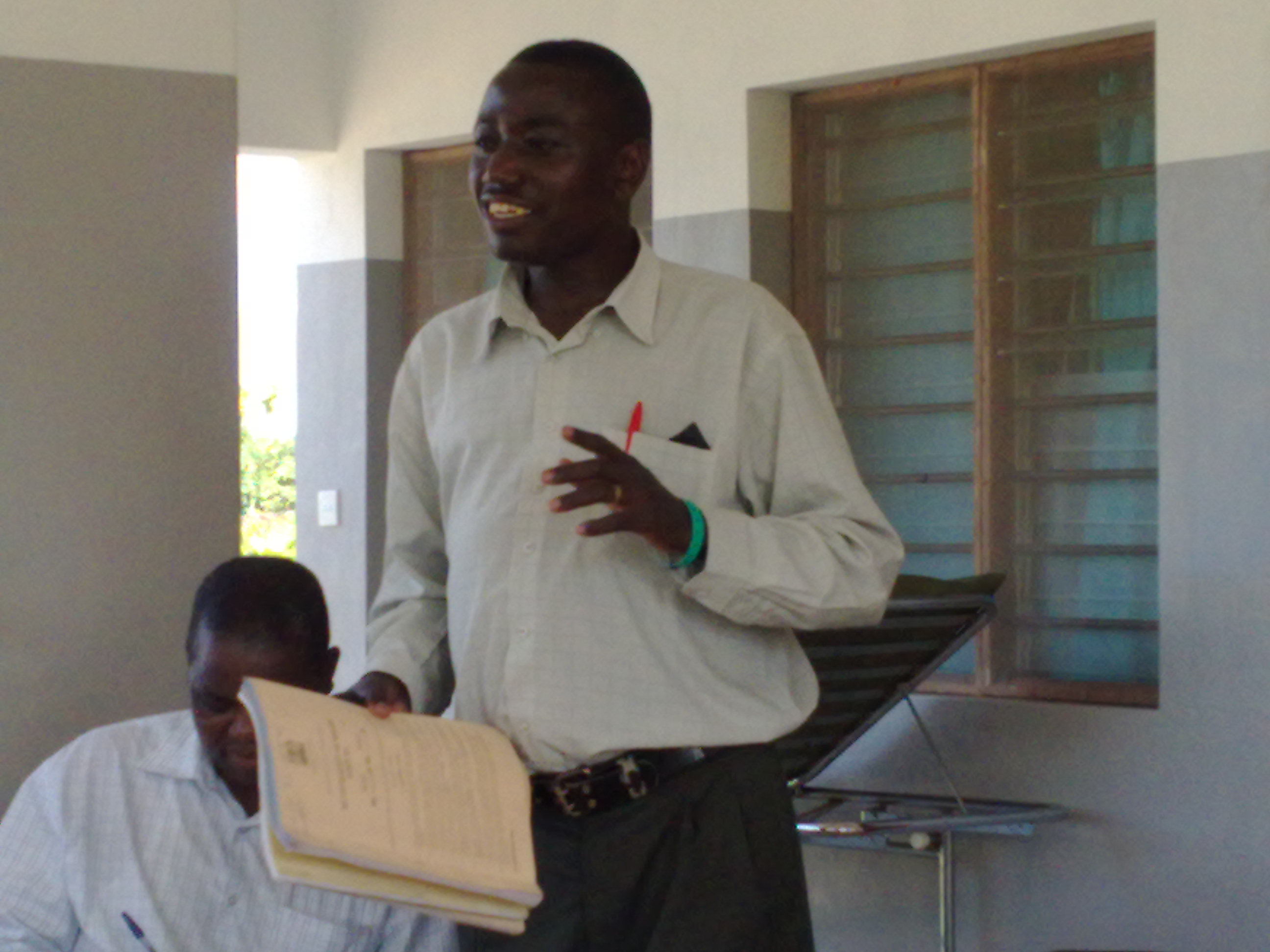
Last week’s Tech Salon, hosted by ICT Works and the UN Foundation Technology Partnership, was on the topic ‘Can youth find economic empowerment via apps, m-payments and social media?’ Fiona Macaulay from Making Cents and I gave some of the opening remarks to get the conversation started (and Wayan Vota kept things lively as usual).

The premise of the Salon was that ‘today’s youth population is the largest in the history of the world, and 90% of these young people live in developing countries. The global youth unemployment rate is the highest on record, and we’re seeing discontent and disenfranchisement play out on the news each day. In fact, the revolution in Tunisia started with an under-employed youth committing self-immolation in frustration…. Technology-based models hold great promise for increasing and improving economic opportunities for young people: low barriers to entry for youth-built apps, the widespread use of Facebook and its promise as a marketing platform, the ubiquity and ease of m-Payment systems like MPESA – these should be a recipe for youth economic empowerment.

During the Salon we explored 3 key questions:

1) How are youth starting businesses or getting jobs in growth-oriented ICT sectors around the world?

2) How are organizations and programs utilizing technology to reach and engage young people?

3) Where should we be cautious or enthusiastic with technology with respect to youth economic empowerment?

This is the first of 3 posts on those questions, starting with Question 1:

How are youth starting businesses or getting jobs in growth-oriented ICT sectors around the world?

I was pretty skeptical about the potential for apps, Facebook and m-payments to resolve the youth employment/income crisis, at least in the context of the rural communities in Africa where I’ve worked over the past several years. So leading into the Salon, I did an informal survey among some colleagues working in Africa to find out how they observed youth making money using technology, and to see whether the idea above had any legs. My thoughts were pretty much confirmed – in the places we are working, some youth are using technology to generate income, but not so much apps, mPayments and Facebook.

In Egypt, colleagues said that youth are repairing cell phones, serving as DJs at wedding parties, setting up photocopy shops and internet cafes, selling phone calls and airtime, running shops that provide children and young people with the opportunity to play games, and using computers to make flyers and posters for certain producers and products in the communities. They also provide satellite connections for poor families to access national and international TV channels – this service is not legal but generates good income for young people.

In Kenya you’ll find youth managing Mobile Phone Kiosks popularly known as ‘Simu Ya jamii’ (community phones). These double up as phone charging points. Pirated music is big business for some youth and phone unlocking services are increasing. One colleague noted that youth are not really creating applications, but in some of our programs, they are involved in piloting new applications, and thus influencing their development. In Zambia, you don’t see much of this type of activity in rural areas, according to a colleague there. But there are village telcos being operated by youth groups and some village groups are setting up banks of solar chargers to support solar lighting. (Cool result: When they set them up at a schools, encouraging women to come each day to charge their lights, they found that school attendance increased).

In Burkina Faso it’s common to see youth selling telephone scratch cards, renting out their phones, offering video services to film at private events, charging up phones for a price. In Senegal, some take phones from one area to another to charge them up for a fee. All over Africa you see video pirating and movie houses, video game houses, video downloading to mobile phones, music on flash drives and flash drives that plug into radios in cars and in collective transportation vans and busses.

There is ‘negative’ business also

Some would place ‘pirating’ and stolen satellite connections here. There is also transactional sex by girls to obtain mobile phones, which are a status symbol. We hear in some communities that adolescents with mobile phones are ‘bad.’ In Cameroon girls said that some boys only use phones to scam people and to steal. Mobiles can also facilitate prostitution. One colleague commented that in Ouagadougou (Burkina Faso) she has seen girls on motorbikes offering themselves by presenting their phone number on their back. We heard from youth in Cameroon that mobiles are commonly stolen and traded. Some parents in various countries do not like movie and game houses, associating them with porn and western culture.

Are youth in rural areas creating ‘apps,’ using ‘apps’ or tapping into ICT development or programming opportunities?

Not really, from what I have seen and what colleagues tell me. There are some shining stars here and there, but this isn’t very widespread yet, and the youth who are developing apps and such tend to be well-educated urban youth. This 2009 study on how the African Movement of Working Children and Youth (MAEJT) uses ICTs is quite interesting in this regard.

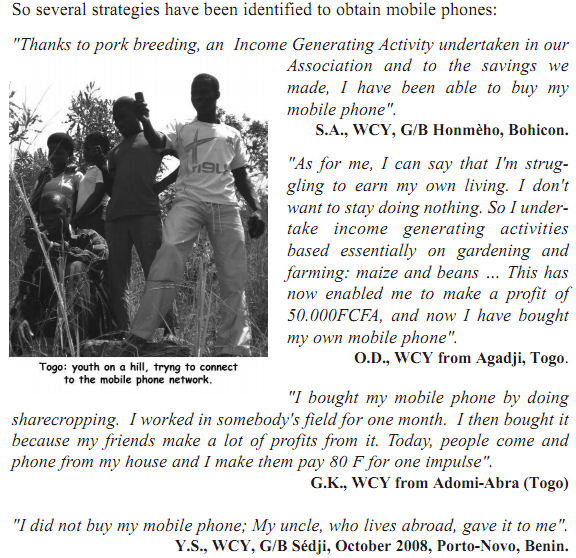
How do youth obtain and use mobiles? (MAEJT study, 2009)

In Egypt, colleagues said Facebook and Twitter groups around specific issues are common among young people in communities. But using ICT specifically for generating income is not. There is inadequate awareness among poor communities on how to make this happen. Although many youth have access to cell phones, ICT is still expensive and non-affordable for many others. Most of the families who have phones in their houses do not have a direct line, which means that they cannot get access to internet through cheap lines. Internet is still very expensive. Getting jobs through the internet is only common among advantaged, well- educated youth, not disadvantaged youth.

In Nairobi, Kenya, iHub and NAiLab have a big pool of developers and there is a lot of action. In rural Kenya, however, access is limited. There is a lot of interest from the youth who have started to catch on though, so colleagues felt it was possible that there could be some type of rural-urban mentoring or connections to help rural youth get on board. In rural Zambia, according to colleagues, sheer poverty means that very few additional resources and capital are available to take on new ideas. There is still very poor mobile phone coverage in some areas, and many young people have already left for urban areas. My colleagues in West Africa did not report seeing any youth developing apps or using Facebook combined with mPayments to generate income. In Kenya, Cameroon, Uganda and some other places, innovation hubs and labs are generating opportunities, but these again seem to be available to secondary- or even more often university-educated youth from urban areas and capital cities or large cities outside the capital.

So, is this bit about apps, mPayments and social media all hype? I’ll explore that a bit more in post 2 of the series. In post 3, I’ll cover the longer term considerations for ICTs and youth economic empowerment and some broader aspects that need to be kept in mind.

Read Full Post »

The 55th Session of the Commission on the Status of Women is taking place this week in New York City, with the core theme of: “Access and participation of women and girls to education, training, science and technology, including for the promotion of women’s equal access to full employment and decent work.”

Some of the girls that we’re working with in our programs are participating, including Fabiola and Shira from Cameroon. I met them both last July when we worked together on the Youth Empowerment through Technology, Arts and Media (YETAM) project. The YETAM coordinator in Cameroon, Judith Nkie, is also attending the CSW as the girls’ chaperone. She certainly also has a lot to contribute on girls, women and ICTs. Judith once said to me “This project is a catalyst in my body.” Judith is awesome.

Girls from the YETAM project worked to prepare the interviews, film and videos below. Each girl interviews another girl from the community about the role of ICTs in their lives. The videos are worth watching as the questions and the responses of the girls are very insightful.

The interviewee in the first video says ICTs help you find out what is happening around the world. She comments that she found out about what just happened in Egypt (the February revolution) because of ICTs. Some of the other things I found most interesting in the videos are:

  • The girls’ recognition of the importance of information for making good decisions
  • The technologies that girls have most access to (mobile phone!)
  • The first time the girls encountered a mobile phone (a few years ago, at a local call box for one, and via an uncle who brought one back from travels for the other)
  • Why it is hard for girls to use ICTs in the community (lack of ICT devices, cost, parents don’t allow girls to learn about ICTs, at school the computers are few – you will see at least 20 persons per computer – and half are broken, the boys are very powerful and they fight us to occupy the computers, girls’ illiteracy, girls don’t continue in school)
  • How often the girls use ICTs (mobiles are used every day, there is only one place to access Internet in the community)
  • What they like most about ICTs (ICTs help me to know what is happening in other countries, I came to know about what happened 2 days ago in Egypt via communication technologies, many youth have been able to be employed through their mobile phones)
  • What they like the least about mobile phones and Internet (scamming, its easy to tell lies by mobile)
  • How can ICTs be helpful to girls (in my community a girl was able to borrow a phone from a friend to report that she was to be married at the age of 12, and the marriage was stopped)
  • Can ICTs be used to hurt girls? (yes, the girls who can afford their own mobile phones are those who are wealthy, when the poor girls see the wealthy girls with their phones, they go into competition, they can go into prostitution to have money to get a phone; but on the other side, girls are also self-employed through the phones, so the mobile phone hurts but it also helps girls)
  • How the communities use the Internet to sell their products (most people in the community use ICTs to communicate to find buyers for their products)
  • What girls would like parents, community leaders and government to do regarding ICTs (improve our access to ICTs, bring in programs and projects that can support youths to use ICTs and learn to use them better, educate parents to help them to see that girls also should be allowed to access this type of training and technology)
  • What hurts most about this ICT thing (when those who are really privileged and who can use the Internet don’t put their talents and privileges to good use, they go there to scam, to do robbery, not to do good; if these youth have the time and this privilege they should not do harm but they should do good.)
Kirby, one of the girls from the US, edited together portions of the videos above with video footage from the rest of the girls in the group, and they used the video to kick off their ‘Girl Led Side Event’ today. The turnout was great. They will continue throughout the rest of the week getting their ideas and messages across in different events and panels. You can follow their thoughts and impressions on the Plan Youth Tumblr or by following @plan_youth on Twitter. My colleague @KeshetBachan is also blogging from the CSW at the Girls Report blog.

Read Full Post »
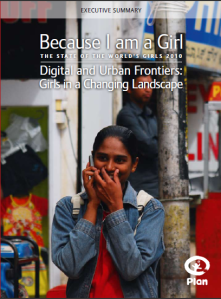
Because I am a Girl 2010

The urban and digital environments are the 21st century’s fastest-growing spheres. Both offer enormous potential for girls around the world, but prejudice and poverty exclude millions of girls from taking advantages of the transformative possibilities that cities and information and communication technologies (ICTs) can offer.  Exploitation and the threat of violence exist in both urban spaces and in cyberspace, especially for the most marginalized and vulnerable girls.

Since 2007, Plan has published annual reports on the state of the world’s girls. The 2010 ‘Because I am a Girl report’ is called Digital and Urban Frontiers: Girls in a Changing Landscape. It focuses on girls in these two rapidly expanding spaces: the urban and the digital.

The piece that I’m most interested is the segment on Girls and ICTs, since that’s the main area I currently work on. (Disclosure: I contributed to the development of the chapter). To give you a taste of what’s in the report, here’s a summary of Chapter 4: Adolescent girls and communications technologies – opportunity or exploitation. You can download the full report here.

Chapter 4’s introduction explains that online behaviors mimic offline behaviors.  Empowerment and abuse of girls reveals itself through technology as it does in other areas of girls’ lives.  Through girls own voices, expert opinion and original research, the report highlights the positive and negative consequences of ICTs, in particular mobile phones and the Internet. The authors talk about the positive ideas and new ways of thinking that ICTs open up for girls in terms of learning, networking, campaigning and personal development. They then discuss the darker side of technology  — how cyberspace makes it easier for sexual predators to operate with impunity, where girls are prime targets for abuse, and where girls are sometimes perpetrators themselves.

Section Two offers girl-related statistics on the digital revolution and the digital divide and highlights the enormous variation between and within countries in terms of digital access, and the gaps between rich and poor, male and female, urban and rural.  The report cautions that excluding girls from the digital revolution will have consequences on their growth and development. For additional global ICT statistics (1998-2009) see this post at ICT4D blog. Another resource on mobiles and women is the Cherie Blair study.

Section Three describes and provides statistics around 7 important reasons that ICTs are important to adolescent girls:

  1. To keep in touch with others and reduce isolation in countries where this is an issue
  2. To further their education and acquire new skills
  3. To take an active part in their communities and countries
  4. In order to have the skills to find work
  5. To build specific skills and knowledge on subjects they might otherwise not know about, such as HIV and AIDS
  6. Because evidence has shown that learning to use these technologies can build self-esteem
  7. In order to keep safe

Section Four goes in depth around ways that adolescent girls compete with adolescent boys for the most use of communications technologies such as mobiles and the Internet, but that often they are using them for different reasons and different purposes. Most of the available research for this chapter is from the ‘North’, yet the studies indicate that girls tend to use ICTs for communication and boys tend toward a focus on the technology itself. Studies on this from the ‘South’ are unavailable to date.

When girls are treated as real partners....

Section Five discusses the barriers that keep adolescent girls from accessing ICTs. In other words, if the importance of ICTs has been established, girls are willing and able and keen to use ICTs, then what prevents them from having equal access to ICTs? Some of the issues that the chapter discusses are those of power and control.

‘I can immediately call the wholesale market to inquire about prices and place direct orders. I am now recognized as a businesswoman, growing and selling sesame seeds, not just as somebody’s wife or sister,’ said a woman in India.

‘You’re a girl – a mobile can cause many problems, and so you don’t need it,’ said the father of a Palestinian girl.

Girls’ access to technology is limited by their societies, communities and families. In patriarchal societies where men control technology, girls and women simply have less access, because ICT’s confer power on the user. Even in educational settings, a study found that boys tend to hog available ICTs. Teachers have distinct expectations from boys vs. girls. Girls also don’t tend to go into the field of ICTs or want to have ICT careers, since the field is typically a male field. ‘Technology appears to be marketed by men for men. It’s time we started switching bright and talented girls on to science and technology,’ comments a British government official.

Women and girls in developing countries however are not receiving the basic education and training that they need to be ready technology adopters. They are seen as users and receivers of technology, not as innovators involved in technology design and development. Once they are computer literate, however, many young women see the computer industry as a route to independence. The report offers statistics on the numbers of young women in countries like South Africa, India, Malaysia and Brazil who are working in the ICT related industries and professions.

What stops girls from using technology?

There are seven key factors that prevent girls from taking advantage of technology:

  1. Discrimination – girls are still viewed as second-class citizens in many societies.
  2. Numbers – boys both outnumber girls and tend to dominate access to computers.
  3. Confidence – because they don’t have equal access at school, girls may be less confident than boys when it comes to going into IT jobs because they don’t feel they have the same skills and knowledge as the young men competing for the jobs.
  4. Language – in order to use these technologies, English is usually a requirement, and for girls with only basic literacy in their own language, this is a major barrier.
  5. Time – girls’ domestic roles, even at a young age, mean they have less free time than boys to explore and experiment with new technologies.
  6. Money – girls are less likely than their brothers to have the financial resources to pay for, say, a mobile phone and its running costs, or access to the web in an internet café.
  7. Freedom – boys are also more likely to be allowed to use internet cafés because parents are concerned about their daughters going out on their own.

Section Six digs into the dark side of cyberspace and the risks that adolescent are exposed to at a time of their lives when they are beginning to develop sexually. One in 5 women report having been sexually abused before the age of 15, according to the authors. The Internet by and large is simply a new medium for old kinds of bad behavior, however; and new technologies simply extend the possibility of abuse to new arenas. Girls who are not even using the Internet are still vulnerable, given that a photo of them can be taken and posted by someone else even if they have no computer access. Cyberbullying and cyberharrassment are other risks that girls face.

Many young people and youth organizations are active in facing these risks and protecting themselves, and various campaigns exist to help adolescent girls be more aware of how to protect themselves while using ICTs. New technology can itself also be a tool to help with counter-trafficking efforts. The chapter outlines some of the different efforts being made to protect girls online, and emphasizes the role of parents and schools in discussing on-line use and being supportive as girls begin exploring cyberspace.

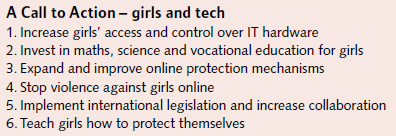
There is a quite broad set of recommendations for a wide array of actors at the end of Chapter 4 that could be taken up, contextualized and fleshed out by different parties or stakeholders into specific calls to action:

Brazilian girls in a digital world. As an annex to Chapter 4 on ICTs, new research with 49 boys and 44 girls, aged 10-14 examines adolescent girls’ rights and protection in Brazil within the context of ICTs. ICT use is growing exponentially in Brazil, particularly among 15-17 year olds, where between 2005 and 2008, ICT usage went from 33.7 to 62.9 percent. The study covers use pattern, links between on-line and off-line behavior, and on-line safety.

Conclusions. The report concludes by calling for greater knowledge about ICT-related sexual exploitation and violence against girls, more emphasis on prevention and stronger international standards. It also points out that girls need to be empowered to use new communications technologies safely, on their own terms, and in ways that promote their development and build their futures.

Call to action for September 22: As part of the launch of the Because I am a Girl Report, Plan is calling for International Day of the Girl to be established on September 22. You can sign the petition here.

Resources

Download the full report here: Digital and Urban Frontiers: Girls in a Changing Landscape

Download the Girl’s Cohort Study: Real Choices, Real Lives. Plan researchers follow 142 girls lives over a 9-year period.

Download past Because I am a Girl Reports (since 2007)

Related posts on Wait… What?

On girls and ICTs

Revisiting the topic of girls and ICTS: Tech Salon Discussions

Being a girl in Cumbana

MDGs through a child rights lens

3 ways to integrate ICTs into development work

5 ways ICTs can support the MDGs


Read Full Post »

I’ll be speaking on a panel called ICT4D, Innovations and the MDGs next week during UN Week in New York and another on Girls and Mobiles hosted by Mobile Active. So, I’ve been putting together my thoughts around girls, child rights, ICTs and the MDGs.  The angle I’m taking is not from the large donor, top down, huge institutional program side, but instead, looking at examples from the work I’ve been closest to over the past few years at the community and district level, mostly focused on child and youth participation in the development process. Check my MDGs through a child rights lens post for more background.

My last post (3 ways to integrate ICTs into your development organization) uses Hannah Beardon’s framework to discuss how organizations can integrate ICTs into their work. Hannah suggests that ICTs can be integrated directly(providing access to ICTs), strategically (using ICTs as tools to support development processes) and indirectly (using ICTs to improve efficiency and communication within the organization).

To complete that post, I’m listing below 5 ways that ICTs can facilitate accountability and transparency, citizen engagement, and public debate, all of which are necessary to bring about development improvements and achieve the MDGs. Obviously these are not the only ways ICTs can support the MDGs, but this post would have been miles long if I’d listed all the initiatives that are out there.

1) Engaging children and youth in the development process

An engaged and active population is a key ingredient for good development programs. Children and youth have much to offer, are directly targeted in the MDGs and many other development initiatives, offer valuable ideas and energy, and make up around half the population in many of the countries that are lagging in reaching the MDGs. ICTs can help children and youth engage in the development process and bring their ideas, opinions and voices alive at the community, district, national and global level. ‘Using new technology, new media, children and youth can claim a space that they didn’t have before. They can influence certain things, advocate on particular issues that are important to them, take ownership in communities and in leadership. ICTs excite them and encourage them to be more involved and engaged.’ Anthony Njoroge, Plan Kenya Community ICT Manager.

ICTs empower young people with skills that make them more confident and more involved at the community level.‘Using ICTs, children and youth have become more responsible because they are not waiting for adults to come in with something. Now they are designing it themselves, they are creating space for themselves and bringing their agenda to adult meetings instead of waiting to be invited in or having to work within the agenda of the adults. It used to be that you’d start working with 20 youth, you’d invite them into a community meeting. You’d see the number go down to 10, to 4, to 3, because they didn’t see any relation to themselves in the topics and the goings on. With integration of technology and the arts however, youth have a high level of interest. It’s really bringing in their opinions, their thoughts and ideas to join their voices with parents. Now they use arts and media to promote communication, dialogue on their issues and look for ways to resolve them. Before they were totally missing from the discussion, but now they are here.’ Judith Nkie, Plan Cameroon Youth Empowerment through Arts and Media Project Coordinator.

Arts and ICTs were used in the above-mentioned project as tools for youth engagement, mapping and prioritizing, research and community dialog. The media produced with the ICT tools was shared first within the community and then outside at the district, national and global levels as a way of engaging decision makers and the public in the youths’ agenda.  For more on how arts and ICTs are being used in the above-mentioned project, see this post. Watch 100 videos made by youth in 6 African countries on topics they are passionate about.

GPS work in Kwale, Kenya

2) Identifying resources and mapping patterns for better decision-making

Tracking and visualizing information is an excellent way to improve decision-making capacity. The advent of simpler and open source participatory digital mapping tools allows community members to map their communities digitally and to have more ownership of the information. Mapping helps identify patterns that may not have been visible before. Local maps shared on-line allow local people to provide their own information from their own perspective, and that information serves multiple purposes at the local level and beyond.

Digital mapping can be helpful when governments decentralize. Municipalities are mapping resources as well as projects and interventions. District authorities can track their own initiatives and those by local and international organizations to avoid duplication of efforts and wasted resources. When maps are public, the population can better demand answers about where resources are being allocated and why. Maps can help with disaster risk reduction and tools such as Ushahidi can help during emergency response. Mapping information is also useful for holding up a mirror to the population to ask them questions about themselves and their behaviors and for showing the direct consequences of actions; for example in a Community Total Led Sanitation mapping project, the community faces its realities about where their own waste is entering food and water sources.

Map Kibera is a good example of participatory digital mapping. mGEOS is a mobile mapping tool developed to help Plan Kenya staff to gather and share data needed for their daily work. Map Kibera and Plan Kenya are collaborating in Kwale on youth and governance work, and in Mathare to work on Community Total Led Sanitation using digital mapping tools (see July 27th entry). In this video, a district youth officer in Kenya talks about why digital mapping is useful for his community.

Mapping Violence against Children in Benin

3) Pulling in quick information to guide further investigation, response, or advocacy; pushing out information for targeted actions

ICTs can be used to gather quick information from a broad population. This can be useful in a variety of situations and themes, including those outlined in the MDGs. For example, SMS are being used to report on whether teachers are showing up at school, where violence against children and women is happening, where help is needed in the aftermath of a disaster, and for tracking endangered wildlife. Crowd sourced information can help governments and agencies get preliminary information so that further investigation and support can be provided in a particular area. Another example is the use of mobiles in different health initiatives, including:  child-birth care; HIV and AIDS prevention and treatment programs; support for volunteer community healthcare workers; and bed net treatment reminders. Most of the ICT and development world is also already familiar with the work of two organizations:  Ushahidi and FrontlineSMS who have been combining SMS with digital mapping.

A program that I’m closely involved with is SMS reporting of violence against children in Benin, where local communities, government agencies and NGOs are collaborating to improve the child protection system. This type of program shows promise if heed is paid to the pros and cons of collecting information by SMS, and if those implementing are clear about the type of information that will be gathered, privacy implications, and how the system will complement existing systems. (Here is one document that outlines some considerations). Increasing controls by governments and mobile phone companies, including SIM card registry and Mozambique’s recent government shut down of SMS services during the bread riots are good examples of how quickly the ICT landscape can change, and how flexible and agile those working in the area of ICTs need to be.

Checking info on constituency development fund

4) Supporting accountability and transparency

ICTs are useful to support accountability and transparency, necessary for attempts to track and ensure good use of funding for different efforts, including those related to the MDGs and other aid and development programs. Making information more available to the public by mobile is one such way.  SODNET’s budget tracking tool, for example, informs Kenyans of how much funding is allocated by the Constituency Development Fund to different municipalities in different categories. Combined with mapping, as outlined in this post, the budget information can help constituents to track where their funds are actually being spent.  Other interesting examples of how ICTs can be used for transparency and accountability can be found at TacticalTech’s Info Activism site and at Technology for Transparency.

Paper forms will soon be digitized….

5) Improving municipal services and information management

Civil registration documents, especially a birth certificate, are a precursor to demanding any number of rights or accessing a wide array of services. Without a birth certificate a child may not be able to sit for school exams, receive immunizations or free health care or claim rights to inheritance or legal protection in courts of law. Proof of age is critical in successfully prosecuting perpetrators of crimes against children such as child trafficking, sexual offenses, early recruitment into the armed forces, child marriage and child labor. ICTs are being used to digitize civil registry in Kenya, for example. Not only are records being digitized, but mobile phones are used to make it more convenient for the population to know when their documents are ready. This saves people time and money and means that more parents will register their children.

But wait, there’s more!

These are only a few examples of ways that ICTs are being used at the grassroots level to improve participation, transparency, accountability, debate and ownership of the development process.  The MDGs are lofty, but informed local community participation and ownership is key in efforts to reach them and in ensuring that marginalized populations can also be included.

Please add your examples of ways that ICTs can support development and ICTs in the comments section!

Related posts on Wait… What?

3 ways to integrate ICTs into development work

11 concerns about ICTs and ‘social media for social good’

I and C, then T

MDGs through a child rights lens

7 (or more) questions to ask before adding ICTs

A positively brilliant ICT4D workshop in Kwale, Kenya

The road to Wa is paved

Read Full Post »

« Newer Posts - Older Posts »