Feeds:
Posts
Comments

Archive for the ‘ICTs, mobile and technology’ Category

The November 14, 2012, Technology Salon NYC (TSNYC) focused on ways that ICTs can support work with children who migrate. An earlier post covers the discussion around Population Council’s upcoming ‘Adolescent Girls on the Move’ report. The current post focuses on the strategic use of data visualization for immigration advocacy, based on opening points from Brian Root and Enrique Piracés of Human Rights Watch (HRW).

Visualizing the US Detention Network and the transfers between detention centers.

The project

The HRW initiative used data to track and visualize the movement of people through the US immigration detention system after noticing that U.S. Immigration and Customs Enforcement (ICE) was moving people very freely without notifying their families or attorneys. HRW was aware of the problem but not its pervasiveness. The team obtained some large data sets from the US government via Freedom of Information Act (FOIA) requests. They used the data to track individuals’ routes through the immigration detention system, eventually mapping the whole system out at both aggregate levels and the level of individual. The patterns in the data informed HRW’s advocacy at the state and federal levels. In the process, HRW was able to learn some key lessons on advocacy and the importance of targeting data visualizations to specific advocacy purposes.

Data advocacy and storytelling

The data set HRW obtained included over 5.4 million records of 2.3 million people, with 10-12 variables. The team was able to connect these records to individuals, which helped tell a meaningful story to a broad audience. By mapping out all the US facilities involved and using geo-location to measure the distance that any individual had been transferred, the number of times an individual from Country X in Age Range X was transferred from one facility to another was visible, and patterns could be found. For example, often people on the East Coast were transferred to Texas, where there is a low ratio of immigration lawyers per detainee.

Even though the team had data and good stories to tell with the data, the two were not enough to create change. Human rights are often not high priority for decision makers, but budgeting is; so the team attached a cost to each vector that would allow HRW to tell decision makers how much was being spent for each of these unnecessary transfers.

They were also able to produce aggregated data at the local level. They created a state dashboard so that people could understand the data at the state level, since the detention facilities are state-run. The data highlighted local-level inefficiencies. The local press was then able to tell locally relevant stories, thus generating public opinion around the issue. This is a good example of the importance of moving from data to story telling in order to strengthen advocacy work.

HRW conveyed information and advocated both privately and publicly for change in the system. Their work resulted in the issuing of a new directive in January 2012.

FOIA and the data set

Obtaining data via FOIA acts can be quite difficult if an organization is a known human rights advocate. For others it can be much easier. It is a process of much letter sending and sometimes legal support.

Because FOIA data comes from the source, validation is not a major issue. Publishing methodologies openly helps with validation because others can observe how data are being used. In the case of HRW, data interpretations were shared with the US Government for discussion and refutation. The organization’s strength is in its credibility, thus HRW makes every effort to be conservative with data interpretation before publishing or making any type of statement.

One important issue is knowing what data to ask for and what is possible or available. Phrasing the FOI request to obtain the right data can be a challenge. In addition, sometimes agencies do not know how to generate the requested information from their data systems. Google searches for additional data sets that others have obtained can help. Sites such as CREW (Citizens for Responsibility and Ethics in Washington), which has 20,000 documents open on Scribd, and the Government Attic project, which collects and lists FOI requests, are attempting to consolidate existing FOI information.

The type of information available in the US could help identify which immigration facilities are dealing with the under-18 population and help speculate on the flow of child migrants. Gender and nationality variables could also tell stories about migration in the US. In addition, the data can be used to understand probability: If you are a Mexican male in San Jose, California, what is the likelihood of being detained? Of being deported?

The US Government collects and shares this type of data, however many other countries do not. Currently only 80 countries have FOI laws. Obtaining these large data sets is both a question of whether government ministries are collecting statistics and whether there are legal mechanisms to obtain data and information.

Data parsing

Several steps and tools helped HRW with data parsing. To determine whether data were stable, data were divided by column and reviewed, using a SHELL. Then the data were moved to a database (MySQL), however other programs may be a better choice. A set of programs and scripts was built to analyze the data, and detention facilities were geo-located using GeoNames. The highest quality result was used to move geo-location down to the block level and map all the facilities. Then TileMill and Quantum GIS (QGIS) were used to make maps and ProtoViz (now D3) was used to create data visualizations.

Once the data were there, common variables were noted throughout the different fields and used to group and link information and records to individuals. Many individuals had been in the system multiple times. The team then looked at different ways that the information could be linked. They were able to measure time, distance and the “bounce factor”, eg.., how many times an individual was transferred from one place to the other.

Highlighting problematic cases: One man’s history of transfers.

Key learning:

Remember the goal. Visualization tools are very exciting, and it is easy to be seduced by cool visualizations. It is critical to keep in mind the goal of the project. In the HRW case the goal was to change policy, so the team needed to create visualizations that would specifically lead to policy change. In discussions with the advocacy team, they defined that the visualizations needed to 1) demonstrate the complexity 2) allow people to understand the distance 3) show the vast numbers of people being moved.

Privacy. It is possible to link together individual records and other information to tell a broader story, but one needs to be very careful about this type of information identifying individuals and putting them at risk. For this reason not all information needs to be shared publicly for advocacy purposes. It can be visualized in private conversations with decision makers.

Data and the future

Open data, open source, data visualization, and big data are shaping the world we are embedded in. More and more information is being released, whether through open data, FOIA or information leaks like Wikileaks. Organizations need to begin learning how to use this information in more and better ways.

Many thanks to the Women’s Refugee Commission and the International Rescue Committee for hosting the Salon.

The next Technology Salon NYC will be coming up soon. Stay tuned for more information, and if you’d like to receive notifications about future salons, sign up for the mailing list!

Read Full Post »

The November 14, 2012, Technology Salon NYC focused on ways that ICTs can support work with children who migrate. Our lead discussants were:  Sarah Engebretsen and Kate Barker from Population Council, and Brian Root and Enrique Piracés from Human Rights Watch.

This post summarizes discussions that surfaced around the Population Council’s upcoming Girls on the Move report, which looks at adolescent girls’ (ages 10-19) internal and regional migration in ‘developing’ countries, including opportunity and risk. (In a second blog post I will cover Human Rights Watch’s points and resulting discussions.)

The Girls on the Move report (to be released in February 2013) will synthesize current evidence, incorporate results of specially commissioned research, illustrate experiences of migrant girls, provide examples of promising policies and programs, and offer concrete action-oriented recommendations.

1) How are migrant girls using ICTs?

While the report’s focus is not technology, the research team notes that there is some evidence showing that adolescent girls are using ICTs for:

  • Extending social networks. In China and Southeast Asia, migrant girls are building and accessing personal networks through mobiles and texting. This is especially pronounced among girls who work long hours in tedious jobs in factories, and who do not have much time with family and friends. Text messaging helps them maintain connections with existing social networks. It also gives them space for flirtation, which may not be something they can do in their former rural context because of cultural norms that look down on flirtatious behavior.
  • Finding new jobs. Both boys and girls use mobiles and text messaging for exchanging quick news about job openings. This suggests there could be an opening for program interventions that would connect to migrant children through texting, and that might supply information on community resources, for example, where to go in cases of threat or emergency—that might then propagate across migrant virtual networks.
  • Sending remittances. Based on research with adolescent girls and drawing from examples of adult migrants, it seems likely that a vast majority of migrant girls save money and send it to their families. Evidence on how girl migrants are using remittances is limited, but a survey conducted in Kenya found that 90% of adult migrants had sent money home to families in other parts of Kenya via mobile phone in the 30 days before the survey. There is more research needed on adolescent girls’ remittance patterns. Research is also lacking on adolescent girls’ access to and use of mobile phones and on whether mobile phones are owned or borrowed from another person who is the handset owner. Remittances, however, as one participant pointed out, are obviously only sent by mobile in countries with functioning mobile money systems.
  • Keeping in touch with family back home. In Western Kenya, migrant brides who are very isolated placed great importance on mobiles to stay in touch with family and friends back home. Facebook is very popular in some countries for keeping in touch with families and friends back home. In Johannesburg and Somalia, for example, one participant said “Facebook is huge.” Migrating adolescent girls and domestic working girls in Burkina Faso, however, do not have Internet access at all, via mobiles or otherwise.

2) Areas where ICTs could support work on child protection and migration

  • Child Protection Systems There is a general global move towards developing child protection systems that work for different kinds of vulnerable children. These efforts are important in the transit phase and right upon arrival as these phases are particularly risky for children who migrate. ICTs can play a role in managing information that is part of these systems. Ways to connect community child protection systems into district and national systems need more investigation.
  • Reporting abuse and getting help One example of ways that ICTs are supporting child protection in India and several other countries is Child Help Lines. ChildLine India received almost 23 million calls as of March 2012, with 62% of callers between the ages of 11 and 18. The helplines provide vulnerable groups of children and youth with referrals to local services, and in the best cases they are public-private partnerships that link with national and state governments. Of note is that boys call in more often than girls, and this raises questions about girls’ access to phones to actually make a call to obtain support. It also points to the need for differentiated strategies to reach both boys and girls.

3) Technology and exclusion

  • Social exclusion and access is a specific challenge due to the pronounced social exclusion of many migrant girls, particularly those who are married or working in socially isolated jobs such as child domestic workers. Girls in these situations may not have any access to technology at all, including to mobile phones.  Girls and women especially tend to have less access than men; they are often not the owners of devices. There is a research gap here, as no one actually knows how many migrating adolescent girls access mobiles and how many can borrow a phone for use. It is not clear if girls have their own phones, or if they are using an employer’s or a friend’s phone or a public call box. This would be a key factor in terms of working with adolescent girls and understanding risk and designing programs.
  • Technology should build on – not be seen as a replacement for – social networks. Girls access to social capital is a huge underlying topic. There is normally a rupture in social networks when girls move. They become socially isolated and this puts them at great risk. Domestic girl workers leave home and become more vulnerable to exploitation —  they have no friends or family around them, and they may not be able to access communication technologies. For this reason it is critical to understand that technology cannot replace social networks. A social network is needed first, and then ICTs can allow girls to remain in touch with those in their network. It is very important to think about understanding and/or building social networks before pushing the idea of technology or incorporating technologies.

4) ICTs and potential risk to child migrants

  • SMS, anonymity and privacy. According to a study one participant was involved in, some children and youth report feeling that they can speak up more freely by SMS since they can text privately even in close quarters. Others noted that some organizations are incorporating online counseling services for similar reasons. A study in Nigeria is ongoing regarding this same topic, and in Southeast Asia it has been shown that girls often use text messages to flirt using an alternate identity.
  • Retaliation. Concerns were raised regarding the possibility for retaliation if a child reports abuse or uses a mobile for flirting and the phone is confiscated.  Practices of self-protection and message deleting are not very well implemented in most cases. A participant noted that some of the low-end phones in Tanzania and Kenya periodically delete outgoing messages and only keep 15 messages on the phone at a time. This can help somewhat, though it is not a feature that is particularly aimed at protection and privacy, rather, it is more a function of low memory space. Safer Mobile is one initiative that looks at risk and privacy; however, like most efforts looking at risk, it is focused on political conflict and human rights situations, not at privacy and protection for child migrants or other types of abuse reporting that children may be involved in.

5) Research gaps and challenges

  • Migration contexts. It was emphasized that migration during an emergency situation is very different from a voluntary migration, or seasonal migration. Work is being done around communication with disaster or emergency affected populations via the Communication with Disaster Affected Communities (CDAC) Network, but this theme does not seem to be one of widespread discussion among US-based NGOs and humanitarian organizations.
  • Migrants are not necessarily disadvantaged however a bias exists in that researchers tend to look for disadvantage or those who are disadvantaged. They often ask questions that are biased towards showing that migrants are disadvantaged, but this is not always the case. Sometimes migrating children are the most advantaged. In some contexts migrating requires family support and funds to migrate, and those with the least amount of resources may not be able to move. In some cases migrant children have a huge, strong family structure. In others, children are escaping early marriage, their parents’ passing away or other difficult situations.
  • Integrated information and data crossing. One issue with research around migrants is that most looks solely at migrants and does not cross migration with other information. Many girls migrate with the idea that they will be able to get an education, for example, but there is not a lot of information on whether migrating girls have more or less access to education. The literature tends to focus on girls in the worst situations. In addition, although there are 4 times as many internal migrants as there are international migrants, focus tends to be on international migration.

In a second post, I will cover Human Rights Watch’s work on using data visualization to advocate for the rights of immigrants in the US.

Many thanks to our lead discussants from the Population Council and to the Women’s Refugee Commission and the International Rescue Committee for hosting! The next Technology Salon NYC will be coming up in January 2013. Stay tuned for more information and if you’d like to receive notifications about future salons, sign up for the mailing list!
Also, if you have research or examples of how child and youth migrants are using ICTs before, during or after their journey, or information on how organizations are using ICTs to support the process, please let me know.

Related posts and resources:

How can ICTs support and protect children who migrate?

New communication tools and disaster affected communities

Empowering communities with technology tools to protect children

Children on the Move website

Read Full Post »

This is a guest post from David Schaub-Jones who works with SeeSaw, a social venture that focuses on how technology can strengthen sanitation and water providers in developing countries. Follow SeeSaw on Twitter:  @ontheseesaw.

In June, two organisations focussed on using ICT (Information and Communications Technology) in the water and sanitation sector joined forces in Cape Town. SeeSaw, a social enterprise that customises ICT to support sanitation and water providers and iComms, a University of Cape Town research unit (Information for Community Oriented Municipal Services) co-hosted a two day event to look at how ICT tools are changing the way that public services function in developing countries.

(from SeeSaw’s website.)

There are growing expectations that harnessing ICT intelligently can bring about radical improvements in the way that health, education and other sectors function, particularly in developing countries. SeeSaw and iComms wanted to look at this in more detail – and to build on the open sharing of experience to provide general principles to those planning to harness ICT for public service delivery. Their overarching goal is to help practitioners cut through much of the complexity and hype surrounding ICT usage and give them a robust set of guidelines with which to plan and negotiate partnerships and projects on the ground.

The event brought together 30+ practitioners – with water sector professionals from across Southern Africa joined by their colleagues from the health sector – a sector that has been quick to innovate, try different approaches and learn lessons. A full write-up of the event can be found here in the Water Information Network of South Africa’s October Newsletter. (See www.win-sa.org).

Key messages

1) Putting in place an effective ICT system can make a visible impact on the ground. It can pay for itself quite quickly in terms of efficiency gains and even costs saved. Yet a fair amount of thought must go into designing the system to fit the local context – just transplanting a system that has worked in one place to a new environment is generally a recipe for trouble.

2) An important spin-off result of looking at how to use ICT is that the effort taken to design a responsive system forces stakeholders to reflect more closely on the existing structures, process and current information flows. This can have significant benefits even if no system is later built.

3) A recommendation is to spend due time and effort in understanding the system, asking direct stakeholders what information they currently get, what information they need and then seeing how and whether ICT systems can be used to gather data that can generate additional, better or faster information and get it to where it is needed (in a way that suits the working patterns of those individuals).

4) For impact at any significant scale it is crucial that ICT systems, whether in healthcare or water and sanitation, integrate with existing government systems. There is a great risk of fragmentation – too many organisations piloting new ICT systems put in place technologies or processes that cannot easily be absorbed into existing government systems (or worse still, undermine these).

5) A lot of initiatives, particularly in the healthcare system, have tried to harness ICT to get people to do what is good for them. And only that. For instance, cellphones used to gather field information can be restricted so that they can only do one thing and no longer function as a phone. Airtime and data bundles used for transmitting information can be isolated to only contribute to ‘the project’. The disadvantage is that this turns the device into something used only for work, something alien and otherwise ‘not useful’. Alternatives do exist though and can be productive. If frontline workers being asked to use phones and new ICT tools are permitted – sometimes on a limited basis – to use them for their own purposes (browsing the internet, accessing facebook, receiving SMS) then they are more likely to engage with the project, look after the equipment, etc. A balance is surely needed, but a quid pro quo arrangement can be a sensible approach. This was characterised as “give them pizza with their broccoli”!

6) ICT tools can be incredibly powerful at improving the flow of data and, from there, the flow of information. But what if the flow of information is not the real problem? There are many issues that undermine healthcare or water and sanitation systems – and a lot of them have little to do with information. Cultural conflicts, different worldviews, individual rivalries, dysfunctional facilities – all of these can be the ‘sand in the gearbox’. Don’t assume that a new ICT system is going to solve all problems – after all, these are tools, not a panacea to what are typically complex and entrenched challenges.

Next Steps

SeeSaw and iComms are now exploring how to take forward research into how to improve information flows and how incentives shape the behaviour of different stakeholders within any ICT system designed for the water and sanitation sector. A similar event is also planned for East Africa in early 2013.

If you are interested in hearing more about these topics, subscribe to SeeSaw’s newsletter for more details.

Read Full Post »

At the October 17, 2012 Technology Salon NYC, we focused on ways that ICTs can be used for qualitative monitoring and evaluation (M&E) efforts that aim to listen better to those who are participating in development programs. Our lead discussants were:  John Hecklinger, Global Giving; Ian Thorpe, UN DOCO and the World We Want 2015 Campaign; and Emily Jacobi, Digital Democracy. This salon was the final in a series of three on using new technologies in M&E work.

Global Giving shared experiences from their story-telling project which has collected tens of thousands of short narratives from community members about when an individual or organization tried to change something in their community. The collected stories are analyzed using Sensemaker to find patterns in the data with the aim of improving NGO work. (For more on Global Giving’s process see this document.)

The United Nations’ Beyond 2015 Campaign aims to spur a global conversation on the post-MDG development agenda. The campaign is conducting outreach to people and organizations to encourage them to participate in the discussion; offering a web platform (www.worldwewant2015.org) where the global conversation is taking place; and working to get offline voices into the conversation. A challenge will be synthesizing and making sense of all of the information coming in via all sorts of media channels and being accountable now and in future to those who participate in the process.

Digital Democracy works on digital literacy and human rights, and makes an effort to integrate qualitative monitoring and evaluation into their program work stream. They use photography, film and other media that transcend the language and literacy barriers. Using these kinds of media helps participants express opinions on issues that need addressing and builds trust. Photos have helped in program development as well as in defining quantitative and qualitative indicators.

A rich conversation took place around the following aspects:

1) Perception may trump hard data

One discussant raised the question “Do opinions matter more than hard data on services?” noting that perceptions about aid and development may be more important than numbers of items delivered, money spent, and timelines met. Even if an organization is meeting all of its targets, what may matter more is what people think about the organization and its work. Does the assistance they get respond to their needs? Rather than asking “Is the school open?” or “Did you get health care?” it may be more important to ask “How do you feel about health?” Agencies may be delivering projects that are not what people want or that do not respond to their needs, cultures, and so on. It is important to encourage people to talk amongst themselves about their priorities, what they think, encourage viewpoints from people of different backgrounds and see how to pull out information to help inform programs and approaches.

2) It is a complex process

Salon participants noted that people are clearly willing to share stories and unstructured feedback. However, the process of collecting and sorting through stories is unwieldy and far from perfect. More work needs to be done to simplify story-collection processes and make them more tech-enabled. In addition, more needs to be done to determine exactly how to feed the information gleaned back in a structured and organized way that helps with decision-making. One idea was the creation of a “Yelp” for NGOs. Tagging and/or asking program participants to tag photos and stories can help make sense of the data. If videos are subtitled, this can also be of great use to begin making sense of the type of information held in videos. Dotsub, for example, is a video subtitling platform that uses a Wikipedia style subtitling model, enabling crowd sourced video translations into any language.

3) Stories and tags are not enough

We know that collecting and tagging stories to pull out qualitative feedback is possible. But so what? The important next step is looking at the effective use of these stories and data. Some ideas on how to better use the data include adding SMS feedback, deep dives with NGOs, and face-to-face meetings. It’s important to move from collecting the stories to thinking about what questions should be asked, how the information can help NGOs improve their performance, how this qualitative data translates into change or different practice at the local and global levels, how the information could be used by local organizers for community mobilization or action, and how all this is informing program design, frameworks and indicators.

4) Outreach is important

Building an online platform does not guarantee that anyone will visit it or participate. Local partners are an important element to reach out and collect data about what people think and feel. Outreach needs to be done with many partners from all parts of a community or society in order to source different viewpoints. In addition, it is important to ask the right questions and establish trust or people will not want to share their views. Any quality participation process, whether online or offline, needs good facilitation and encouragement; it needs to be a two-way process, a conversation.

5) Be aware of bias

Understanding where the process may be biased is important. Everything from asking leading questions, defining the meta data in a certain way, creating processes that only include certain parts of the community or population, selecting certain partners, or asking questions that lead to learning what an organization thinks it needs to know can all create biased answers. Language is important here for several reasons: it will affect who is included or excluded and who is talking with whom. Using development jargon will not resonate with people, and the way development agencies frame questions may lead people to particular answers.

6)  Be aware of exclusion

Related to bias is the issue of exclusion. In large-scale consultations or online situations, it’s difficult to know who is talking and participating. Yet the more log-in information solicited, the less likely people are to participate in discussions. However by not asking, it’s hard to know who is responding, especially when anonymity is allowed. In addition, results also depend on who is willing and wants to participate. Participants agreed that there is no silver bullet to finding folks to participate and ensuring they represent diversity of opinion. One suggestion was that libraries and telecenters could play a role in engaging more remote or isolated communities in these kinds of dialogues.

7) Raising expectations

Asking people for feedback raises expectations that their input will be heard and that they will see some type of concrete result. In these feedback processes, what happens if the decisions made by NGOs or heads of state don’t reflect what people said or contributed? How can we ensure that we are actually listening to what people tell us? Often times we ask for people’s perceptions and then tell them why they are wrong. Follow up is also critical. A campaign from several years ago was mentioned where 93,000 people signed onto a pledge, and once that was achieved, the campaign ended and there was no further engagement with the 93,000 people. Soliciting input and feedback needs to be an ongoing relationship with continual dialogue and response. The process itself needs to be transparent and accountable to those who participate in it.

8 ) Don’t forget safety and protection

The issue of safety and protection for those who offer their opinions and feedback or raise issues and complaints was brought up. Participants noted that safety is very context specific and participatory risk assessments together with community members and partners can help mitigate and ensure that people are informed about potential risk. Avoiding a paternalistic stance is recommended, as sometimes human rights advocates know very well what their risk is and are willing to take it. NGOs should, however, be sure that those with whom they are working fully understand the risks and implications, especially when new media tools are involved that they may not have used before. Digital literacy is key.

9) Weave qualitative M&E into the whole process

Weaving consistent spaces for input and feedback into programs is important. As one discussant noted, “the very media tools we are training partners on are part of our monitoring and evaluation process.”  The initial consultation process itself can form part of the baseline. In addition to M&E, creating trust and a safe space to openly and honestly discuss failure and what did not go so well can help programs improve.  Qualitative information can also help provide a better understanding of the real and hard dynamics of the local context, for example the challenges faced during a complex emergency or protracted conflict. Qualitative monitoring can help people who are not on the ground have a greater appreciation for the circumstances, political framework, and the socio-economic dynamics.

10) Cheaper tool are needed

Some felt that the tools being shared (Sensemaker in particular) were too expensive and sophisticated for their needs, and too costly for smaller NGOs. Simpler tools would be useful in order to more easily digest the information and create visuals and other analyses that can be fed back to those who need to use the information to make changes. Other tools exist that might be helpful, such as Trimble’s Municipal Reporter, Open Data Kit, Kobe, iForm Builder, Episurveyor/Magpi and PoiMapper. One idea is to look at some of the tools being developed and used in the crisis mapping and response space to see if cost is dropping and capacity increasing as the field advances. (Note: several tools for parsing Twitter and other social media platforms were presented at the 2012 International Conference on Crisis Mapping, some of which could be examined and learned from.)

What next?

A final question at the Salon was around how the broader evaluation community can connect with the tools and people who are testing and experimenting with these new ways of conducting monitoring and evaluation. How can we create better momentum in the community to embrace these practices and help build this field?

Although this was the final Salon of our series on monitoring and evaluation, we’ll continue to work on what was learned and ways to take these ideas forward and keep the community talking and growing.

A huge thank you to our lead discussants and participants in this series of Salons, especially to the Community Systems Foundation and the Rockefeller Foundation’s monitoring and evaluation team for joining in the coordination with us. A special thanks to Rockefeller for all of the thoughtful discussion throughout the process and for hosting the Salons.

The next Technology Salon NYC will be November 14, 2012, hosted by the Women’s Refugee Commission and the International Rescue Committee. We’ll be shifting gears a little, and our topic will be around ways that new technologies can support children and youth who migrate, are forcibly displaced or are trafficked.

If you’d like to receive notifications about future salons, sign up for the mailing list!

Previous Salons in the ICTs and M&E Series:

12 lessons learned with ICTs for monitoring and accountability

11 points on strengthening local capacity to use new ICTs for monitoring and evaluation

Read Full Post »

Everybody loves memes and those who work in or care about international development are no exception. One meme that popped up early 2010, is the oft-quoted “there are more mobile phones than toilets.” Apparently, the origin of the phrase was the India census. Subsequently, the statistic was used to raise a point about water and sanitation in India by a UN institute. It was picked up in a New York Times article and became generalized to “more people have [access to] mobile phones than toilets” and “there are more mobile phones than toilets” and other variations.

This simple idea has captured the hearts and minds of many development and technology practitioners and theorists the world over. The phrase has become a staple illustration for those who are looking at the potential of mobiles to change the world. But there is more to it than simple ‘access.’ We need to think beyond access.

What is missed in this meme’s beautiful simplicity is that the mobile access/mobile phones referred to are not necessarily equally distributed. A recent blog post by Marc Bellemare refers to a study he worked on (with Ken Lee) called “Look Who’s Talking: The Impacts of the Intrahousehold Allocation of Mobile Phones on Agricultural Prices.”

“…mobile phones do not seem to be the household public good many development practitioners think they are. In other words, policies designed around the distribution of mobile phones to households (rather than individuals) might contain the seed of their own failure if the intrahousehold [use] of technology matters.

Moreover, after a referee asked us to look at whether major household surveys asked about mobile phone ownership at the household or individual level, I was surprised to find that many of those surveys only collect information on the former.

So if there is one thing I would like our article to change, it’s the kind of data that are collected: We should really collect information on individual rather than on household mobile phone ownership.”

The GSMA and Cheri Blair Foundation study on women and mobiles found that women lag behind in mobile phone ownership in many African, Latin American, Middle Eastern and Asian countries. Women are even further behind in terms of access and use of the Internet.

At the practitioner level, assuming women everywhere can access and use mobiles and Internet can make a project run into problems, as described in this quick video.

In some places where women’s literacy and numeracy skills are quite low, projects designed to share or collect information by mobile can run into additional challenges as related below.

Girls themselves in some places note that despite their interest, boys will physically fight them to access available computers or mock girls who want to learn.

The existence of open and available spaces and platforms (whether virtual or physical) doesn’t automatically mean they are  “accessible” to everyone, including in many cases, to women and girls.

As wonderful as the idea of ‘open’ is (and don’t get me wrong, I’m a huge fan of ‘open’), ‘open’ can still exclude. Even in purposefully open spaces and frameworks like the Open Knowledge Festival, women lag behind in terms of papers submitted for presentation and women speaking on panels. We lag behind slightly less in terms of doing the legwork of organizing, which shouldn’t surprise anyone.

At the Beyond Access Conference put on by IREX yesterday, I had the opportunity to facilitate a discussion session on Women and ICTs where we got into some of these issues and talked about how libraries can help. The panelists included Thinley Choden from the READ Bhutan project, Danica MacAvoy from Clinton Global Initiative, and Marieme Jamme of Africa Gathering. The session space was filled with engaged and insightful folks who shared their valuable ideas and experiences as well, including:

  • Numbers that showed the big access gap between men and women.
  • Access is not the only measure, however – as the conference notes we need to go “Beyond Access” to look at use, purpose, and many other aspects.
  • Safety is the number one reason that girls and women give for not accessing ICTs.
  • Libraries are often seen as knowledge centers and conceived of as more reputable spaces than Internet cafes for girls and women to frequent.
  • Librarians and community facilitators at library spaces can serve as mediators to help ensure that access to equipment and other materials is equally open to all.
  • Women mentors and role models, eg., female librarians, are an important way to encourage girls and women to spend time at libraries or to be more confident in accessing information and communicating through technology.
  • One of the most important things a library can do is create safe space for girls and women to gather and discuss issues of importance to them.
  • Depending on context, in some places this needs to be a physical space; in others situations, a virtual space can work.
  • Men and boys play a big role in advocating and encouraging girls and women to access information, to communicate, and to come together and participate.
  • If offered space and opportunity, women and girls (and anyone else) can teach themselves to use new technologies.
  • Libraries will be most successful for women and girls if they facilitate access and sharing of information that is relevant and in demand by women and girls, not what outsiders think should be in demand.
  • Low information access is holding back girls and women from advancing in careers such as ICTs and coding, because up-to-date books are not accessible in many places.
  • Supporting people to ‘join the global network’ through uploading information about themselves and their lives can serve as a tool by which community and personal projects can be examined, discussed and shared.
  • What a library is and what one looks like will vary according to context and culture; the key is having a physical or virtual safe space where information and communication can take place.

So even if there are more mobile phones than toilets, the conversation can’t stop there. We still need to talk about access, and we need to go “beyond access” too, as this great gathering yesterday so aptly noted.

Read Full Post »

I’m just home after a week at the Open Knowledge Festival in Helsinki (and wishing I could have cloned myself and attended each of the 13 streams!):

Here’s a video summary of some of the highlights of the Open Development stream.

Thanks so much to everyone who organized, supported, funded and attended the sessions!

Also see:

Read Full Post »

OK Festival is in full swing here in Helsinki, and if today is anything like the past two days, it will be full of information and exchange on everything “open.”

A number of us have been working hard to pull together the Open Development Stream, which started yesterday and which followed very nicely on Tuesday’s fantastic series of panels on Transparency and Accountability (with a heavy focus on the Open Government Partnership and Open Data) and the Open Data Journalism and Visualization streams.

Here’s a quick Storify summary of yesterday’s last Open Development session “Taking it Local: 10 ways to make ‘open’ relevant in low resource or marginalized contexts,” It was moderated by Soren Gigler from the World Bank’s Innovation for Governance Team and included superb group of panelists:  David RodriguezMichael Gurstein, Huy Eng, Philip Thigo, and Barbara Birungi.

For the session, my colleagues David and Max Rodriguez from Plan El Salvador did some really great short videos around transparency, internet access, connectivity and related topics and how they are perceived and lived out in rural communities where they are working.

This first video with Marco Rodriguez (he’s also on Twitter), the Sub-Secretary of Transparency for the Government of El Salvador, is just a small example of some of the realities around “open” and accessibility, and the challenges of engaging every day people in some of the initiatives we are talking about here at OK Festival. (Not to mention it and the other videos with Marco and others have a number of fantastic metaphors and soundbites!)

.

.

.

.

Read Full Post »

This week the mEducation Alliance* will host its second symposium, bringing together institutions and organizations that are interested in and/or supporting the use of mobile technologies in education.

The main theme for this year’s Symposium is partnership, and sessions fall into the following categories: public-private partnerships, mobiles for reading, mobiles for inclusive education and assistive technology, mobiles for education system strengthening, mobiles for youth workforce development, and mobiles for education in crisis and conflict settings.

One reason I’m excited about the Symposium is that I’ll be sharing preliminary findings and seeking input on some research around mobiles and youth workforce development (mYWD) that I’m working on for the mEducation Alliance. The research will culminate in a landscape review published around this time next year. The topic is timely considering the so-called ‘youth bulge’ in many countries, the huge numbers of young people (including those of all education levels) unable to find or create sustainable livelihoods, and the increasing ubiquity of mobile devices.

In general, youth workforce development programs seek to identify the skills and knowledge that specific industries need and to support youth to improve their education and develop the hard and soft skills required to work in those industries. Mobile technologies are being integrated in a number of ways in YWD; from mobile phone repair training to the use of ‘pico’ projectors for training to micro-tasking.

The mYWD landscape review will revolve around key questions such as: Which organizations are working on mYWD? How are mobile technologies currently being used in youth workforce development programming? Are there additional areas where they could be considered? What factors hinder or facilitate the use of mobile technologies in YWD programs and what are some of the challenges? Is there any evidence that mobile technology is having a positive or negative impact on youth workforce development? One important aspect of the study will be its consideration of the intersection of gender and mYWD from a few different angles, including how gender impacts access to mobile youth workforce development programs, how mobiles affect access to youth workforce development programs, and whether mYWD programs have a differential impact on young men and young women.

A working group will be formed to delve more deeply into the topic of mYWD. At the Symposium, we’ll be gathering initial input about what the working group’s priorities should be and what are the best channels and means to discuss topics and share mYWD-related learning. The working group will be open to a wide range of organizations and institutions interested in a more in-depth examination of mYWD.

In connection with the working group and the landscape review, five learning events will take place over the next several months on mYWD sub-themes. These will be documented for sharing and on-line discussion on the mEducation website. I’ll also be doing some key informant interviews and constant scanning of the literature and the field in general over the next several months. If you have something to share, please be in touch!

If you are attending the mEducation Symposium and you are interested in youth, mobile technologies, and workforce development, be sure to check out the mYWD track. (And don’t forget to RSVP for ICT4Drinks on Thursday evening!)

If you’re not attending the Symposium or are otherwise unable to attend the mYWD sessions, keep an eye out for the upcoming Learning Series events or contact Matt French (MFrench [at] jbsinternational [dot] com) or me (lindaraftree [at] gmail [dot] com) for information on the landscape review or to join the working group.

I’m still casting the net far and wide for information on mYWD, so any relevant information is most welcome!

—-

*The Mobiles for Education (mEducation) Alliance is an international collaborative effort between bilateral and multilateral donors, NGOs, foundations, private sector partners, academic researchers, and implementing organizations. Our collective agenda is to explore cutting‐edge intersections between mobile technologies, education and development, to reduce duplicative efforts, and promote collective knowledge‐sharing. The increasing ubiquity of mobile phones and coverage and the current and possible utilization of other mobile devices, including e‐Readers, tablet computers, flash memory, micro/ “pico” projectors, and audio/visual devices among other technologies, provide valuable opportunities for supporting quality education impact in developing countries.

Read Full Post »

New technologies are changing the nature of monitoring and evaluation, as discussed in our previous Salon on the use of ICTs in M&E. However, the use of new technologies in M&E efforts can seem daunting or irrelevant to those working in low resource settings, especially if there is little experience or low existing capacity with these new tools and approaches.

What is the role of donors and other intermediaries in strengthening local capacity in communities and development partners to use new technologies to enhance monitoring and evaluation efforts?

On August 30, the Rockefeller Foundation and the Community Systems Foundation (CSF) joined up with the Technology Salon NYC to host the second in a series of 3 Salons on the use of ICTs in monitoring and evaluating development outcomes and to discuss just this question. Our lead discussants were: Revati Prasad from Internews, Tom O’Connell from UNICEF and Jake Watson from the International Rescue Committee. (Thanks Jake for stepping in at the last minute!)

We started off with the comment that “Many of us are faced with the “I” word – in other words, having to demonstrate impact on the ground. But how can we do that if we are 4 levels removed from where change is happening?” How can organizations and donors or those sitting in offices in Washington DC or New York City support grantees and local offices to feed back more quickly and more accurately? From this question, the conversation flowed into a number of directions and suggestions.

1) Determine what works locally

Donor shouldn’t be coming in to say “here’s what works.” Instead, they should be creating local environments for innovation. Rather than pushing things down to people, we need to start thinking from the eyes of the community and incorporate that into how we think and what we do. One participant confirmed that idea with a concrete example. “We went in with ideas – wouldn’t SMS be great… but it became clear that SMS was not the right tool, it was voice. So we worked to establish a hotline. This has connected [the population] with services, it also connects with a database that came from [their] own needs and it tracks what they want to track.” As discussed in the last Salon, however, incentive and motivation are critical. “Early on, even though indicators were set by the community, there was no direct incentive to report.” Once the mentioned call center connected the reporting to access to services, people were more motivated to report.

2) Produce local, not national-level information

If you want to leverage technology for local decision-making, you need local level information, not broad national level information. You also need to recognize that the data will be messy. As one participant said, we need to get away from the idea of imperfect data, and instead think: is the information good enough to enable us to reach that child who wasn’t reached before? We need to stop thinking of knowledge as discrete chunks that endure for 3-4 years. We are actually processing information all the time. We can help managers to think of information as something to filter and use constantly and we can help them with tools to filter information, create simpler dashboards, see bottlenecks, and combine different channels of information to make decisions.

3) Remember why you are using ICTs in M&E

We should be doing M&E in order to achieve better results and leveraging technologies to achieve better impact for communities. Often, however, we end up doing it for the donor. “Donors get really excited about this multicolored thing with 50,000 graphs, but the guy on the ground doesn’t use a bit of it. We need to let go.” commented one participant. “I don’t need to know what the district manager knows. I need to know that he or she has a system in place that works for him or her. My job is to support local staff to have that system working. We need to focus on helping people do their jobs.”

4) Excel might be your ‘killer app’

Worldwide, the range of capacities is huge. Sometimes ICT sounds very sexy, but the greatest success might be teaching people how to use Excel, how to use databases to track human rights violations and domestic violence or setting up a front-end and a data entry system in a local language.

5) Technology capacity doesn’t equal M&E capacity

One participant noted that her organization is working with a technology hub that has very good tech skills but lacks capacity in development and M&E. Their work over the past year has been less about using technology and more about working with the hub to develop these other capacities: how to conduct focus groups, surveys, network analysis, developing toolkits and guides. There’s often excitement on the ground – ‘We can get data in 48 hours! Wow! Let’s go!’ However creating good M&E surveys to be used via technology tools is difficult. One participant expressed that finding local expertise in this area is not easy, especially considering staff turnover. “We don’t always have M&E experts on the ground.” In addition, “there is an art to polls and survey trees, especially when trying to take them from English into other languages. How do you write a primer for staff to create meaningful questions.”

6) Find the best level for ICTs to support the process

ICTs are not always the best tool at the community or district level, given issues of access, literacy, capacity, connection, electricity, etc., but participants mentioned working in blended ways, eg., doing traditional data collection and using ICTs to analyze the data, compile it, produce localized reports, and working with the community to interpret the information for better decision-making. Others use hand-drawn maps, examine issues from the community angle and then incorporate that into digital literacy work and expression work, using new technology tools to tell and document the communities’ stories.

7) Discover the shadow systems and edge of network

One participant noted that people will comply and they will move data through the system as requested from on high, but they simultaneously develop their own ways of tracking information that are actually useful to them. By discovering these ‘shadow systems’, you can see what is really useful. This ‘edge of network’ is where people with whom headquarters doesn’t have contact live and work. We rely on much of their information to build M&E systems yet we don’t consult and work with them often enough. Understanding this ‘edge of network’ is critical to designing and developing good M&E systems and supporting local level M&E for better information and decision-making.

8 ) The devil is in the details

There are many M&E tools to choose from and each has its pros and cons. Participants mentioned KoBo, RapidSMSNokia Data GatheringFrontlineSMS and Episurveyor. While there is a benefit to getting more clean data and getting it in real-time, there will always be post-processing tasks. The data can, however, be thrown on a dashboard for better decision-making. Challenges exist, however. For example, in Haiti, as one participant commented, there is a 10% electrification rate, so solar is required. “It’s difficult to get a local number with Clickatell [an SMS gateway]; you can only get an international number. But getting a local number is very complicated. If you go that route, you need a project coordinator. And if you are using SMS, how do you top off the beneficiaries so that they can reply? The few pennies it costs for people to reply are a deterrent. Yet working with telecom providers is very time-consuming and expensive in any country. Training local staff is an issue – trying to train everyone on the ICT package that you are giving them. You can’t take anything for granted. People usually don’t have experience with these systems.” Literacy is another stumbling block, so some organizations are looking at Interactive Voice Response (IVR) and trying to build a way for it to be rapidly deployed.

9) Who is the M&E for?

Results are one thing, but as one participant noted, “part of results measuring means engaging communities in saying whether the results are good for them.” Another participant commented that Ushahidi maps are great and donors love them. But in CAR, for example, there is 1% internet penetration and maybe 9% of the people text. “If you are creating a crisis map about the incidence of violence, your humanitarian actors may access it, it may improve service delivery, but it is in no way useful for people on the ground. There is reliance on technology, but how to make it useful for local communities is still the big question…. It’s hard to talk about citizen engagement and citizen awareness if you are not reaching citizens because they don’t have access to technology.” And “what about the opportunity cost for the poor? ”asked one participant. “Time is restricted. CSOs push things down to the people least able to use the time for participation. There is a cost to participation, yet we assume participation is a global good. The poorest are really scraping for time and resources.  ‘Who is the data for?’ is still a huge question. Often it’s ‘here’s what we’re going to do for you’ rather than meeting with people first, asking what’s wrong, then listening and asking what they would like to do about it, and listening some more.”

10) Reaching the ‘unreachable’

Reaching and engaging the poorest is still difficult, and the truly unreached will require very different approaches. “We’re really very much spoke to hub,” said one participant, “This is not enough. How can we innovate and resolve this.” Another emphasized the need to find out who’s not part of the conversation, who is left out or not present when these community discussions take place. “You might find out that adolescent girls with mobility issues are not there. You can ask those with whom you are consulting if they know of someone who is not at the meeting. You need to figure out how to reach the invisible members of the community.”  However, as noted, “we also have to protect them. Sometimes identifying people can expose them. There is no clear answer.”

11) Innovation or building on what’s already there?

So will INGOs and donors continue to try to adapt old survey ideas to new technology tools? And will this approach survive much longer? “Aren’t we mostly looking for information that we can act on? Are we going to keep sending teams out all the time or will we begin to work with information we can access differently? Can we release ourselves from that dependence on survey teams?” Some felt that ‘data exhaust’ might be one way of getting information differently; for example a mode like Google Flu Trends. But others noted the difficulty of getting information from non-online populations, who are the majority. In addition, with these new ICT-based methods, there is still a question about representativeness and coverage. Integrated approaches where ICTs are married with traditional methods seem to be the key. This begs the question: “Is innovation really better than building up what’s already there?” as one participant commented. “We need to ask – does it add value? Is it better than what is already there? If it does add perceived value locally, then how do we ensure that it comes to some kind of result. We need to keep our eye on the results we want to achieve. We need to be more results-oriented and do reality checks. We need to constantly ask ourselves:  Are we listening to folks?”

In conclusion

There is much to think about in this emerging area of ICTs and Monitoring and Evaluation.  Join us for the third Salon in the series on October 17 where we’ll continue discussions. If you are not yet on the Technology Salon mailing list, you can sign up here. A summary of the first Salon in the series is here. (A summary of the October 17th Salon is here.)

Salons run by Chatham House Rule, thus no attribution has been made. 

Read Full Post »

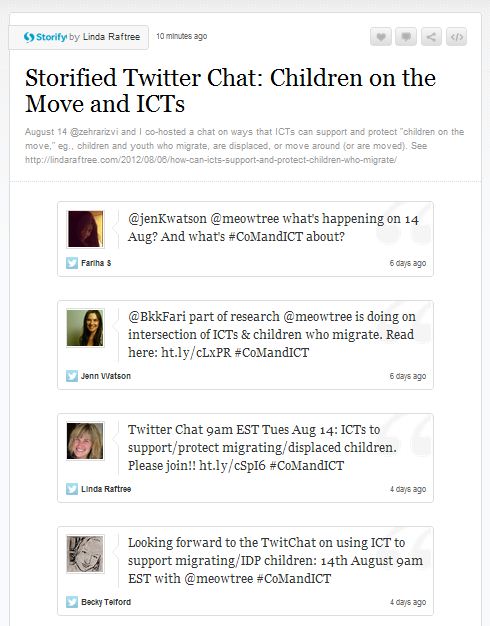
On August 14, @zehrarizvi and I co-hosted a Twitter chat on ways that ICTs can support and protect “children on the move,” eg., children and youth who migrate, are displaced, or move around (or are moved). Background information on the issue and the research.

We discovered some new angles on the topic and some resources and studies that are out or will be coming out soon, for example an upcoming Girls Count study on Girls on the Move by Population Council, a UNHCR paper on ICTs and urban refugee protection in Cairo, and Amnesty’s Technology, People and Solutions work.

Thanks to everyone who participated – whether you were actively tweeting or just observing. We hope it was as useful to you all as it was to us! If you think of anything new to add, please tweet it using #CoMandICT or email me at linda.raftree [at] planusa.org.

Read the Storify version here (with a bonus picture of @chrisalbon holding up a ‘burner’ phone). Don’t know what a ‘burner’ phone is? Click and take a look.

Read Full Post »

« Newer Posts - Older Posts »