Feeds:
Posts
Comments

Archive for the ‘m4D’ Category

Civil society has been working for years on participation, transparency, accountability and governance issues. Plenty of newer initiatives (small and large) look at new technologies as a core tool in this work. But are these groups talking and learning from each other? What good practices exist for using new technologies to improve transparency, accountability and governance? What are some considerations and frameworks for thinking about the role of new technologies in this area of work? What needs consideration under this broad theme of good governance?

Tuesday’s Technology Salon* in New York City focused on those issues, kicked off by our two discussants, Hapee de Groot from Hivos and Katrin Verclas from Mobile Active. Discussion ensued around the nuances of how, with whom, when, why, and  in conjunction with what do new technologies play a role in transparency, accountability and good governance.

Some of the key points brought up during the Salon**:

What is “good governance?”  The overall term could be divided into a number of core aspects, and so the discussion is a big one and it’s complicated. Aid transparency is only one small part of the overall topic of good governance.

The World Bank definition includes aspects of:

  • Participation of citizens in political processes, freedom of expression and  association, free media
  • Political stability and absence of violence
  • Government effectiveness in the delivery of services
  • Regulatory quality, rule of law
  • Control of corruption

There’s a need to look at governments and aid, but also to look at the private sector. Some commented that aid transparency is in vogue because donors can drive it but it’s perhaps not as important as some of the other aspects and it’s currently being overemphasized. There are plenty of projects using ICTs and mobiles in other areas of governance work.

More data doesn’t equal more accountability. Data does not equal participation. Can mobile phones and other ICTs or social media reduce corruption? Can they drive new forms of participation? Can they hold power accountable in some ways? Yes, but there is no conclusive evidence that the use of new technology to deliver data down from governments to people or up from people to governments improves governance or accountability. The field of tech and governance suffers from ‘pilotitis’ just like the field of ICT4D. Some participants felt that of course open data doesn’t automatically equal accountability and it was never the idea to stop there. But at the same time, you can’t have accountability without open data and transparency. Opening the data is just the first step in a long road of reaching accountability and better governance.

Efficient vs transformational. Transactional efficiency within a system is one thing. Transformation is another. You can enhance an existing process from, say, writing on paper to calling on a landline to texting in information, thereby improving accuracy and speed. But there is something more which is the transformational side. What’s most interesting perhaps are those ways that ICTs can completely alter processes and systems. Again, there are a lot of promising examples but there is not much evidence of their impact at this point. One participant noted that current evidence seems to point toward the integration of mobiles (and other ICTs) into existing process as having a greater impact and quicker uptake within large, bureaucratic systems than disruptive use of new technologies. But the question remains – Are the systems good systems or should/could ICTs transform them to something totally different and better or can ICTs help do away with poorly working systems entirely, replacing them with something completely new?

Is open data just a big show? Some alluded to opaque transparency, where a government or another entity throws up a bunch of data and says “we are being open” but there is no realistic way to make sense of the data. Some felt that governments are signing onto open data pacts and partnerships as a fake show of transparency. These governments may say, “The data base is available. Go ahead and look at it.” But it costs a lot of money and high level skills to actually use the data. In addition, there is a need for regulatory frameworks and legislation around openness. Brazil was given as an example of a country that has joined the open government partnership, but as yet has no regulatory framework or freedom of information act, even though the country has a beautiful open government website. “Checks and balances are not inherent in the mobile phone. They need to be established in the legislation and then can be enhanced by mobile or other technology.” Open Data Hackathons can help turn data into information. The question of “what does open data actually mean?” came up also and the “cake test” was recommended as one way of defining “open”.

Is open data an extractive process?  Some at the Salon cautioned that the buzz around Open Data could be a bit false in some ways, and may be hyped up by private companies who want to make money off of nice data visualizations that they can sell to big donors or governments. The question was raised about how much data actually gets back to those people who provide it so that they can use it for their own purposes? The sense was that there’s nothing wrong with private companies helping make sense of data per se, but one could ask what the community who provided the data actually gets out of this process. Is it an extractive data mining process? And how much are communities benefiting from the process? How much are they involved? Mikel Maron wrote a great post yesterday on the link between open data and community empowerment – I highly recommend reading it for more on this.

Whose data? A related issue that wasn’t fully discussed at the Salon is: who does the information that is being “opened” actually belong to (in the case of household surveys, for example)? The government? The International NGO or multilateral agency who funds a project or research? The community? And what if a community doesn’t want its data to be open to the world – is anyone asking? What kind of consent is being granted? What are the privacy issues? And what if the government doesn’t want anyone to know the number of X people living in X place who fit X description? Whose decision is it to open data? What are the competing politics?

For example, what if an organization is working on an issue like HIV, cholera, violence or human trafficking. What if they want to crowd source information and publicly display it to work towards better transparency and improved service delivery, but the host government country denies the existence of the issue or situation? In one case I heard recently, the NGO wanted to work with government on better tracking and reporting so that treatment/resources could be allocated and services provided, but when the government found out about the project, they wanted control over the information and approval rights. Government went so far in another case as to pressure the mobile service provider who was partnering with the organization, and the mobile service provider dropped out of the project. These are good reminders that information is power and openness can be a big issue even in cases not initially identified as politically charged.

Privacy and security risks. The ubiquity of data can pose huge privacy and security concerns for activists, civil society and emerging democracies and some at the Salon felt this aspect is not being effectively addressed. Can there really be anonymous mobile data? Does the push/drive for more data jeopardize the political ambitions of certain groups (civil society that may be disliked by certain governments)? This can also be an issue for external donors supporting organizations in places like Syria or Iraq. Being open about local organizations that are receiving funding for democracy or governance work can cause problems (eg., they get shut down or people can be arrested or killed).

Can new ICTs weaken helpful traditional structures or systems?  Is new tech removing some middlemen who were an important part of culture or societal structure? Does it weaken some traditional structures that may actually be useful? The example of the US was given where a huge surge of people now engage directly with their congressperson via Twitter rather than via aggregation channels or other representatives. Can this actually paralyze political systems and make them less functional? Some countered, saying that Twitter is somewhat of a fad and over time this massive number of interactions will settle down, and in addition, not everyone gets involved on every issue all the time. Things will sort themselves out. Some asked if politicians would become afraid (someone – help!! there is a study on this issue that I can’t seem to locate) to make some of the secret deals that helped move agendas forward because they will be caught and so openness and transparency can actually paralyze them? In other words is it possible that transparency is not always a good thing in terms of government effectiveness? The example of paying Afghan police directly by mobile phone was given. This initiative apparently ended up failing because it cut decision makers who benefited from bribes out of the loop. Decoupling payments from power is potentially transformational, but how to actually implement these projects when they disrupt so much?

Does new technology create parallel structures? Are parallel structures good or bad? In an effort to bypass inefficient and/or unaccountable systems, in one case, private business owners started their own crime reporting and 911 system to respond and accompany victims to report to the police and follow up on incidents. Questions were raised whether this privatization of government roles was taking justice into ones’ own hands, forcing the government to be accountable, allowing it to shirk responsibilities, or providing a way for government to see an innovation and eventually take on a new and more effective system that had been tried and tested with private funds. This same issue can be seen with parallel emergency reporting systems and other similar uses of ICTs. It may be too early in the game to know what the eventual outcomes of these efforts will be and what the long term impact will be on governance. Or it may be that parallel systems work in some contexts and not in others.

***

The Salon could have gone for much longer but alas, we had to end. Dave Algoso covers some of the other ideas from the Salon in his post Technology for Transparency, Accountability and Governance, including how to approach and define the topic (top down vs bottom up? efficiency vs transformation?) and the importance of measuring impact.

Thanks to UNICEF and Chris Fabian for hosting the Salon. Thanks to Martin Tisne from the Transparency and Accountability Initiative for sparking the idea to choose this topic for the first Technology Salon in NYC, and thanks to Wayan Vota for inviting me to coordinate the series.

Contact me if you’d like to be on the invitation list for future Salons.

*The Technology Salon is sponsored by the UN Foundation’s Technology Partnership with the Vodafone Foundation as a way to increase the discussion and dissemination of information and communication technology’s role in expanding solutions to long-standing international development challenges. Technology Salons currently run in Washington DC (coordinated by@wayan_vota) and San Francisco, with New York City as the latest addition, coordinated by yours truly.

**The Salon runs by Chatham House Rules, so no attribution has been made in the above post.

Read Full Post »

I had the great pleasure of participating and serving as a moderator* for TechChange’s Mobiles for International Development course from October 15-November 4, 2011, along with a great group of people interested in how mobile phones can support development processes.

Course topics included mMoney; mHealth; mobiles for monitoring, evaluation and data collection; mobiles and radio; and mobiles in education.

The first week of the course went both broad and deep via a compilation of blogs, videos and longer documents from a range of thinkers and doers in the mobile space.

The second week introduced participants to a number of mobile tools, including MPesa (Mobile Money Transfer Platform), InSTEDD GeoChat and Riff (Mobile Collaboration and Data Stream Analysis Software), RapidSMS/Souktel (Mass Texting Software Interface), Sana Mobile (Mobile Diagnostics Platform), Medic Mobile, TxtEagle, FreedomFone.

The third week offered a number of chats with well-known practitioners and thinkers in the above mentioned areas or developers of particular tools that had been covered in week 2.

Things I liked about the course:

  • Platform. The TechChange platform is really nice. It’s engaging and well-designed. Things are easy to find making participation smooth. It took me a day or so to learn where to find things, but after that, it was easy to join in and access the course materials.
  • Format. This was my first ever on-line course and I found it very energizing and thought-provoking. I loved that the first week was an in depth overview on ICTs and development in general. We were exposed to a huge range of thinking from very positive to very wary and critical of the use mobiles and ICTs in development work. Long and short videos, blogs, guides and research were made available and these really stimulated a lot of discussion around development models and frameworks, the role of NGOs and corporations, e-waste, top down vs bottom up, innovation and local capacities, and all kinds of issues. The second week dove deeper into particular areas and many of these discussions continued, but now with different groups as people began self-selecting according to their particular interests (health, education, etc.) Unfortunately I missed most of the 3rd week because I was out at another conference, but the roster of experts who came onto the platform to chat with the group was stellar and according to participant feedback, quite stimulating as well.
  • Discussions. The format was conducive to great discussions, from small group Skype discussions (each participant was assigned to a small group at the beginning, and these groups held a few discussions over the course period), to random chats, to forums and sometimes Twitter. These discussions were very useful to generate new ideas and dig into topics and tricky issues.
  • Participants. On the one hand it might be nice to have courses aimed at levels of experience, but on the other hand I liked that there were all levels of expertise chatting and discussing, and people from a wide range of backgrounds. This enriched the group discussions and the variety of inputs.
  • Organizers. The organizers did a stellar job of engaging and encouraging the group and being responsive to any technical difficulties encountered.

Things I would like to see in future courses:

  • Less hours per week. It was hard for me to clear my schedule to participate in everything as I would have liked. Dispersing the activities over 4 rather than 3 weeks (as the organizers are planning for the future) might help with that. Of course this might be an issue with me, not with everyone. The good thing is that course materials are available for a few months after the course has closed.
  • Short sessions on setting up specific tools. I was really glad that Tech Change took the full first week to look at the big picture before focusing in on tools and  I was super impressed with the wide range of materials they pulled together to get people thinking and discussing all the different aspects that need considering before deciding on a technology tool or “solution.” I think it would be really helpful, following the big picture thinking, to offer some short courses or sessions focusing on the actual technical use of particular tools so that participants can get hands-on experience also.
  • General courses as well as in-depth courses. This course was fantastic for getting a general overview, and good for both people with little experience with mobiles in development and for those who already have technical or practical experiences with programs with a mobile or ICT element. It would be great to also have courses that focus an entire 2-3 weeks on one aspect such as ICTs in Education, mHealth or mMoney. I certainly could have spent 2-3 weeks learning about and discussing a single aspect of “m” something. I’m sure TechChange has their hands full with new course offerings, but as they expand, this would be great to see.
Overall, I really enjoyed the course and hope to participate in another one in the future. I’d definitely recommend these courses to others interested in ICTs and development.
.
*Note – I attended the course gratis in exchange for helping TechChange shape the content and curriculum and serving as a moderator during the course. (Thank you, social media. Thank you, barter system!)
.
A few other posts related to development of the course:
.

Read Full Post »

The funny thing about ICTs and Development (and mostly everything else in this world) is that just when you think things are plugging along, you get the rug pulled out from under you and have to re-think everything.

A couple of weeks ago, I was heading off to the ICT for Rural Development (ICT4RD) Conference in Johannesburg. Before I left, I got an invitation from Ken Banks to participate in an ”ICT4D Postcard” project, which I thought was a nice idea. I took a moment to find a photo and pen a few lines and went on my merry way to Joburg.

Little did I know that several of the key thinkers and writers in the ”ICT4D” space were going to deconstruct the concept over the next fortnight in a flurry of sometimes harsh and pointed, always thoughtful posts.

The day the ICT4RD conference started, Steve Song posts his Three reasons why M4D may be bad for development rant wherein he makes some pretty strong (and relevant) points, such as:

“…the future is going to be a surprise and tying the notion of development to a particular mode of technology [eg., the mobile phone] is as bad an idea now as it was in 1999” and “Mobile operators have entrenched themselves with development agencies as the saviours of access … what the mobile operators have achieved through this embrace is the effective sidetracking of debates about competition and affordability.”

Then Ken’s ICT4D Postcards post goes up, and no more do I look at it and have a think about the photos and captions, then Erik Hersman (White African) throws up his rant on The Subtle Condescension of ICT4D, which gets the whole ICT4D-slash-anti-ICT4D world in a tizzy and which has a lot of good, strong points, like:

”I was recently discussing this term with one of my Kenyan tech friends, where he stated, ’I always picture a team from the UN putting up toilets in Uganda when I hear of ICT4D’” and ”It also feels like [ICT4D] is how international NGOs are trying to stay relevant, by creating a new department and new initiatives that the big funders will buy into and support (themselves to stay relevant). Ask yourself, how many ICT4D projects in Africa are more than pilot projects? How many are just Westerner organizations parachuting in, which have no hope of staying alive beyond the time and funds put in by their organization? Sounds like the same old ’aid story’ to me.”

Erik closes with “We have to thinking less of ICT as something that’s about development, and more of it as a commercial venture. We need more focus on ICT4$ than ICT4D.”

And I am left thinking, well very much yes! …and also, sort of no…. But I can’t get straight in my mind what makes me hesitate. Maybe it’s that in my experience, not all ’development’ initiatives are the stereotypical foreigners parachuting in with new gadgets? Or maybe it’s because I am super wary of the trickle-down economic growth model and I think that the world needs something different?

I don’t have to wait long before Jonathan Donner drops some good points into the debate in his post More letters, more problems, concluding:

”I don’t think we’re going to move off ICT4D as the default compound term, at least for a while. But I like these discussions and think it is important for the community to have them from time to time…probably quite frequently since the field/ community of practice is increasingly methodologically diverse, and growing. The conversations are not easy as some might like them to be, but that is because they are about a “compound” community. Regular bouts of reflection are not just navel gazing – they should help us remain reflective, careful, and precise in the use of the terms we use to describe what we do and why we do it.”

Followed by Wayan Vota who pops in with the Challenge of Defining ICT4D or Why Erik Hersman is ICT4$, whereby he defines ICT4D and ICT4$ as two wholly different industries. Projects can be ICT4D and ICT4$, neither approach is perfect and there is plenty of failure in both, and the 2 should be symbiotic, he says.

“Let us not confuse two whole different uses of ICT. In the tech start up world, ICT is a means to make money. Software developers code products like MXit or M-PESA and hope to sell them at a profit to to venture capital funders and people that are currently under served by the market place. The focus is on $. This is ICT4$ and they should be proud of their efforts.

In the international development world, ICT is used to deliver education, healthcare, etc more efficiently. We have great products like FrontlineSMS, ChildCount+, and Ushahidi, and sell them to donor funders so we can deliver them free or subsidized to those under served by government or in market failure situations. The focus is on impact versus $. This is ICT4D, and I am proud to use the term.

Notice the different focus. In no way should a tech startup and its funders seeking to maximize profit seek to work in ICT4D, just like it would be laughable for a development organization (funder or implementer) to run a tech startup to be the next Facebook.”

Not to be left out, one of the top critics of ICT4D, the ICT4D Jester, pipes in on the stupidity of any acronym that sounds like a Prince Song [I wholeheartedly agree!]. He gets to the political heart of the discussion about ICT4D and ICT4$ in his post ICT *or* Development, Part 3: The Jester Meets the White African:

”The underlying issue is a deep one that goes straight to the heart of economic development. To compress the last century of economic history into a nutshell,* countries that attempted centralized socialism lost to capitalist countries in the contest to make as much money as possible as quickly as possible.…

In the last few decades, however, countries like the United States have been running the experiment of rampant free-market capitalism. Among other things, this led to the dramatic financial crash of 2007-2008, a population unable to wean itself off of resource consumption, and increased inequality, not only economically but also in terms of health, education, and well-being. If that’s what happens under what could be argued is the closest thing to a “pure” free-market capitalism, any reasonable person should be reconsidering the lesson of the Cold War victory.”

The Jester goes on to explain that ”progressive activity” is necessary to counterbalance capitalism and mitigate the inequality caused by capitalism and that ICT4D in practice tends to embrace this progressive side of things.

ICT4$ is needed, but someone also needs to focus on D. (The Jester, of course, does not necessarily say that D should proceed via ICT4D!)”

He sums up with, “Yes, ICT4D is a four-letter word (with a number), but wear it proudly in your progressive technology activities, and cast it off – way,way off – for your for-profit ones. Meanwhile, don’t forget that the world needs both types of activity. Of course, the one thing you can’t do is split yourself in two.  And, that, perhaps, is another reason why it’s so difficult to make a profit and serve a poor population simultaneously.”

David Kobia continues in his post ICT4D Cont (first acknowledging that he’s ’whipping a dead horse’) that ”ICT4D and indeed then [sic] term ICT in general in this breakneck environment has come to symbolize access to technology at the lowest rung – basically a booster seat at the table with the adults. He asks, ”Is there a very remote chance that the role of technology in development has been slightly overemphasized?”

And Tony Roberts chimes in with his own Rant In Defense of ICT4D, where he joins the Jester in pointing out that the ’free’ market hasn’t done anyone [eg., the 99%] any favors in the ”developed” or the “developing” world.

”The problem with relying on commerce is that the ‘free’ market is fundamentally flawed; for 300 years it has abjectly failed to meet the needs of millions of people at the periphery. Whilst elites in capital cities enjoy relative opulence, marginalised communities are unable to secure adequate nutrition, basic healthcare or human rights. These divides continue to widen. In response people form not-for-profit organisations to have their voices heard and their community development needs addressed; sometimes employing ICT for these Developmental ends. Not-for-profits exist because of the failure of markets.

ICT4$ alone is not capable of fixing this problem….

When communities refuse to accept injustice and deprivation and form associations of solidarity with those at risk we should give them our respect. If they seek practical assistance in applying ICT for Development we should offer whatever assistance we are able. There will often be a positive role for ICT in community development.

ICT4D alone, of course, is not capable of fixing the system.”

In addition to all the blog posts that Erik’s provocative post spawned, there are some great points made in the comments section:

For example, Paul comments (and I summarize)

”Left to its own devices, ’ICT4$’ will mostly chase the same set of rich urban market users, just as the bulk of SV consumer startups chase the same demographics…. So, yeah, make these things follow commercial logic and thereby sustainable, but the answer is not to deprecate the ’D’ in favor of the ’$’. Both need to be kept in mind because a rising tide raises all Gini coefficients…. Local capacity, sure, but that isn’t always the cheapest/fastest way to do it (which is what commercial logic would dictate). Again, to care about advanced capacity building, you have to care about the ’D’.”

(@hapeeHapee says ”To me the container ICT4D is useful as a hashtag for twitter, as a common ground for research and practitioners, social movements and ngos still play a role as do active citizens, open source is still an alternative used to prevent closed source standards and the market is still something to be very careful about because the driving force of profit is not the same as creating change.”

So. Much. To. Think. About.

It’s a really messy world out there and the field [formerly known as?] ”ICT4D” is no exception.  The issues being wrestled with are much broader than ICT and D. I’ve picked out points and angles that resonated with me from the various posts. I can’t say that any one of the authors is 100% right (nor, probably, would any of them claim to be). Or maybe they are 100% right in certain situations, but not all.

Should International NGOs stop creating dependencies and killing local initiatives? Yes.

Does the ’free’ market allow for dignity and well-being for all? No.

Maybe that is the heart of the question – how to operate in a way that does not create dependency or stifle economic growth but that also does not exclude or marginalize a large part of the population. Maybe it always comes down to that ’capitalist’ vs ’some other kind of inclusive and sustainable growth model’ discussion… And maybe a clearer divide between ICT as a growth sector and ICT-enabled development programs that aim to reach the most marginalized (where the market does not reach) is needed. Or maybe not, if you believe ethical business models can achieve both. (I’m still waiting for those models to become the widespread norm and don’t see it happening any time soon, anywhere).

And what about ICTs as tools to improve civic participation, voice, access to information, transparency, accountability and good governance so that [ideally] exclusion is reduced and resources generated by economic growth (and/or resources allocated to fill the gap where the market fails to reach, or resources designated toward improving services that are/should be provided by government) are better and more honestly allocated… And what about new technologies that support more transparent political and decision making processes? (What is the acronym for those kinds of ICT uses?) Oh, so messy….

In any case, I think the discussion is helpful in raising issues and making us all think more about the terms we use, and the processes and products we support, drive and promote.

If there is one thing the field [formerly know as?] ’ICT4D’ does do, it’s bring together good people who think deeply and who honestly care about how they are contributing to making the world a better place.

Take some time to visit the links and read the full posts if you haven’t yet, they are very much worth it!

*****

Updates:

16 Nov 2011:

RT @kiwanja: Check out the #BBCClickRadio podcast for a slightly extended debate on the merits of ”#ICT4D” terminology. http://is.gd/HUK37e

RT @hapeeg: More ICT4D Please! – My take on the ICT4D debate by @david_barnard http://tinyurl.com/c55tpg4 #ICT4d #ICT4RD #Tech4Dev #Africa.

David Barnard notes that “there is also more than one real “White African” serious about making a contribution to the future of this continent.” 

“These two issues represent different sides to the same coin – but often require very different approaches, and different roleplayers, to achieve the desirable objectives…. Whatever you prefer to call technology is irrelevant – IT / ICT / ICT4D / ICT4RD / M4D/ Tech4Dev, etc. What really matters is the intent, the objectives and the motivation for using it.

But, technology for technology’s stake is downright stupid. Too many technology for development projects and interventions fail because of the emphasis on the technology without understanding the development issue/s and/or what it would take to ensure the implementation of the technology will ultimately achieve success and impact. Too many technology competitions, awards and challenges place too much focus on the development of “more new tools” rather on what has been achieved.”

17 Nov 2011:

RT @mtotowajirani: New blog post: #OccupyTech: Take the money out of tech…and put the impact back in! http://bit.ly/tTAogC #occupy (Wherein Simeon Oriko takes on #ICT4$ with a new slogan – suggested by @noniemg – Take the SH out of IT… ” He says:

“Here’s the bottom line….Unless you are directly making an impact in someone’s life with you apps and all the hustle around them, you’re really doing nothing meaningful. …  Money is driving people in totally wrong directions!  Sober up and think about it for a second. What’s more meaningful and worth your hustle? Money or impact?”

And I missed Niall Winters original thoughts, including ideas from @katypearce, on this post The 4 in ICT4D.

“The ‘4’ places an emphasis on “giving it to you”, and all the issues that brings up regarding donation. I hadn’t really thought about it in that way before, coming from the perspective nicely described by Kleine and Unwin (2009):

Our preferred terminology is ICT4D, in part because it is the most widespread term, but also especially because it places explicit attention on the ‘4’, or what kind of development is being addressed. Rather than the ‘and’ of ICTD, the ‘for’ of ICT4D forces users of the term to confront the moral and political agendas associated with ‘development’. By focusing on the ‘4’ we are forced to make explicit what we mean by ‘development’. The interplay between ‘information’, ‘communication’ and ‘technologies’ for ‘development’ is one that offers considerable intellectual and practical challenges, and it is these that this paper seeks to explore.

 Hence, the ‘4’ for me is a challenge to think about the nature of inclusivity in my work, the power relations embedded within any intervention and the appropriateness of the technologies used or being developed.”

22 Nov, 2011

kdiga’s reply on ICTDJester’s blog: says we need to ask 4 questions and agree on some principles when invoking ICT4D:

1) Are we attempting to see the reduction of poverty (in all its multiple dimensions?) from the use of ICTD?
2) Are we attempting to see the reduction of inequality?
3) Are we seeing lower numbers in child mortality, an improvement through healthier families, or more student graduating Grade 12 as a result of ICT usage, less environmental degradation – how are we measuring?
4) Are we able to see less lives lost?

23 Nov, 2011

Ian Thorpe’s post “ICT4What” says part of the issue here is that ICT4D is a huge field (and a subset of “technology” which is an even bigger field, and which has absolutely everything to do with “development” – eg, read Jared Diamond’s book Guns, Germs and Steel) and people are talking at cross-purposes and using all different definitions.  ‘The development, spread and use of technology is a huge field with lots of actors each playing their part, with plenty of room for different motives and philosophical or empirical approaches – even contradictory ones  – since in the end they will all contribute to the change that takes place through collaboration, competition and even contradiction. In short it’s a complex adaptive system. Past technological spread has always resulted from the actions of multiple actors often with very different motives and philosophies: Inventors, entrepreneurs, governments, consumers, academics, not for profits and others have all helped shape the way technology is currently used both consciously and unconsciously. Using technology to make money is a key component of spreading technology that improves lives, but it’s only part of the story.”

Ian concludes that “it doesn’t matter that we don’t agree, in fact it’s a good thing. A diverse approach involving multiple actors and friction between them is in the best interests of the field because it allows different models to co-exist, compete and learn from each other, and it allows then to be judged in the market and the marketplace of ideas.”


Read Full Post »

A few weeks ago, Iulian Circo, who’s working at Population Services International (PSI) in Mozambique, asked if I’d look at some slides about an idea called ‘Movercado’. I checked it out and it seems pretty cool.

Movercado is described as “an  interpersonal communication experiment” with the goal of supporting behavior change communication (BCC) in large countries with poor infrastructure.

The problem that Movercado would address?

‘Taking behavioral messages above the line (TV, Radio, Mass media)  doesn’t really work beyond the all important effect of creating awareness. Organizations such as PSI know that very well and focus a lot on inter-personal communication. That means we need a critical mass of trained “agents” placed throughout the country that conduct standardized information, education and communication sessions in their communities.  Obviously, supervising, training and deploying such an army of “agents” is difficult, slow and very costly. Additionally, efforts to ensure quality and keeping the training materials up to date adds to the costs. Finally, reaching the critical mass required to have an impact with this traditional model in a large country is very difficult.’

Enter Movercado, which aims to facilitate this process through a series of face-to-face training, SMS, calls, incentives, data collection and personalized messaging with agents and the target population.

There is a step-by-step detailed description on the Movercado blog, but since I don’t know the context well, it was confusing at first. So Iulian created a quick user  scenario and had a friend draw up the visual below to help with understanding the process and flow of the application:

How would Movercado work?

‘Manuel lives in Beira, Sofala Province. He sells airtime and cigarettes nearby the port and is always looking for more business opportunities. He also goes to school at night. One day he sees an announcement in the papers about an inter-personal communication training offered by PSI, that will allow him to supplement his income. He registers for the training.

The training is about inter-personal communication in the area of Malaria Prevention. Upon successful completion of the training, he receives a training kit that contains training materials, training aids, information sheets as well as a stack of cards containing unique codes. He leaves his telephone number and some other personal details with the trainer and three days later he receives a SMS informing him that his registration with Movercado is completed and he can start delivering IPC sessions.
.
Now, Movercado links his details to the range of codes in his kits, which means that every code in that range represents a session in Malaria prevention conducted by Manuel.
.
Emelita works at the market nearby the port selling cashew nuts and tangerines. She often buys airtime from Manuel. One day Manuel asks her if she knows anything about malaria prevention and proceeds to go through the standardized session as learned in the training. Upon completion, he hands her a card and tells her that she should text the code on the card to such and such number – the message is free and she will receive an additional 5MTN in cash (6 cents US). 
.
After arriving home, Emelita texts the code to the given number. A few minute later she receives a message congratulating her for having undergone a very important prevention session along with a voucher for 5 MTN in airtime. 
.
Shortly after, Manuel receives an SMS  informing him that the session with Emelita has bene validated and he receives an incentive in Airtime or M-Kesh, whichever he prefers.
.
A few months later, due to the rainy season, malaria becomes more prevalent in Beira. Manuel receives an SMS informing him that during this period his incentives for every session delivered will be higher. 
.
A month later Emelita receives a call from a trained PSI quality control agent who goes through the session with her, reinforces the message and provides more specific information on Malaria, including health centers where nets are available for free.
.
Less than six months later, Manuel finishes all his cards. He calls PSI on a toll-free number and is informed that in order to receive new cards he needs to attend a refresher training – he is given specific details about the regular refresher trainings implemented by Nova, a partner in Beira.  
.
In another scenario, Manuel works for Viva, a local community NGO. In this case Manuel’s incentives may be slightly different, as per the agreement between PSI and Viva. Viva themselves receive a payment for every session that Manuel conducts (or they receive points that are then converted in financing), and they may be trained and certified to deliver either the initial training and/ or the refreshers themselves.

I think the idea has merit. My main concern is the still low mobile phone penetration rate and skill levels in Mozambique. The ITU reports only 31 mobile phone subscriptions per 100 inhabitants (likely lower in rural areas), an adult literacy rate of 55%, and the country has low network coverage. It is currently ranked 141st out of 152 in terms of ICT access, 135th in terms of use and 147th in terms of ICT skills by the ITU. So the idea would need to be supplemented by other approaches to reach the majority of the population (something Movercado aware of too, of course).

Iulian  has written up some other potential risks to the idea, such as quality assurance control and the possibility that people would try to game the system.

I think it’s a really interesting model. What do others think?

Read Full Post »

Last week’s conference: “The Power of Information: New Technologies for Philanthropy and Development” hosted by the Indigo TrustThe Institute for Philanthropy and The Omidyar Network was somewhat of a ‘who’s who in ICT4D’. It provided an incredible opportunity to hear and discuss what some of the best minds are up to with regard to technology and innovation in development. (Check the conference videos here for more.)

The purpose of the conference was to bring innovators and donors together. In addition to the panelists, many other leaders in the field of social media, ICT4D and innovation as well as a variety of donors and funders were around to chat with during breaks, lunch, dinner and drinks. Conference topics included transparency, accountability and democracy; health; finance and rural development; youth empowerment and education; human rights; and fostering innovation and enterprise.

I got a lot out of the conference, but want to focus on two areas of specific interest:

  1. Balancing innovation (inspiration) and process (sustainability)
  2. Building bridges between new technologies and existing initiatives

Balancing innovation (inspiration) and process (sustainability)

Philip Thigo from SODNET started the day off with an introduction and a great set of questions* to explore around ICTs and development.  I found myself nodding and frantically typing and tweeting to catch and share as many of them as I could:

  • Are technologies just tools or are they the engine of transformation?
  • Are they universal? Can we cut and paste them from one context/culture to another?
  • Is it about connecting old and new tech for use by marginalized people and groups? Should we be creating interfaces between new and old tech?
  • What about power hierarchies with relation to access? Will disempowered communities automatically adopt technology and turn its use and information into action?
  • What about the challenge of laws and limitations on technologies and the selective enforcement of these laws by the state with regard to access, ownership, and control of information and knowledge?
  • What are the accountability, ethics and responsibilities of technology activists and developers? How are we evaluating our actions and decisions and their impact on people lives?
  • Is it worth taking the risk?

Philip emphasized the need to fail fast, learn fast, and move fast when working in this area. “We need to think about people first, not technology first,” he said. “We should strike a balance between supporting innovators (inspiration) while at the same time strengthening process (sustainability).”

I couldn’t agree more.

Though there is a sense (and a couple panelists, including Philip, commented) that anyone can use social media, that people don’t need training, and that ideally you should just hand over the tools and let people get to work, I do think that ‘striking a balance’ is critical, especially when talking about funding and implementing particular initiatives that are seeking specific outcomes related to development. This isn’t to say that we need an over orchestrated process, but I do think it’s important to remember that not everyone can pick up technology as easily as those who are immersed and surrounded by it 24/7.

Yes, technology needs to be ‘demystified’ and tech is getting simpler and simpler, but based on experience working with staff, community leaders, local organizations, youth and teachers in rural Benin, Kenya, Mozambique, Senegal, Mali, Cameroon, Rwanda and Ghana, it’s clear to me that not everyone can just jump in and go. Not everyone speaks English, not everyone knows about coding, not everyone has used technology before, not everyone feels confident even if they are very curious, and some people want additional support to get going.

In addition, ICT4D-type projects need good overall design, beyond the technology piece. They need a good think-through in terms of sustainability (for programs that are meant to endure), local context, unintended effects, privacy and protection (especially if they are human rights related, work with vulnerable people or could put users in any kind of risk).

As many would agree, the tech is only 10% of it. There is a trend toward developing more detailed user manuals and guidance on what to think about when designing initiatives using new tools like Ushahidi because of demand for this from users. I do think that donors, implementers and innovators need to keep that in mind, and be sure that they are planning for and funding that other 90% [eg, all the ‘boring’ stuff that makes the 10% of the ‘cool and -exciting’ stuff work – like good planning, core staff, logistics, monitoring and evaluation or as the link I mentioned above says, outreach, branding, translation, verification, documentation, integration with other systems….]. I also think donors should be supporting the local strengthening of people and organizations’ skills, capacities and strategic thinking via funding to innovation and tech hubs and support to universities and other kinds of opportunities for further education, training and experimentation in the area of technology for people in ‘developing’ countries, starting from local context and local realities.

Building bridges between new technologies and existing initiatives

Some major transparency initiatives are gaining more and more traction at the moment, for example the recently-launched open government program led by the US and Brazil (and rejected by India) and the International Aid Transparency Initiative (IATI). In addition, there are some really interesting locally led transparency initiatives happening all over the place. The panel on Transparency, Accountability and Democracy highlighted a number of tech tools and platforms that are being used to enhance this area of work (including  Frontline SMSMy Society, and Huduma) and some broad thinking around the topic by Owen Barder, who highlighted various aspects of aid transparency and the giant disconnect in terms of what the general public, governments receiving aid, and donors want to know about aid efforts.

Following the panel, a great question came up from Martin Tisne from the Transparency and Accountability Initiative (TAI).  He said that the transparency and accountability field has been around and funded for many years but it is atomized. He wondered how the different initiatives represented on the panel all fit into the broader picture. Owen agreed that atomization is a very serious concern. “The answer to it is open standards that enable people to take information from all these sources and mash it up and make it available to everyone. This is ‘unsexy’ and doesn’t photograph well but it’s potentially revolutionary in the way that the web has revolutionized our lives.” Owen emphasized the need for donors to invest in areas that maybe don’t seem so innovative and exciting, but that are critical to moving the field forward. (This goes back to the first point – the need to balance innovation and process, and funding for the other 90%).

Stephan King from the Omidyar Network continued during the donor panel to talk about transparency and accountability. He added that “tech tools are not a panacea,” and asked how technology can supplement and complement the work that many organizations are already doing. “Many charities and non-profits don’t know how to use technology,” Stephan said, commenting that there is a role for Omidyar and others to help organizations realize the benefits and utilities of technology to help reach scale, innovative solutions, and to provide feedback loops. “Technology is important in the area of transparency and accountability because it can engage citizens,” he said. “It allows people to access information in a way like never before.”

Martin (from the Transparency and Accountability Initiative) followed, saying that TAI is a collaborative of major funders who are looking at the whole field of transparency and accountability. The field as a whole is about 20-25 yrs old, he said, and is currently very atomized. “We need, as funders overall, to ensure that this growing and exciting community of practice [technology in transparency and accountability] isn’t just another atom within the overall transparency and accountability movement,” he said. “How can technology feed and nurture this overall community of practice? Technology has potential to do something really exciting in our field, to solve problems we’re really poor at, such as scale.” He also talked about the potential for tech to help engage citizens. “This field is and has been monopolized by policy wonks in the cities, in the capitals, but we have an opportunity to reach citizens and that’s really exciting.”

“The vast majority of technology and accountability groups — 95% — however, don’t harness the potential of mobile technologies really strategically, yet the potential is exciting if they did.” Martin asked how we can link organizations with fantastic grassroots networks and/or that really know how to use media with those that are using technology. “If we can crack this complex bridging issue of how to bring the transparency world and the tech world together we will have achieved a huge amount.” It’s not enough to bring government groups and tech groups to the table and think it will happen overnight, he said. “What we are trying to do is to focus on people, on entrepreneurs, on individuals who really understand the problems and the solutions that tech can provide as well as focus on organizations. We find a lot of program officers who know what tech can do or a CEO who has a vision of what tech can do but it doesn’t percolate throughout the organization.” TIA wants to bring together the people who understand the problems together with those who may have the technology solutions. Martin’s idea to bring technology folks together with transparency and accountability folks together to make “tech babies” was a big hit….

These points also resonated strongly with me as someone working in a large development organization that is looking at how to integrate new technologies into its work, and being one of few people within the organization with the specific responsibility of bridging programs and new technologies. It’s  simultaneously comforting and frustrating to know that organizations typically struggle with this and also good to know that some donors are aware of the challenge and willing to support it to be overcome.

Philanthropy and social media

In closing this too-long post, I just want to mention that as background material, Indigo Trust and the Institute for Philanthropy produced an impressive paper called Philanthropy and Social Media, which gives an overview of social media, how it’s being used for communication and social impact, and why social media is important (with separate sections on communication messages, knowledge sharing and reporting, overcoming barriers to inclusion, connecting people, improving service delivery, scaling fast, fundraising, transparency and accountability). The paper also summarizes some conversations with investors in social media. Two charts I find extremely on target are the “tips and advice on investing in social media” and the “roadmap for engaging with social media.” They are both simple and well laid out, and would be useful not only for donors but for anyone who is engaging with social media in development work.

Many thanks to Will and Fran at Indigo Trust for the invitation to participate in the conference!

*See also Charlie Beckett’s great overview of the conference and the key questions he pulled out from the day.

Read Full Post »

This week I came across the “Feedback Mechanisms in International Assistance Organizations” report by CDA Collaborative Learning Projects, based on research undertaken by the Listening Project and funded by the Gates Foundation.

The findings and recommendations are very intuitive and it’s nice to have them gathered in one place. The report can serve as a starting point or a pause-and-reflect moment for organizations working specifically on humanitarian accountability as well as those who are looking to integrate better ‘downward’ or beneficiary feedback into development or humanitarian work overall. It also offers good food for thought for those interested in crowd sourcing and the use of new technology for citizen engagement and input.

The report is not too long, and it’s easily laid out for a quick read, so I’d recommend downloading the .pdf and digesting it fully.

To whet your appetite, here are some points I found interesting:

Why do agencies seek recipient feedback?

Four reasons were identified in the report: to improve accountability, to improve effectiveness, to respond to donor requirements or media pressure, and to increase security for staff. Feedback from recipients* was seen to give staff the fuel needed to pressure higher-ups for necessary changes in programming; beneficiary feedback often improved program quality and recipient satisfaction, and seeking dialogue and communication with communities tended to reduce threats of violence. When accountability was a donor requirement but wasn’t part of a larger organizational buy-in or value, unsurprisingly, initiatives were less successful.

To many reading this post or who may read the CDA report, the benefits of participation and feedback and accountability are already obvious, nonetheless it’s  good to see them captured and documented in a report as a support to those who are trying to establish accountability and transparency mechanisms in less-friendly or convinced atmospheres.

Other key points (any quotes come directly from the report):

  • All practitioners interviewed for the study “expressed their unequivocal commitment to participatory and inclusive approaches to humanitarian and development work, and placed significant emphasis on accountability mechanisms.” In addition, many organizations have signed different charters and standards including SPHERE  Guidelines, the Humanitarian Accountability Partnership (HAP) Standard in Accountability and Quality Management and the INGO Accountability Charter. This rather contradicts the impression the media often likes to give about aid agencies as being totally unaccountable to anyone. Or maybe certain parts of aid agencies are more interested and prone to seek accountability and transparency than others.
  • The report says, however, that there are still issues with continuous feedback loops and information doesn’t always return from whence it came. “Typically information gathered from primary stakeholders flows through different parts of organizations, but decisions are rarely communicated back to communities.” One could also ask how often this feedback (or similarly, any information, or data) is returned to communities in accessible formats so that they can use it as well for their own purposes.
  • Good accountability mechanisms are not possible without management buy-in or staff competency. Managers play a critical role in “creating incentives and requirements for field staff to regularly solicit and utilize feedback.” Organizations need to invest in the skills necessary to ensure honest feedback can happen at community level, and/or among the various people and organizations involved (community members, CBOs, local partners, local staff, management staff, headquarters, government, etc).
  • Different agencies are working to develop frameworks to improve feedback and accountability mechanisms. “Some of these new approaches have built-in mechanisms for integrating recipient voices into program strategies and operations.” Some organizations have been collecting primary stakeholder feedback and sharing information with recipients for years as part of participatory development processes. However, the report says, often the exercises are very focused on individual projects or towards particular practical results and the richness of the feedback is not fully appreciated or systematically fed into broader decision-making processes.  “The practices of systematically listening to, gathering and analyzing people’s perspectives, recommendations and complaints have not become routine in many agencies.”
  • Feedback mechanisms need to be designed together with recipients. “Mechanisms must also be appropriate to the specific contexts where they are intended to operate, and agencies have to consider the most appropriate name for the [system], channels, and methods for raising complaints, and culturally appropriate ways of responding.” This is especially important in tense environments or with people who are not accustomed to voicing their opinions.
  • Trust is important, and according to the report is “the first step in getting meaningful feedback. Providing information about the goals and expectations of the organization is the first step in building trust…. Organizations need to establish systematic procedures for reviewing, investigating and responding to feedback or complaints. All this needs to occur in a consistent, timely manner for people to believe in the system and use it.” My own experience with children and youth participation initiatives, has taught me it’s also critical to discuss and agree on clear and honest expectations about what can and will be done with the feedback, and the degree to which feedback will actually be able to change a situation. This goes back to the report’s point on management buy-in and institutional systems. Unless your organization really wants to hear the feedback, is willing to change itself or its actions or viewpoints to respond to the feedback, and has the internal capacity to respond and modify how it’s doing things, asking people what they think can be really tricky and potentially demoralizing for all involved. It’s never nice to hear people say “why did you ask us if you didn’t want to know” or “what is the point of knowing what we think if you’re not going to change?”
  • New and emerging approaches are being tested, including those that use innovative tools and technologies such as SMS and social media. However, the same principles apply to these new technologies as to any other type of feedback loop, and it’s clear that there are still challenges with new technologies.  As mentioned earlier in the report “Most organizations that were successful in gathering feedback… and distributing information back… found it necessary to have more than one mechanism in place…in order to provide options for all of the different groups within the local community to provide feedback and to get information.” This is especially true with new technologies, given the large numbers of people left out of feedback loops due to cost, literacy, age, gender, and access if only SMS or social media are used. Specific challenges with new technologies are highlighted in the report, such as the case of Haiti where an SMS service was set up and people were very willing to use it, “but the agencies had not incorporated a way to monitor the replies and feedback. This resulted in some frustrations and a lost opportunity for a feedback loop between recipient and aid agencies.”

Page 17 of the report offers some good examples of what effective feedback loops look like, page 20 lists several areas that need investment and incentive to ensure effective feedback mechanisms and to guarantee that information is properly gathered and well-utilized, and page 23 offers a list of recommendations for effective and comprehensive feedback loops.

Read the full report here.

*I’m not a big fan of the terms ‘recipient’ and ‘beneficiary’ but have used them here because they are the terms used in the report.

Related Posts:

Ian Thorpe does a good job of commenting some of the portions of the report I didn’t expand on:  “Listening to the people we work for

Read Full Post »

This is a guest post by Rebecca Tapscott who, along with Joe Paveyis interning with us in Cameroon for the next couple months. Rebecca wrote a first post about the what and the why of setting up an Ushahidi system in Cameroon to track violence against children and Joe goes more into depth about the technical side of setting the actual system up in his post Digitizing violence reporting. Sounds complicated… because it is!.

Here Rebecca writes about how she and Joe are better understanding mobile phone use and community context by living in the community. She also goes into how the team is training youth on how the system works and getting youth’s input into the design and use of this type of system in their community

Learning what information to include when sending SMS reports on child abuse.

One component of our ICT4D internship with Plan is working “in the field” with the community to help implement the Ushahidi reporting system for violence against children (“VAC”).  To this end, Joe and I are living in Bamessing community, a village in the North West Region of Cameroon, also one of the three program units (“PUs”) hosting the YETAM program.

Bamessing has no running water, limited network coverage, and sporadic electricity.  The region is also known for high rates of child/forced marriage, domestic violence and school dropouts.  If a VAC Ushahidi system can work here, it can work anywhere.

Piloting the site in Bamessing has several benefits as well.  First, we are working with a group of motivated youth who have received extensive training on the four categories of  child abuse and violence against children (physical, psychological / emotional, sexual, and neglect or negligent treatment), as well as their legal rights under the UN Convention on the Rights of the Child and other international and national protocol.

Second, the Bamessing community is saturated with cell phones, and most of the youth in the YETAM group have their own personal cell phones.  Joe and I had a discussion with Odelia, our “land lady” and the 30-year-old widow of the late pastor, who told us that she first noticed cell phones in Bamessing in 2010 (though some say they’ve been around since 2004).  Since then, she has owned five cell phones, although she never uses one to text, and makes only one or two calls a week.  Instead, cell phones seem to serve as a sort of portable doorbell.  Neighbors, friends, and acquaintances “beep” each other (give a missed call, which does not cost any credit) to relay a predetermined message.  Credit is expensive relative to other daily costs and, as previously mentioned, the network here is tenuous.  Texting requires literacy, dexterity, and decent vision, which are limiting factors for many of the adults in the community.

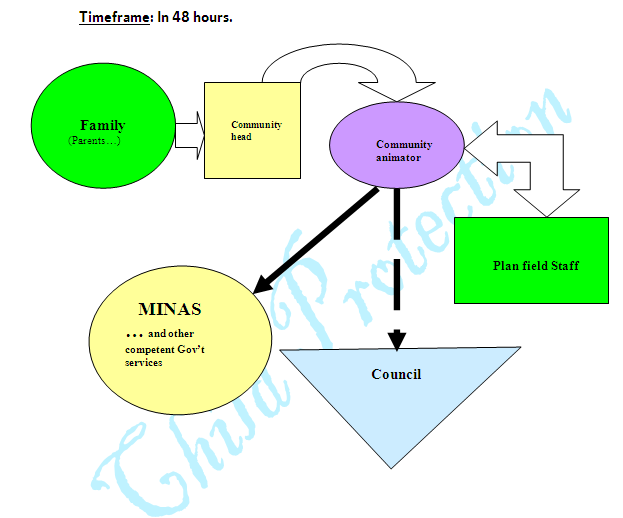
Finally, Cameroon seems to have the advantage of a functioning (albeit imperfect) offline system for reporting and responding to VAC.  I spoke with a delegate from the Ministry of Social Affairs (“MINAS”), who explained some of the system’s weaknesses to me, namely that the ministry is highly underfunded and understaffed.  He also lamented that reporting is lacking, due to inadequate knowledge of civil law (instead, most people are familiar with customary law, which often reinforces certain rights violations), and inability to report violations.  While knowledge of civil law must come from human led sensitization and education projects, the Ushahidi platform can enhance reporting ability in Cameroon.  Through our discussions with Plan staff in Yaoundé, we came to the optimistic conclusion that the government might increase investment in staff, resources, and educative programs in direct response to the number and severity of reports that come through the Ushahidi system.

Given these caveated benefits, our current challenge is to introduce the concept of reporting through Ushahidi to the YETAM youth group, teach the youth how to report incidents, integrate their feedback into the system, get the online system up and running, pilot it, and present it to MINAS.

Our first opportunity to present Ushahidi to the youth was during the YETAM refresher training, held June 22 – June 27, 2011 at a local high school in Bamessing.  Joe and I worked with Georges (Plan Cameroon’s ICT coordinator for the area) and Judith (the YETAM coordinator in Cameroon) to design a module to introduce Ushahidi and our particularized reporting system.  First, Georges and Joe explained Ushahidi and answered questions on a theoretical level.  We then described our intention to use Ushahidi for reporting VAC, what information must be included in reports of VAC, and what information will be displayed on the Ushahidi site.

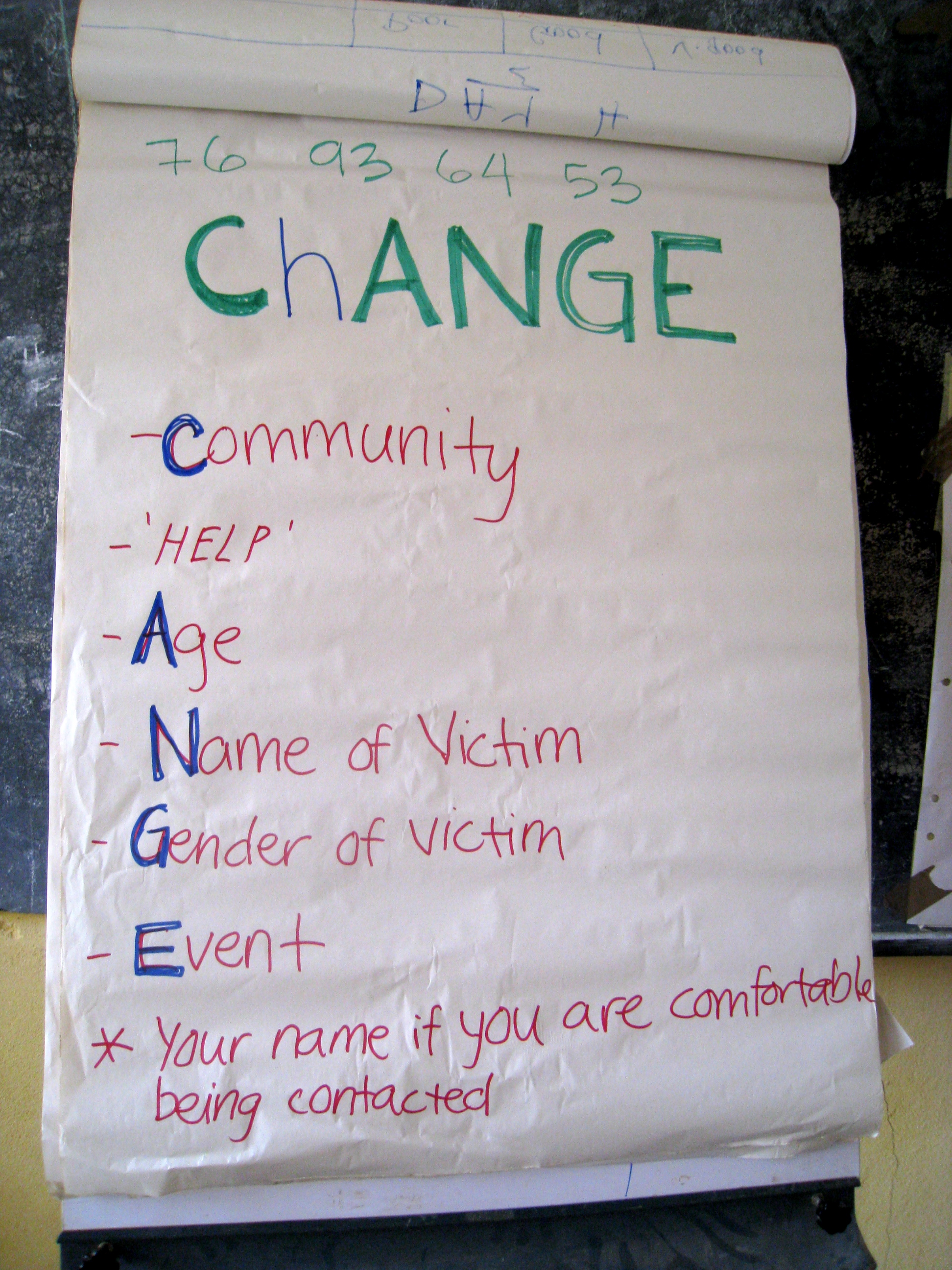
We created an acronym (ChANGE) to help the youth remember what information to include in text message reports. (C: Community; h: False letter– we said “help” so people can remember, but really nothing should be reported there, A: Age, N: Name of victim, and your own if you are comfortable reporting it, G: Gender, E: Event.)  Then we gave a practice scenario and asked five participants in the class to show how they would report the message. We reviewed each message for number of characters, noting that a single text message is limited to 140 characters, and also checked to make sure that all the necessary components were included.  All five messages were similar, reading something like:

My name is Judith. I beg of you for my friend Mary who is 14 years old and whose father is taking her from school to give to a 60 year old man for marriage in Bamessing community.

Most of the messages ran long, but did include the five required components.  One area of confusion was what level of geographic specificity to include.  We explained that while the report must be as specific as possible to facilitate a response, the Ushahidi site will present a more general geographic location so as to preserve anonymity for victims and reporters.

We asked the youth for feedback on the system, which resulted in more questions clarifying what is appropriate to report, and the level of confidentiality of reporting.  One concern was that often the phone network is down, making it impossible to send text messages.  We clarified that all the old methods of reporting still exist, and that community animators and Plan staff can be sought out to report either by text message or the other ways.  By the end of the training, the youth agreed that this would be a useful system, and some commented that they particularly appreciate the unique level of anonymity associated with SMS reporting.

This month, Joe and Georges will finalize the Ushahidi system, Joe will create brief manuals for system users, and Joe and I will provide additional training on using the system.  We hope to have the youth send sample text messages to the site in the next month to test the system, to train the youth, and to provide sample data to present the site to potential government partners. Our colleague Nathalia (the Child Protection Advisor in Plan Cameroon) also suggested that we create a ‘child and youth friendly’ guide to how Ushahidi works that can be used for training, so we’ll get going on that also.

Read Full Post »

This is a first guest post by Jacqueline Deelstra, who is working for about 2 months to support Plan Benin to solidify their SMS Reporting and Tracking of Violence against Children (VAC) project.

The VAC Benin project started as a pilot in February 2010. Plan Benin welcomed Paul Goodman (see earlier posts) for the month of May to support refining and optimizing the actual SMS and mapping system, and Jacqui is now spending 10 weeks looking further at the non-technological aspects that underlie the initiative, including staff training, links with government duty bearers, and community input around the idea and practice of SMS-based reporting.

During the initial workshops with staff, government representatives and youth in February 2010, we identified the need to map out and better understand what information should be collected in order to 1) allow Plan staff and government to understand the nature of violence against children in Benin, respond to VAC reports, and to avoid creating parallel information systems and 2) the need to provide clear guidance and training to ensure consistent categorization of reported cases. Jacqui writes about this below. (More on the overall project and process via the links at the end of this post.)

In coming to Benin for two months as a consultant to work with Plan staff on a project using FrontlineSMS and Ushahidi to collect and map citizen reports of violence against children (explained previously in this blog) I knew part of my work would be training staff in the technology and answering their questions about how it works and what it’s good for.  In other words, that this work would fall under the often discussed buzz phrase “capacity building” for local staff. And certainly, many questions have come to me about aspects of the technology.

For example, how data from Ushahidi can be downloaded for analysis and to make graphs for reports and how staff without access to Ushahidi as administrators can use the public site to submit cases of violence that are reported to them in person as opposed to being submitted directly from the reporter to our Ushahidi platform via our SMS helpline.

During the recent trainings I carried out in Cotonou on Tuesday and Wednesday I was able to demonstrate to staff members the features of Ushahidi, but just as important was the chance to field a lot of interesting comments and questions. As this was the first time many staff members had seen the vacbenin.ushahidi.com site, it was a process of discovery. There was resulting curiosity about things I had just taken as given in the system.

Comments were made about how we are currently processing reports of violence received by SMS by classifying them into certain categories and specifically why we chose the categories we did for the type of violence and location. The categories we have are listed below.

Current categories on the Violence Against Children (VAC) Ushahidi site in Benin

From French to English they translate to:

Type of Violence– death, sexual violence, psychological violence, physical violence, negligence, exploitation and kidnapping

Location– At home, at school, at work, in the community and in institutions.

You will see next to categories right now there is the statement: “Select as many as needed.” Everyone knows it is difficult to classify many things into just one box. Thus, with cases of violence such a forced marriage it was initially decided that multiple boxes should be checked because it certainly entails sexual and physiological violence and potentially physical violence, and we wanted to cover all our bases.

However, comments from the standpoint of the country office staff pointed to a different conclusion: you have to categorize each report in just one category or else it will be difficult to do a good analysis of the data. They see instead that there is one category which the case belongs to above all, (for forced marriage this would be sexual violence) and that is how it should be categorized. As it was explained to me they look at the categories and say, “just because only one box is checked does not mean the case does not belong to other categories, and selecting one box ensures there is not double counting of cases in the analysis.”

Finally, in our discussion of the choice of locations when processing a report, questions come up about why “at work” was chosen, when other locations more specifically of interest to staff, such as the market, were not included. (Note: the original categories were taken from the UN Study on Violence Against Children, which provides the framework for the overall program.) Staff explained that markets are known to be dangerous places for children who work in them and thus they would like to see if reports come in specifically about that. They also discussed their feeling that “at home,” is too vague. Violence at home could be committed by parents against their own children. Or it may be violence committed against domestic workers or other children living in the household, which they have the impression happens frequently. But the category “at home” does not provide any insight into that question.

The clear value of this discussion of categories and what information would be of most use to the local staff points to another buzz phrase in development, “participatory methods for program design, monitoring an evaluation.” Without consulting various staff members and getting that local knowledge about what issues a project should be tracking and addressing, it is likely the project will not be as useful and impactful as it could be. Especially with a project like as this one that is gathering data for the sake of advocacy, awareness raising and informing future programming, the way data is collected and classified has to fit the local needs and context.

Thus in my trainings this week it was certainly not only the Cotonou-based staff that learned something. I learned more about what types of violence are of interest to staff and how we can make this project work better for them by better meeting their information needs.

Related posts:

Future proofing the VAC Benin project (by Paul Goodman)

Update from Benin: charting a course forward (by Paul Goodman)

Revisiting the SMS violence reporting project in Benin

Tracking violence against children in Benin video

Community-based child protection

Tweaking: SMS violence reporting system in Benin

Finding some ICT answers in Benin

7 (or more) questions to ask before adding ICTs

Fostering a New Political Consciousness on Violence against Children

Related links:

Text messages to help protect children against violence

Plan International case study: Helping children report abuse in Benin

Read Full Post »

Youth learning to use GPS in Pitoa, Cameroon (photo: Ernest Kunbega)

Last Monday I attended Africa Gathering London. The topic was ‘Social Media Revolutionizing Africa: How is new media changing Africa, giving voices to the voiceless, improving governance and transparency, and changing narratives?’

The event stimulated thinking and brought up some hot discussions around technology, traditional and social media, aid and development, participation and governance. (Big congratulations to Marieme Jamme  for curating a great line up that brought in an interesting and engaged group of participants and to William Perrin of Indigo Trust for keeping things on track and generating good debate!) See the program, the speaker bios and some short video interviews.

Some quotes, thoughts and debates from the day:

  • If your purpose is to bring more people into discussions, remember that radio, Facebook, and Twitter audiences are distinct and be sure you are thinking differently about how to engage them all. Remember that many people in Africa prefer to talk not write.  (from BBC’s Africa Have Your Say – @bbcafricahys‘s presentation)
  • You can’t resolve all of Africa’s issues with one approach. The countries are very different and local context really matters. But you also can’t design something for every tiny demographic. Where is the sweet spot between localized and scale? (discussion after the morning workshop)
  • People should not sit in the UK deciding and develop things for Africans. Develop things with Africans, or support Africans to develop things themselves. This idea got retweeted a lot, with lots of agreement. But H Taylor – @HFTaylor88 also commented via Twitter that this rhetoric has been around for ages within NGOs…. (discussion after morning workshop)
  • It’s great that the market has been able to bring mobile phones to so many people in Africa, but the market can’t do it on its own as many are still left out. There needs to be more incentive to reach remote areas. There needs to be education, cash transfers, government regulation if we want to really realize the potential of mobiles. Mika Valitalo – @vatamik commented that in many African countries, mobiles are still taxed as luxury items, making them more expensive than they should be. (Clare Melamed -ODI – @claremelamed‘s “Is the Mobile Phone Revolution Really for Everyone”.)
  • Any big story today on CNN has a social media component, yet there is still the idea that social media only breaks news and ‘it won’t make the history books until CNN or BBC report on it’. If CNN is not planning to do a story but sees everyone is talking about it on Facebook and Twitter, they will cover may rethink covering it. CNN finds good opinions and stories on social media, but their primary news source will continue to be their correspondents. Emrys Schoemaker – @emrys_s however questioned whether mass media use of citizen journalism is a broadening of voices or if it’s cheap content for big media – or both. (Faith Karimi/CNN/@faithCNN’s presentation and resulting discussions.)
  • Social media gives African youth an uncensored worldwide platform, letting them feel included in shaping Africa’s image, but the youth using social media in Africa are still the middle class and the rich. We need to find ways to include other youth. (Faith Karimi – @faithCNN’s presentation and resulting discussions.)
  • The Guardian’s Global Development Site and Poverty Matters blog are trying to get away from the vision of ‘poor Africa’ and have only been accused of ‘poverty porn’ once in 9 months (which Liz said irritated her to no end as they really try to avoid it). (I remember the case…) They stay away from the typical ‘flies in the eyes’ photos, but sometimes there really is starvation in Africa, and in those cases, a photo of a starving child might actually represent reality. (Someone countered that African newspapers should use photos of drunk, vomiting Brits to illustrate stories about parliament).  (Liz Ford/deputy editor/@lizford‘s talk and discussion)
  • Is the Guardian’s Global Development site one-sided, taking the view that aid is good rather than other ideas on how to best achieve development? Development is much larger than ‘aid’ and when talking about development we need to remember the bigger picture and the alternative views that maybe aid is not the best (or only) way to ‘do development’. The Guardian is quite open to new thoughts and ideas and invites anyone with ideas for blogs or stories to be in touch with them. They consider their site a ‘work in progress’. (Note: I like the Guardian’s site very much as it is one of the few media sources that discusses and seems to really promote and engage in the ‘#smartaid / @smart_aid‘ discussion). (Liz Ford’s talk and discussion)
  • Many African leaders, not to mention the public and the media, will listen when high level people call their attention to something, but problems can’t be solved by the same people who created them, especially if those people are considered morally bankrupt. Karen Attiah – @karennattiah  commented in from Twitter that a big part of development work should focus on rebuilding the broken social contract between governments and citizens in Africa. So how can we connect policy makers with ordinary Africans? How to bridge the gap between policy makers and grassroots approaches and implementation. (Panel with Alex Reid/@alreidy and Carolina Rodriguez /@caro_silborn – media heads at Gates Foundation and at Africa Progress Panel)
  • Not all sources are created equal – this is true for traditional and for social media. Social media is not about the technology, it’s about the human need to communicate. You can make traditional media more social also. Even those without access to social media will get around harsh barriers to tell their stories because of the urge to communicate. So the best thing is to create a social experience, not to worry so much about getting ‘jiggy’ with the technology. (from Kevin Anderson/@KevGlobal‘s presentation. See Putting the social in media.)
  • New technologies can impact on public debate, people’s political capabilities, citizen-state relations, relationships with other government actors. Frontline SMS Radio, for example, could be a very useful tool for this because radio is still the main way to communicate with the majority of Africa. Using Frontline SMS Radio, stations can sort through messages they get, understand them better, and use the information to orient their radio programs as well as other things. Radio can play a very strong and useful role in governance. (from Sharath Srinivasan/ @sharath_sri‘s presentation. See FrontlineSMS at Africa Gathering.)
  • Youth can have a big impact on community development if given space to influence. There is money (eg., in Cameroon, at local government level) but it needs to be better spent. Informed and involved youth can hold government accountable for spending it better. Local level advocacy has a greater impact on youths’ lives than global level initiatives because you can make as many laws as you like, but unless people are putting them into place and practice at a local level they don’t matter. Organizations should listen to young people but not make them dependent on NGOs because the real duty-bearers are family, community, government. NGOs need to be models of their own methodologies; eg., if an NGO is encouraging people to criticize the government, the NGO should be ready to receive the same scrutiny around its own work and behaviors. Social media can play a role in this process by showing what is happening at the local level to a global audience. (from my presentation and the resulting discussions. See Youth Empowerment through Technology, Arts and Media)
Julia Chandler (@juliac2) did a great round-up of the day’s presentations and discussions on her blog: Part 1 and Part 2. The Guardian continues the discussion here and of course the Africa Gathering website is a great place for more information.
.
Update – more posts about Africa Gathering:
Great perspective from Tony Burkson – @tonyballu – who I really enjoyed talking with at the post-event drinks: A Day at Africa Gathering.

Read Full Post »

This is a guest post by Joe Pavey who, along with Rebecca Tapscott, is interning with us in Cameroon for the next couple months. Rebecca wrote a first post about the what and the why of setting up an Ushahidi system in Cameroon to track violence against children. Here Joe goes more into depth about the technical side of setting the actual system up.

Our first major discussion about the VAC Cameroon site was in regards to how reports should pass through the system. For obvious reasons the information contained within these reports is extremely sensitive, so each step of the workflow process needs to be determined with the best interests of the children involved in mind.

The existing offline system for reporting violence against children was agreed upon through an exhaustive deliberation process with government, community, and local council members. In short, a lot of hard work has gone into making the existing offline system something that all parties agree on and it would not only be negligent, but counterproductive not to use this as a blueprint. For this reason the online system we are working on should respect, support and ultimately serve to expedite the current process, not replace it.

Under this current system Plan serves in the capacity of witness in cases of child abuse. Plan Cameroon has partnered with several governmental agencies to investigate and respond to reports they receive. Which agency this is depends upon the circumstances of the abuse.  Age, gender, and location are all factors in determining which agency will be responsible. For example, abuses taking place in the home are currently handled by the Ministry of Social Affairs, but cases involving female children are handled by the Ministry of Child and Women’s Empowerment.

The current policy also requires that all reports of violence against children received by Plan staff be forwarded to the sector office within 48 hours.

Existing community-level reporting flow

Following this, the report has 24 hours to reach the country office in Yaounde. This one of the processes we are hoping to expedite with the implementation of the digitized system.

Existing flow of next-level reporting - at Program Unit and Plan Country Office

If this sounds complicated, that’s because it is. As outsiders who are new not only to the culture, but also to the peculiarities of local bureaucracy, much of Rebecca’s and my first session was taken up with trying to understand the rules and regulations already in place. Thankfully we have Cameroonian colleagues in the local office to help us navigate and understand all of this.

The Ushahidi System

Ushahidi allows three methods for submitting reports: (1) Text Message, via Frontline SMS or another text messaging tool, (2) Email, and (3) Submitting a report directly through the site. These actions can be taken by individuals in the community or by Plan Staff if they are alerted of a particular incident. A fourth means of submitting reports to Ushahidi, via voice messaging, was previously available through a plug-in called Cloudvox. Unfortunately the company that created the Cloudvox plug-in was recently acquired and has suspended this product for the immediate future, and we haven’t identified an alternative voice messaging system. This is unfortunate as we were hoping to be able to offer voice messaging as a reporting method for non-literate youth — although bandwidth limitations may have rendered this impossible anyway.

Information workflow for Plan Cameroon VAC Crowdmap site (updated; this is version 2.)

Based on the information that needs to be tracked and reported on, our current plan is to separate reports into four categories, each with several subcategories as follows:

  1. Form of Violence
  • Physical
  • Sexual
  • Emotional/Psychological
  • Negligence
  1. Gender of Victim
  • Male
  • Female
  1. Age of Victim
  • 0-5
  • 6-12
  • 13-18
  1. Location of Incident
  • Home
  • Work
  • School
  • Community

Current Crowd Map set up with 4 main categories.

Creating these reporting categories (and each of their subsequent subcategories) will allow this information to be tracked separately, or to be looked at in terms of how categories overlap with each other. Since the Ushahidi platform allows users to choose more than one category or sub-category when submitting an incident report, no data need be lost in the effort to isolate and contextualize information.

For example, by tracking Gender and Location of Incident separately we will be able to more easily visualize how many incidents of abuse are taking place at schools in a certain community, how many of the victims are girls versus boys, and how each of those categories relates to reports from other regions. This will be especially important information to the government who has different agencies in place for tracking violence against children and youth depending on the circumstances. It will also be useful for Plan staff who can then tailor programs and awareness campaigns in a specific community towards the issues that are most prevalent there.

Plan Cameroon staff, partners and youth have create a detailed online map of each council area in which this project will take place, however, mapping of reports will be restricted to a less precise level described to us as the ‘community level’. It’s hard for Rebecca and me to conceptualize just how specific of an indicator this is, though once we are living in the community – a transition taking place this week – it should become easier to measure. The reason for mapping the location of incidents at the community level is privacy. If reports were mapped too precisely they could compromise the identity and safety of a child — a result that would be entirely unacceptable.

On the Ushahidi ‘back end’, each report of an incident will also contain a Description section that will allow information outside categorical parameters to be included in reports. This could be the body of a text message, a summary of a voicemail, or any other details that are deemed to fall outside the determined privacy boundaries (eg., this will allow us to keep identifying information and other details in the system, yet keep it from going public).

Over the course of our week in Yaounde, we engaged in many discussions regarding how we could make the online information workflow match that of the offline system. The conclusion seemed to be that involving community members and Plan staff in initial approval of reports might be possible, but that expecting all six of the varying government agencies that currently respond to such reports to use this digital system would be problematic. At this point we are hoping that the official agreement can be reworked slightly so that only MINAS, the Ministry of Social Affairs would need to be involved in the system.

By week’s end we had drafted an initial proposal for what the workflow for the system could be. It is by no means final and will likely go through numerous revisions over the course of our work here, but it will provide us a good base to build from in the future.

Unfortunately our progress on setting up the site itself has been handicapped by technical issues with the Crowdmap website that cause the site to crash when trying to create subcategories. We have engaged with members of the Ushahidi staff and they are currently working to fix the bug, but we don’t have a timeline as to when they will have the issue resolved.

We have now left Yaounde for Bamessing where we will be initiating our field work on the YETAM project, working with youth on creating short films, performing more community mapping, and we hope that the mobile Internet connection will allow us to continue to work remotely on the Crowdmap site.

Read Full Post »

« Newer Posts - Older Posts »