I was in a global strategy meeting at the organization where I work last week. We had people from various disciplines present from across the organization and the goal was to chart a path to 2015 and beyond.
For the first couple days it seemed like a lot of talk and a lot more talk. We had very bright, very capable people representing different aspects of our work in the room. This can make things quite messy and tiring, and it can feel like everyone is talking in circles because there are so many perspectives and angles and factors that need to be considered in finding shared ground. Sometimes we are so participatory and complicated that we get in our own way. But by the 3rd and final day the perspectives had come together into a much clearer view of where the organization is headed, and we had the beginnings of a shared plan for how to get there.
We worked in a few main groups, and I participated in the Communications group. Much of our discussion centered around integrating better communication in all aspects of our work rather than seeing the role of Communications (and the Comms Team) as designing one-way messages out to the public. One colleague described this as ensuring ‘built in’ rather than ‘bolted on’ communications.
For me the discussions and end decisions were great, because there was a shared push in the group to move the organization towards things that I think are very important.
Some of the aspects we talked about included:
Communicating within programs
the critical role of Communications within programs – eg., Communications shouldn’t only happen at the end of a program (press releases, events or media work to share what was done); rather communication is a critical tool within programs to help reach program and development goals at various levels
the role of information and communications tools (new and old ones, high and low tech) at the community level to improve impact, efficiency, reach, engagement, decision-making, transparency and accountability
the need to strengthen our ability to better integrate information and communication tools into program efforts, measure the impact of different tools and efforts, and share experiences around this
Communicating with ‘the public’ (our ‘stakeholders’)
ensuring consistency in what we do and how we talk about what we do
space for children and young people to tell their own stories both behind the camera and in front of the camera, as producers of media not as objects of or consumers of media
reaching people through the ‘heart’ (which we are quite good at) as well as the ‘head’ (which we need to get better at)
communicating evidence of impact as well as anecdotal and personal stories
using different information and communication tools to communicate at varying levels of complexity and technicality to different ‘audiences’
using various kinds of media to tell a deeper and more complex story than is currently told
finding the sweet spot between a) talking to ourselves in boring technical language and b) over-simplifying or ‘dumbing down’ the complexity of people’s lives and the work that we’re involved in
having a strong and unified global goal so that each team or office can move towards that shared goal, but allowing the flexibility to take the path that makes the most sense locally
good communication at every level — community, district, national, global, ‘North’ and ‘South’, internal and external, networked — to involve people (including ‘beneficiaries’, ‘supporters’, ‘advocates’ and any other ‘stakeholder’) in community development work and in achieving child rights
opening the channels and lessening hierarchical controls on communications so that staff can feel more confident about communicating and using social media both internally and externally
using a combination of communication channels to reach our goals; eg., community radio enhanced by SMS; television programs enhanced by use of web and vice versa
new communications technology to facilitate connections among the network of people we reach (the ‘participants’ and the ‘supporters’ and all those in between)
Communicating for decision-making and accountability
the role of communications in knowledge sharing and knowledge management, internally and externally
creating better feedback and accountability loops to enable communities and the children and youth that we work with to have more of a say about the work we are doing and how we talk about it
using new technology to better organize, share and use the information that we already have, both internally and externally
using info-graphics to visualize information so that we can make better decisions about programs and to be more accountable to the public and to program participants
Even more important than ‘talking about’ the topics above, we worked on plans to actually do them…!
Note: this is not an official meeting report but rather my own take-aways from the workshop.
This is a post by Jo-Ann Garnier-Lafontante. Jo-Ann and I go back a long way. We worked together on a few youth media and participation programs in the past and became friends. She and the youth that I met through her were the first people I thought of when I heard about the earthquakes in Haiti last January. It’s people like Jo-Ann and the youth she works with who are bringing Haiti back to its feet.
On January 12th at 4h53pm I was in my third-floor office at Plan Haiti, meeting with Guerdy the Human Resources Manager and talking about staff issues and projects for the New Year. Suddenly the ground seemed furious with us. I can still hear the sound of heavy concrete collapsing and people screaming. After I saw the toilet literally explode in front of us, I told Guerdy “We’re going to die.” I saw images of my family before me. I tried to call them, but I could not get through. I was terrified. My husband worked in a 6-story building and I could not reach him…
Between three violent aftershocks Guerdy and I managed to get out of the building and into the parking lot. I remember seeing several shoes my colleagues had lost in the stairs while running out of the office. I saw my other colleagues horrified, crying and trying desperately to communicate with their loved ones on their cell phones. I saw this little girl, maybe she was 12, who had come to hide in our parking lot. I had never seen her before… she smiled at me. She told me she lived in the neighborhood, that she escaped from her house and the rest of her family was still missing. She was wounded, the features of her face hidden behind dust.
Four hours later, my husband miraculously appeared in our parking lot, sweating and breathless. I had tears in my eyes when I saw him. He told me about the things he saw on his way to Plan’s office and we started the journey home together. It was awful. We saw people either walking like zombies, screaming, crying, carrying injured people or dead bodies—or desperately looking for loved ones. When we got home, my mother, my 1-year-old daughter and 7-year-old son were in the street in front of our house…stunned and speechless. I grabbed them and held them so tight. I heard that my father and nieces were stuck downtown but they were okay. Now… what about the rest of the family, friends … we could only wonder.
I remember the funerals of my aunt and my grandmother. My father had to remove his own mother from the rubble that had been her home, after six days of digging. We had gotten my aunt out of her collapsed home after two days of digging but she died on the way to the hospital—and then her body was lost among the other bodies and we never found her again.
I remember seeing so many people around Port-au-Prince queuing for burial ceremonies for their loved ones. I thought Haiti had died.
On the last day of 2010, I sat at a meeting at Plan’s new office in Port-au-Prince. It was for the children’s and youth event we are planning for the anniversary of the earthquake. I was amazed at the change since last January. At the meeting we talked about celebrating life. We talked about a new beginning for Haiti and how the engagement of children and youth is essential to its success. I felt our excitement. I feel so proud to be a part of this.
According to what I have witnessed over the past year, Haiti’s promising future is guaranteed because of the potential inside its children and youth. After the earthquake, I saw how young people were so keen and motivated to support their peers. Now I see them mobilizing again to raise awareness about cholera and saving lives.
The earthquake devastated Haiti, but it also provided a chance for this country to be reborn. Children and youth immediately understood their role in this reshaping—they played a key part in the emergency response and they have told us from the beginning that they are ready to do whatever it takes to help reconstruct their country. We adults—and especially the decision makers among us—should listen to their insights and follow in their footsteps and do whatever it takes to fulfill our responsibilities to this country. In the near future, I think there should be a group of young advisors standing behind the President and each Minister.
Today I weep for my aunt, Gagaye (this is how we called her), and my grandmother, Nini, and so many other family members and friends whom I am missing, and also for those I did not know and who left us too soon. But today I also celebrate life. I celebrate the strength I see in the communities where Plan works. I understand the wise person who said “a country never dies…” I now know this is true more than ever because a country like Haiti can count on its children and youth to keep it alive.
Jo-Ann narrates the video below about the work she’s been involved in over the past year. It’s worth a look.
When people tell their own stories and take photos of themselves, the results are quite different from when outsiders bring in their stereotypes and their agendas.
I love love love this photo series by youth in Croix des Bouquets and Jacmel.
In October, 2010, Plan commissioned Natasha Fillion, a Canadian photojournalist based in Port-au-Prince, to train and work with 22 teenagers to document their own lives in their own home, neighborhoods and schools. The youth, ages 14-19, got a crash course in photography and were given a digital camera and sent out ‘on assignment’ in their communities. Their brief was to cover topics such as home life, education, leisure, friends, everyday Haiti, and anything about which they were passionate. The photos were taken over a period of 2 weeks.
Fillion commented ‘I go out and I’m covering demonstrations, violence and destruction but there’s a whole side of Haiti that the media, the whole world doesn’t get to see, and I told the students — this is your opportunity to show people what Haiti is really like. These are photos that tell the story of Haiti as a whole, not just news.’
February 3, 2011, update:
Interview with 2 of the youth photographers and Natasha Fillion.
Do you know of any good blogs from local aid workers? I enjoy reading all these blogs from western-educated aid workers like myself, but we do tend to have a fairly similar way of looking at things, so it’d be great to read something from a different perspective. Any suggestions?
He’s right of course. It would be nice to add some local perspectives to the lists of aid and development bloggers that float around.
Two well-known sites to find ‘local’ voices are Global Voices and Rising Voices. There is also Maneno which is (used to be?) a platform for bloggers in Africa, but it seems to be under maintenance while an open source platform is developed. I’m not sure how many of the bloggers on those platforms technically work at aid or development organizations, but regardless of that minor detail, you will get great local perspectives on aid and development issues there.
But the question stands – where can we find local aid and development worker blogs?
I spent a few days in Nairobi early last week with our education and our ICT staff from Ghana, Uganda, Senegal, Mozambique, Kenya, Egypt and a few other folks, including the brilliant Mika Valitalo from our Finnish office and people from regional and headquarters levels. We were looking at goals and challenges in our education programs and thinking about where ICTs might play a role.
The process was really interesting. Starting a few months back, each country shared their education context analysis onto a wiki. In a second round they narrowed down to a specific area in education, looked at the information and communication flow and gaps, and identified areas where there might be an ICT solution. They focused mostly on mobiles, but in many cases mobiles were supported by computers, servers and laptops as well as non-digital information and communication tools and also solar technologies. Each country team met by Skype with Mika and an external consultant to discuss the concepts and get ICT advice and support. Then they updated their concepts and got additional feedback. For the third round, they added rich pictures to show what the specific ICT solutions might look like. Everyone had an opportunity to give input into everyone else’s ideas via the wiki.
At the meeting in Nairobi, we spent a day sharing the concepts with each other for clarification and focused input. Colleagues shared the broader education context in their countries and specifically in the communities where they are working. Then they illustrated the specific education issues and the ICT solutions that they were suggesting and/or the places they felt ICTs could help. Some of the ICT solutions focused on a very specific technology or device. Others showed how different types of ICTs could be integrated at different points in the process. Others required development of a totally new ‘solution’.
Some of the areas where colleagues thought ICTs could support education included: teacher training for those working in remote communities, adult literacy (especially literacy retention post literacy training), improving exam scores, livening up and improving in-class curriculum, and transparency and accountability in education. We spent 2 days then working in different small groups on the concepts, cross-pollinating ideas and deciding which of the concepts were most relevant to all 6 countries (in order to make it more possible to scale them) and which were most feasible and do-able.
The ideas were all a good fit with our global education strategy (see page 9) which focuses on service delivery (in partnership with local governments and communities); organizing and empowering rights holders; and grassroots participatory advocacy to influence education policies, financing and practice. The strategy prioritizes actions around equal access to education, quality of education, and education governance (see page 10).
Accountability and transparency in education
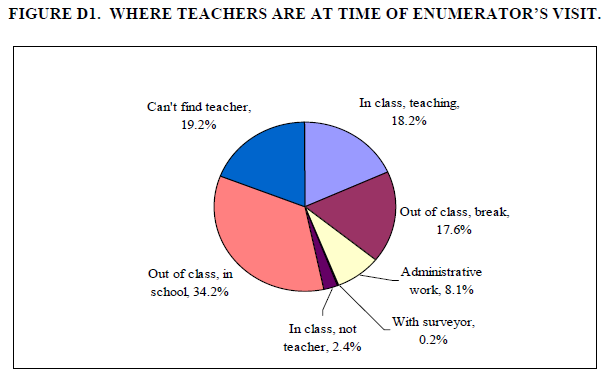
One of the concepts that captured the most interest from the whole group was that of using ICTs to improve accountability and transparency in education. Education is one of the areas where “Quiet Corruption” is often found. ‘Quiet corruption, which can take the form of absenteeism among teachers or doctors, the distribution of fake drugs, or the sale of diluted fertilizers to poor farmers, is having a damaging effect on people in Africa, according to the African Development Indicators report released by the World Bank….’ (March 18, 2010 article)
It's time for class.... where is the teacher to be found?
Edison, Charles and Erik, our colleagues from Uganda, did a short skit illustrating the different points in the primary education system where corruption happens. Their points correlated well with this summary of quiet corruption in education from a July 5, 2010 article in the Independent:
‘Early this year, the Transparency International (TI) Africa Education Watch Programme report: Africa Education Watch: good governance lessons for primary education showed that the government’s perception that massive enrollment is a sign of success of the UPE [universal primary education] programme must be revised to address the problem of overcrowding in classrooms, studying under trees, poor financial management, illegal fees, and lack of school inspection. The report exposes irritating embezzlement of UPE funds and abuse of authority by head-teachers who charge illegal fees, make students offer labour on teachers’ projects, sexual harassment, and systematic teacher absenteeism. The report noted that 85% of schools surveyed had either deficient accounting systems or none at all. In most cases, financial records were either unavailable or incomplete. The survey found limited financial documentation at district education offices and at schools. Most people who handle school grants had no training in basic finance management.
Another survey titled, The Efficiency of Public Education in Uganda, conducted in 2007 by the Ministry of Education to determine efficiency in provision of education services found an average rate of teacher absenteeism of 27% in Uganda, compared to other countries like Zambia (17%), and Papa New Guinea (15%). The aggregate loss caused by this absenteeism constituted 19% which translates into Shs 53 billion out of the Shs276 billion of the Education ministry’s wage bill.
In a swift headcount at the beginning of this year, the Education ministry established that the number of pupils listed in primary school registers was 25% higher than those actually studying. Similarly, the report established that the number of students in lower secondary schools had been exaggerated by 12%. For instance at Amaji Primary School last year, the school register had 816 pupils. But when the headcount was conducted the school administration could not account for 302 pupils.
It is reported that many districts’ chief administrative officers have failed to show proper accountability for the UPE and USE funds.’
The Uganda team also explained that:
Parental interest in education is very low because since Universal Primary Education launched, parents feel it’s the government’s responsibility. Some youth we were working with in Kenya last year made a short film about poor performance in primary schools covering the same issue (see below).
Teachers’ salaries are paid directly to their bank accounts, and there is no way to punish them if they don’t show up.
There are mechanisms to ensure that donor funds go from the national level to the district level and then on to the school, but no accountability mechanisms to ensure that they get from the school to the classroom and are translated into quality education for children.
District level government authority and accountability ends when they transfer funds to the schools; school directors can report to them that they have received funding and that everything is going fine when it’s really not.
Local school committees are often made up of people who are not neutral and who do not have the best interest of the children in mind. In some cases, school committee positions are used for personal gain and to launch individual political careers and political campaigns.
Lack of parental and community involvement in the education process and in school governance means that no one is demanding accountability from teachers and schools.
Sexual and physical violence in schools is very common and underreported. When it is reported, often nothing is done about it.
(Start playing the video, then click the small ‘cc’ button to turn on captions in English)
Colleagues from the other countries face the same challenges in their work and in their own children’s education.
Can ICTs play a role?
What is the solution then? Colleagues suggest that motivating parents and the community to get more involved in school governance and demanding transparency and accountability can begin to change the situation. This obviously requires a lot more than ICTs. So several different actions would be taken to engage and motivate parents and the community to take a bigger role in their children’s education. Then ICTs can be integrated into and support the process for sharing education information with parents, such as student absenteeism, grades, parent-school meetings, exam dates and scores, etc. Parents and students would also be able to report when teachers do not show up or suspected corruption. Students could also report abusive teachers, absent teachers, and other issues they are not happy with at the school. A neutral party would manage and hold the information that flows in and out to protect students from reprisal and to protect teachers from any abuse of the system in case fraudulent or incorrect information is reported. Commitment from those responsible for overseeing education to respond to the issues raised and take serious action is also needed, and this may be the biggest challenge overall. Plan can play a role there, leveraging existing relationships with local and national governments and Ministries.
The idea needs quite a bit of further work, a closer look at feasibility, and more research and input from local communities and parents. As mentioned, the ICTs are actually a small, but potentially very important, part of a much larger initiative to get parents and communities involved in school governance to demand transparent, accountable and quality education and budget spending.
Challenges in the process
Some of the challenges that we had to manage well during this initial piece of the longer process included:
We needed to ensure that we were starting with the context and the need for better information and communications, not starting with the technology and devices and building initiatives around them. Yet we also had to avoid getting lost in the overall context and missing the opportunity to pinpoint potential ICT solutions at specific places within the context. Role play and flip chart illustrations of the ‘problem’ and the ‘solutions’ were very useful for getting more concrete (“So, Kofi is here in his community and he wants to …. So he uses xxx to do this, and then this happens and then….).
Though we wanted to specifically look at places that mobiles and other ICTs could support, it was important to list out all the factors that needed to be in place in order for the ICTs to work and to think clearly about the constraints we might face during implementation. One good question to help with that was, after seeing an idea or ICT solution presented, to ask “What needs to be in place in order for that to happen?” Then you start to remember critical things like community motivation, government interest to actually resolve a problem, electricity, someone to set up and manage a server, a strong enough network to download multimedia content, mobile versions of websites, educational content re-design for mobiles, teacher training on how to integrate ICTs in the classroom, limitations of SMS for doing something other than rote learning, higher versions of a mobile operating system, a smart phone, etc.
We had input from a potential corporate partner during the process. We learned that corporations are thinking several years ahead to what will be coming down the line; however non-profit are normally working within existing constraints and trying to find solutions that work here and now in the resource poor places where we work or ways to get around those constraints. Multi-level solutions seemed to be a good possibility; eg., ideas that can rely on SMS today, but have potential to expand as networks expand and data enabled mobiles become more available.
A corporation tends to think in terms of vendors, results, timelines, launch dates, price points, return on investment whereas a non-profit (at least ours) tends to think in terms of community members, organizations, process, participation, local context. Our facilitator even told us that a corporation normally does a presentation by starting with the solution, and then spending the rest of the presentation showing why that is the right solution. A non-profit usually starts a presentation by sharing all the context and background, and showing the process that led to eventually reaching the potential solution, including every step along the way, how ownership was achieved in the process, why different decisions were made and who participated in them. So keeping corporate vs non-profit cultures and languages in mind is also important when working on joint initiatives.
We need to remember to establish measurable indicators of success so that we can tell if this new type of intervention has a different/ better/ greater / lesser impact than carrying out a similar process without ICTs or with a different set of ICTs. This is something we will address once the full idea is developed. Impact measurement is very important to both corporate partners and development organizations.
This was the first time many were involved a process of this kind, so keeping the balance between technology and development goals was a constant challenge. We sometimes veered too far towards focusing on all the details of the context and then back to focusing too much on that piece of the context where a potential technology solution was seen. I think we were moving toward a pretty healthy mix of both. The process is nowhere near complete, and as we continue to work on the ideas and look at feasibility and actual implementation, we should find the sweet spot.
The work above was guided by Plan Finland’s recent publication ICT Enabled Development – Using ICT strategically to support Plan’s work. On the whole, it was a great learning process for everyone involved, and we came up with some good ideas that we will flesh out in the coming months. Having the opportunity to patiently and carefully think through areas and ways that ICTs can support program goals around education and discussing the ideas at length with colleagues was a capacity strengthening exercise for all involved and will mean that we will be more prone in general to thinking about incorporating ICTs in our work going forward.
Ivan and Massilau working on some mapping in Inhambane, Mozambique.
I had the pleasure of working with Iván Sánchez Ortega in Mozambique earlier this month, and I learned a ton about the broader world of GIS, GPS, FOSS, Ubuntu and Open Street Maps from him. We also shared a few beers, not to mention a harrowing plane ride complete with people screaming and everyone imagining we were going to die! But I suppose it’s all in a day’s work.
Below is a cross-post by Iván about Maps for Mozambique. You can find the original post here, and a version in Spanish here. Note: the opinions expressed below belong to Iván and not to his former, current or future employeers…..
*****
Last week was a small adventure. I went to Mozambique to make maps, as part of the Youth Empowerment through Arts and Media program. The main goal was to train youngsters in order for them to make a basic cartography of the surrounding rural communities.
This travel is part of the Humanitarian OpenStreetMap Team activities. After the successes of Kibera and Haiti, we want to check how much we can help by providing cartography.
Cartography in developing areas provides a great amount of situational awareness – in order to help, one needs to know where the help is needed. In the case of Mozambique rural communities, we’re talking about knowing who has a water well and access to healthcare and education, and who doesn’t.
The problem with rural Mozambique is that the population is very disperse. Each family unit lives in an isolated set of huts, away from the other families in the community. There is so much land available that the majority of the land is neither used or managed.
Which leads to think that, maybe, the successes at Kibera and Haiti are, in part, due to them being dense urban areas, where a kilometer square of information is very useful.
It has been repeated ad nauseam that geographic information is the infrastructure of infrastructures. Large-scale humanitarian problems can’t be tackled without cartographic support – without it, there isn’t situational awareness, nor will coordinating efforts be possible, something very important in an era when aid can get in the way of helping. However, even with agile surveying techniques and massively crowdsourced work, the cost of surveying large areas is still big. And, as in all the other problems, technology isn’t the silver bullet.
—-
That said, the way one has to go to reach the rural communities doesn’t have anything to do with the occidentalized stereotypical image of rural sub-Saharan Africa. There are no lions, nor children with inflated bellies due to starvation.
There is, however, the image of a developed country but in which the public agencies work at half throttle. Mass transit, garbage collection, urbanism, civil protection, environment, job market, education, social security. Everything’s there, but everything works at a much lower level than one could expect. To give out an example, the Administraçao Nacional de Estradas (national roads administration) plans switching of one-way lanes over hand-drawn sketches.
The reasons that explain the situation of the country are not simple, not by far, but in general terms they can be resumed in two: the war of independence of 1964-1975 and the civil war of 1977-1992. Living is not bad, but also not good, and part of the population is expecting international humanitarian aid to magically solve all of their problems.
When one stops to think, the situation eerily reminds of the Spanish movie Welcome, Mr. Marshall. Only that everyone’s black, they don’t dance sevillanas, and instead of railroads they expect healthcare and education.
Wait a moment. A reconstruction 20 years after a civil war, external aid, and the need of cartography for a full country. This reminds me to the 1956-57 Spain general flight, popularly known among cartographers as the American flight.
These aerial photographs, made in collaboration with the U.S. Army Map Service, had a great influence in the topographic maps of that period, and even today they are an invaluable resource to study changes in land use.
—–
Which is, then, the best solution? To inject geospatial technology may be a short-term gain, long-term pain in the form of 9000€/seat software licenses. Mr. Marshall won’t come with a grand orthophotogrameric flight. Military mapping agencies won’t implement SDIs (spatial data infrastructures) overnight. Training aid workers and locals into surveying is possible, but slow and expensive, although it might be the only doable thing.
I spent the first 2 weeks of November in Mozambique working on the continuation of the Youth Empowerment through Arts and Media project. This year, we are piloting digital mapping in addition to the other ICT tools that we’ve been integrating into the project. We weren’t able to find anyone locally in Mozambique who could train on Open Street Map but luckily were able to link up with Portuguese-speaking Iván Sánchez Ortega from OSM in Spain. (In case you didn’t catch the link – the official language in Mozambique is Portuguese…)
Iván was a great trainer and the youth from the two associations (Vuneka and Litanga) that we are working with really took to the idea of digital mapping and learning some new skills in the area of painting, theater, print journalism, radio, video and blogging. See some of Ivan’s thoughts on this Maps for Mozambique post.
Here are some photos of the work we did while in Mozambique….
Video training – this young woman took to video work amazingly fast. I was thoroughly impressed. She tended to her baby throughout the training and still managed to keep up with the rest.
We practiced digital mapping in Inhambane with Iván.
The arts group did a fantastic mural in the school yard that faces the busy street.
We met with community leaders to start mapping one sector of the Magaiça Community. Albertina sketched out on the ground where each group would go.
We split into 4 groups, each walking for over 2 hours, to map the perimeter of just one sector of Magaiça. (Things are really spread out here).
Albertina wasn’t quite sure why we couldn’t take any shortcuts and wanted to walk on every single path, but she was good sport. She eventually understood that we were tracking. She wanted to be sure that the community would get the map. “Lots of organizations come here but they don’t return.”
Albertina showed us a giant bees’ nest. Can we put that on an OSM map as a waypoint? It matters locally….
The ‘fuel tank’ on the little boat we used to cross from Inhambane to Maxixe to use the faster internet at the Plan Office. The scandal of the day was a girl on the boat, upon arriving to Inhambane, talking on her mobile and telling the person that she was in Maxixe. There was a general uproar on the boat and she was admonished and teased for using her mobile to lie to her man.
The guy on the left said he gets lost in Internet for hours, searching and learning. “I only go to school for the social part, I use the Internet for learning”
Working on a map.
Recruitment posters appeared on the Friday that we left. Interesting.
The fabulous team from Associations Litanga and Vuneka and the staff.
There’s a new Youth and Participatory Governance initiative that I’m going to be supporting from the social media and ICT side, and I’m really excited about.
My colleague Jess in our UK Office gives an overview:
What is the theme? Contributions should capture practical experiences of governance work involving youth. Contributions should include: the processes young people have been engaged in; innovations, achievements and challenges; lessons and ways forward. Each article should be around 2,500 words. (Note: this includes innovative ways that youth are engaging with support of ICTs.)
Who can contribute?We are seeking submissions from adults and young people working in the field of youth and governance who would like to contribute an article to this Special Issue. You might be a youth activist, a practitioner from an NGO or international agency, or a member of government, for example.
How will contributors be supported?Support will be provided to contributors throughout the drafting process, including a writing workshop (a ‘writeshop’) in Nairobi in March next year during which contributors will receive one-to-one support and meet with others working on participatory governance to discuss and share their experiences
When do articles need to be written? Anybody interested in contributing needs to submit a 500 word summary by December 5th. Articles will be selected in December. Authors will submit a first draft of their article in February 2011 and, after further drafting, a final draft in June/July 2011.
I had the chance to talk with Jess (the project coordinator) at Plan UK about my role last week. I’ll be supporting with dissemination (starting here with this post) to help get as many good submissions as possible. I’ll also be reviewing submissions that have ICT components to them; supporting participating youth with writing drafts and at the writeshop in Nairobi this March; and looking at how we can use social media to support the initiative throughout.
I’m really happy to be involved because this is something I want to dig into into and the process will offer a chance to learn about methodological innovations in this area that can be replicated and shared within some of the other programs I’m supporting. I also love that young people are encouraged to submit ideas for the journal and that they will be involved in writing and documenting their experiences. Sometimes their voices are really missing in these debates because they are not in the habit or don’t have time to write and document their work, or because of other factors like language or access. (And we all know that if it’s not on the Internet, to many of us it ‘doesn’t exist’).
To be honest, I’m also excited because it will give me a ton of new stuff to share here, and maybe during the process we’ll be successful in getting some more young people and practitioners blogging.
Another reason I’m keen to participate was this bit in the concept note: Youth and governance efforts have been ‘largely unsystematic and often constrained by the vague and paternalistic parameters of the UN Convention on the Rights of the Child (McGee, forthcoming 2010). However this is changing and there are calls for new models, tools and approaches that enable young people to take a more meaningful role in decision-making.’ Looking forward to the discussions around that.
Submit a concept!
If you are working on programs around youth and governance, youth and transparency, youth and accountability and related areas or know of young people or young people’s organizations who are, please check out this link on how to submit a concept or contact me (lindaraftree at gmail) or Jess (Jessica.Greenhalf at Plan-International dot org). If the youth you’re working with are more comfortable in a language other than English or French, please let us know so that we could see how to support them to engage.
Please share this call for submissions through your own networks – we are hoping for a real variety of contributions to what should be a great Special Issue!
I like to share good training guides when I come across them, so here is a quick summary and a link to Bamboo Shoots. It was originally created by Plan in Cambodia.
Bamboo Shoots is a training manual on child rights, child centered community development and child-led community actions for facilitators working with children and youth groups. You can download it here.
Bamboo Shoots was developed to: Increase children’s understanding of their rights as defined by the United Nations Convention on the Rights of the Child (UNCRC); raise children’s awareness of their rights and build their capacities to claim them; create opportunities for children to recognize, identify and prioritize issues and problems or gaps in relation to child rights violations; and provide opportunities for children to influence agendas and action regarding identified and prioritized child rights violations.
Bamboo Shoots takes complicated concepts and breaks them down into easy language and engaging, interactive sessions. It also offers good resources and background material for facilitators so that they can manage the sessions well.
Part One:
I like this manual because it starts off right in the first chapter with the importance of setting the tone and the context for good child and youth participation. It provides ideas on selecting participants and facilitators, and gives a description of a good facilitator. It provides recommendations on the setting and practical considerations for managing a workshop with children, as well as good paragraph to help think through when and when not to include other adults in the training.
The guideline goes through the 6 principles for making child participation a reality:
Non-discrimination and inclusiveness
Democracy and equality of opportunity
Physical, emotional and psychological safety of participants
Adult responsibility
Voluntarism, informed consent and transparency
Participation as an enjoyable and stimulating experience for children
It shares Plan’s code of ethics on child participation and important steps to follow in working with children, as well as tips on how to establish a good working relationship with children, how to help children learn and develop their potential, how to help children build self-confidence and self-esteem, and how to encourage children to develop a responsible attitude towards others and a sense of community. There is a section on how to keep children safe also and an explanation of a facilitator’s ‘duty of care’.
A last section of part one lists common facilitation techniques and tools, such as: role-play, working in pairs and groups, idea storming, whole group discussion, questioning, projects, buzz sessions, drawing, photographs, video, word association, recreating information and more; and gives ideas on when they are most useful.
Part Two:
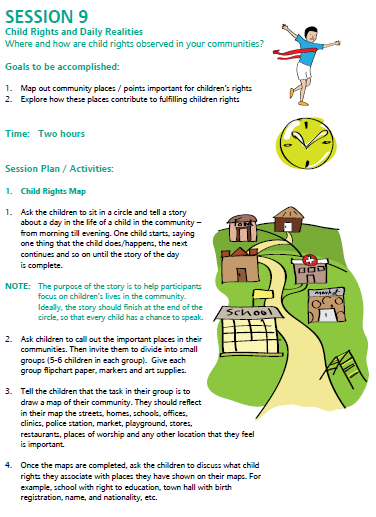
Section 9 on community mapping
The next section has very complete sessions on:
the concept of rights
the history of human rights, and international treaties on rights
children’s rights as human rights
duties and responsibilities in relation to child rights
making sure children are involved
child rights and daily realities and making a child rights map
gaps in fulfilling child rights
setting priority problems and violations of child rights
creating an action agenda and proposed solutions to the gaps identified
Each session comes complete with a pre-training assessment, reading material for facilitators and handouts for participants.
Part Three:
The last section of the manual helps facilitators take children through the steps to child-led community action, including children’s participation in all the program and project cycles: assessment, planning, implementation, monitoring and evaluation.
Needs-based vs. Rights-based
It also explains Plan’s rights-based child-centered community development approach, the foundations of that approach, and the difference between needs-based approaches and rights-based approaches. It goes on to cover planning and supporting child-led community action.
The last section of the guide offers a list of resources and references.
For anyone working with children, or even anyone looking for an excellent comprehensive community training package on rights and community-led action, I really recommend checking out Bamboo Shoots. Whether you are working through media and ICTs or using more traditional means for engaging children, this is a great guide on how to do it well from start to finish. I’ll be referring to it often.
This is a cross-post of an article written by Shawn Hayward, who interns with Journalists for Human Rights (JHR) via the International Youth Internship Program (IYIP). You can read Shawn’s original post here.
It’s easy to get jaded seeing sign after sign in the streets of Accra pointing the way to one NGO or another. Despite the slew of development organizations here, people continue to live with poor drinking water, low incomes and lack of decent health care.
One NGO (besides jhr, of course) seems to be taking a step in the right direction. Plan Ghana has been working with children in the country since 1992. The goals, according to their website, are to provide quality education and teacher training, create awareness of children’s rights and ensure food security for children.
Anyone can state goals on a website. It’s much harder to find effective ways to achieve them. Plan Ghana held a forum this week as part of a week-long workshop on the status of children in the country. They flew in 80 youth delegates from all over West Africa. It had real results.
This wasn’t an event where adults tell kids what they should think. The young delegates posed questions to the forum guests, including the United Nations Representative for Violence Against Children, Marta Santos Pais, and the Ghanaian Minister of Sports and Youth, Akua Sena Dansua.
Most importantly, the kids got a chance to tell their stories to a wide audience, and the media and representatives from various NGOs had a rare opportunity to hear well-spoken, motivated youth describe their experiences with children’s rights abuses.
One girl from Cote D’Ivoire told us in her native French how girls in her country are beaten by child traffickers when they refuse to prostitute themselves, and how a three-year-old girl was sexually abused by a neighbour. Police jailed the man for 72 hours and released him.
Outside the auditorium, Plan Ghana displayed pictures made by West African children that illustrate the abuses they’ve seen during their young lives. There were images of people being beaten, stabbed, raped and murdered.
I remember drawing snowball fights and monster trucks when I was their age, maybe the occasional army tank. No one being murdered though, or raped—I was lucky enough to grow up far away from that.
The forum was effective because the kids were active participants, not mere objects to be educated. We learned as much as they did during the forum, if not more. These kids came away with the pride of knowing they played a role in shaping their future, and Plan Ghana distinguished itself as more than just another NGO with a bunch of goals posted on its website.
I work on digital development research, strategy and evaluation with an emphasis on responsible data use, inclusion, gender, and children and young people. I support organizations to develop, implement, and engage staff and partners in responsible data policy and practice. I enjoy facilitating and moderating convenings, workshops and learning-focused events.
I’m affiliated with:
The MERL Tech Initiative: I founded The MERL Tech Initiative, which sits at the intersection of digital technology and the social sector. We support thoughtful tech-enabled program design, implementation, and monitoring, evaluation, research and learning (MERL). We convene communities to share good practice and improve programmatic outcomes. We advocate for responsible, ethical, realistic approaches that center people, communities and societies. My consulting practice is under The MERL Tech Initiative umbrella.
Technology Salon:Technology Salon is an intimate, informal, and in person, discussion among information and communication technology experts and international development professionals. Technology Salons happen in various cities. I convene the NYC Technology Salon. Technology Salon is the non-profit arm of The MERL Tech Initiative, enabling The MERL Tech Initiative to accept 501c3 funding.
This is a personal blog that does not represent official views of my current, past or future employers, affiliates or other organizations with whom I engage. Any opinions expressed herein are my own, and I take responsibility for them.














 Wait... What?