This is a guest post by Alana Kapell. Alana has recently joined the Office of the Special Representative on Violence against Children as the children’s participation expert. As part of her work to further define a child participation strategy and identify key opportunities for learning and collaboration, she is researching projects and initiatives related to the UN Study on Violence against Children (UNVAC) specifically focused on involving children in preventing violence.
Six years after the UN Secretary General’s Study on Violence against Children (2004-2006) and in preparation for the 2012 Statement to the General Assembly, the Special Representative of the Secretary-General (SRSG) on Violence against Children is currently assessing progress made since the Study recommendations were released in 2006. This is a strategic occasion to gain perspective on progress achieved and to reflect on good initiatives, factors of success and define opportunities for further advancement.
Many initiatives, projects, networks and advancements were born out of the process, including continued efforts to support children’s participation. In order to gain further insight into children’s own efforts and perspectives, partners are invited to help inform the analysis of ‘progress made’ by sharing information (reports, publications, videos, research, etc.) about children’s own efforts to end and prevent violence.
Contributions should be current (e.g. developed from 2007-2012) and focus on ‘progress made’ with children or how children themselves perceive violence in their lives and communities.
Additional areas of interest include:
Research: any research or data collection done with children.
Links to UN Study: initiatives that were started as a direct result of the UN Study process.
New forms of Violence: material or details where children have identified and/or addressed new, hidden or emerging forms of violence.
Prevention: examples of initiatives undertaken by children to raise awareness in their communities and projects aimed at preventing violence against children.
Evaluation: information that measures the impact or outcomes of children’s participation and efforts related to ending violence against children.
In addition, there are numerous partners and networks supporting and facilitating children’s participation to prevent and end violence. Community, national, regional and international efforts exist to ensure children’s views, opinions, realities, recommendations and actions are informing and shaping our collective efforts.
We would also like to update our contact lists and map the individuals, organizations, children’s groups, etc. who are supporting children’s participation to prevent and end violence. We want to reconnect with groups who were involved with the UN Study process, including the follow up and to also identify new partners who are doing innovative and important work.
We are looking to connect with both adult led organizations and child led organizations and initiatives working on issues related to violence against children and children’s participation.
Please be in touch with me [akapell at unicef dot org] if you have any information to share!
The field of Information and Communication Technology (ICTs) tends to be dominated by men. Is this because men are more suited to working in technology? Because women don’t want to? Because boys are more interested from an early age?
Probably not. What is more likely is that there are factors throughout girls’ lives that discourage them from going into this field.
At a personal level, I’ve been lucky enough to work in settings and environments that are largely positive towards women in this field. I’ve met and collaborated with numerous wonderful men who treat me with respect and who have been more than willing to work side-by-side, to help me out, to ask for advice, to share their own experience and information, and to support and promote the work I’m involved in. The fact that I work more on the social side of ICTs rather than the super technical, engineering or ‘coding’ side, however, may have something to do with my positive experiences.
Many women who work on the more ‘techie’ side report feeling discriminated against, and the numbers tell a story that’s worth looking into.
In the US, for example…
When women are shown in the media working in technology, they are often seen as rare, they are patronized or sexualized, and their appearance is noted and commented on. (And don’t even get me started on ‘booth babes’ at for-profit technology conferences.)
As Miriam writes in ‘First Female Engineer Graces the Cover of Wired Magazine‘, ‘I’m glad they’ve featured her here, and I’m glad that she’s not scantily clad like most of the women who grace the covers of national magazines. But when will we get beyond the idea of Rosie the Riveter? When can women across fields just be acknowledged the way their male counterparts are–for their accomplishments? …Posing her like Rosie feels antiquated, and also draws attention only to the fact that she’s a woman in a man’s world–not that she’s an incredible engineer in her own rite [sic].’
It’s the same, or perhaps more pronounced, the world over.
At last year’s Commission on the Status of Women, Fabiola, a 17 year old from Cameroon commented: “when a girl succeeds to sit on a computer lab, a boy will raise his voice on her, saying: ‘Why should you be holding a computer mouse when at the end of the day you will be holding a baby’s napkin?’”
In other parts of her talk, Fabiola recognized the important role that her parents played in keeping her in school and encouraging her to study for a career related to the sciences.
This highlights the importance of not only education, but of positive parental and community support and a broader set of changes that allow girls to have more freedom and more opportunities. Girls need to know that they have options open to them. And boys need to know too that girls can ‘do stuff’. Women role models are important, and where there are not yet women in certain careers to serve as role models, positive support from men to encourage girls to explore their options is key.
More girls and women in ICTs is not only an individual opportunity for women to earn an income. It can also mean that ICTs products and tools will be designed with women in mind. And I’m not talking about making things pink and purple to appeal to women, I’m talking about the design that responds to real needs in the real lives of women and girls around the world.
As part of a broader effort to encourage more girls to consider wider options, ‘Girls in ICTs Day‘, was established last year and will now be an annual event on the UN Calendar, to be celebrated every year on the fourth Thursday in April.
Many initiatives are underway already to support girls and women in the ICT sector. More governments recognize the importance and necessity of taking deliberate steps. The ITU’s latest report notes that “The choices made by policymakers, enterprises and individuals on investment in education and training must strive for gender equality—that is, to give women the same rights, responsibilities and opportunities as men.”
Positive attitudes and support from families, friends, communities, the private sector and the media is also part of the solution to helping girls see their potential.
The Girls in ICT Portal offers statistics and advice on how to encourage more girls to consider ICTs as a career option.
A version of this post originally appears on the World Bank’s Connect4Climate site.
Twenty years ago, at the Rio Earth Summit, 178 governments committed to a series of legally non-binding principles designed to commit governments to balance development and environment in a way that would bring a more sustainable future. Principle 10, the first international declaration that recognizes the rights of people to hold governments accountable for their policies regarding the environment, was one key result of the summit. It provides a means for people to engage in the decisions made by political leaders and government agencies about environmental issues that affect livelihoods and long-term wellbeing.
“Environmental issues are best handled with participation of all concerned citizens, at the relevant level. At the national level, each individual shall have appropriate access to information concerning the environment that is held by public authorities, including information on hazardous materials and activities in their communities, and the opportunity to participate in decision-making processes. States shall facilitate and encourage public awareness and participation by making information widely available. Effective access to judicial and administrative proceedings, including redress and remedy, shall be provided.” – Principle 10 of the Rio Declaration
Like Principle 10, the Zero Draft recognizes the need for broad public participation in decision-making, linked to a strengthened right to access information and to better civil society capacity to exercise that right. It notes that technology can make it easier for governments “to share information with the public and for the public to hold decision makers accountable” and that it is critical to work towards universal access to information and communications technologies. (Clauses 17 and 18). A recent analysis showed that participation, accountability, transparency, Principle 10/access to information and social inclusion/ equity are among the terms that share an ‘excellent’ level of interest among governments, UN agencies, civil society groups and other stakeholders.
Along with public participation, the Zero Draft also calls for “increased aid effectiveness, taking into account the Paris Declaration, the Accra Action Agenda and the Busan Partnership for Effective Development Cooperation in ensuring that aid is effective, accountable and responsive to the needs and priorities of developing countries.” Greater coherence at international and national levels is urged, including “effective oversight of resources to ensure that developing countries have steady and predictable access to adequate financing, including by the private sector, to promote sustainable development.’
A role for Communications and ICT tools
ICTs can play a role in supporting Principle 10 and Zero Draft, and pushing for appropriate mechanisms for response and redress.
Mass media campaigns and communication for development (C4D) approaches have long been used to disseminate information and encourage environmental awareness and behavior change. New media has improved access to information and allows multi-channel communication rather than one-way broadcasts. Greater access to mobile phones and to new media channels mean that a broader population than ever before can be engaged in and/or participate proactively in defining and acting on Rio+20 and its outcomes.
In addition to information sharing and behavior change, ICTs have the potential to play a strong role in helping civil society organize and push for greater transparency, openness and accountability around Rio+20. As Chantal Line Carpintier suggests, “Rio+20 should also agree on an effective accountability process for all actors – governments, business and industry, local authorities, NGOs and other major groups and stakeholders. Accountability and ownership by all actors would favour implementation. There is growing support, for instance, for public reporting on sustainability performance. A registry of commitments is one of the tools that have been suggested to follow up on commitments made at Rio+20 to avoid previous lack of implementation.”
An effort similar to the open government partnership and the International Aid Transparency Initiative or the integration of sustainable development goals and Rio+20 commitments into these two efforts could be something to consider, along with a mandate for corporations to also open their activities to public scrutiny.
On-line organizing combined with both online and offline actions (in places that have ready access to social media) can help the world prepare for Rio and to push for its outcomes to be implemented.
Access, capacity and the communication cycle
Despite the great potential for ICTs in communication, change and accountability efforts, however; lack of access to ICTs and potentially low capacity to interpret data that might be presented on-line in such a registry is of concern in less accessible rural communities and among some marginalized groups.
Education levels, literacy, and other excluding factors such as poverty and gender discrimination can severely limit ICT and social media access for a large number of people. In addition, information produced in dominant cultures or languages can exclude or override those with less power. As Angelica Ospina notes in her post Knowledge Brokers, ICTs, and Climate Change: Hybrid Approaches to Reach the Vulnerable, “There are many misconceptions about what ‘reaching out’ implies, as in practice it requires much more than making climate change information and knowledge publicly available through Internet-based tools such as Web portals and online databases.”
Therefore, there needs to be, “a more holistic understanding of the information cycle, including the creation, acquisition, assimilation, management, dissemination and ultimately the USE of climate change information, particularly within vulnerable contexts. Beyond the provision of climate change information, it’s necessary to consider if/how the information is being integrated -or not- into decision-making processes at the local, regional or national levels,” she says.
The Children in a Changing Climate project uses a variety of participatory development and media tools for children and adolescents to explore and document climate change in their communities, and to share their findings and suggestions to adults and other decision makers.
From information and knowledge to practice
There is also a need “to identify, adapt and adopt innovative approaches for the effective delivery and the local appropriation of climate change messages, and most importantly, for the translation of information and knowledge -both new and traditional- into climate change practice.” This will require strong efforts as well as resources to create an inclusive environment that fosters greater participation, as mandated by Principle 10, and local ownership of sustainable practices.
“Working with knowledge brokers, also called “human infomediaries” who can help bring people together, identify local needs and transfer information and knowledge more effectively is one such approach to improve information and communication flows,” Ospina advises. “Human infomediaries support an active process that involves exchanges between people, facilitating the development of climate change strategies, adoption of adaptation and mitigation practices, and processes of local change and innovation.”
Building on Ospina’s observations on how to bring information to the “last mile,” meaningful ways to bring community knowledge and information into higher level discussions need to be found. Local communities have vast knowledge on resilience, climate patterns, local environments and local situations and histories that can be documented and shared using ICTs both to benefit themselves and to share at broader levels, improving South-South cooperation and innovation. Multi-media curricula such as the Children in a Changing Climate website bring together young people’s voices and opinions around climate change and environment.
Post Rio+20, digital tools are one of many information and communication mechanisms that local communities and their citizens can use to confirm, validate, contest and dispute information related to compliance with commitments being put forward by those responsible for upholding them. Participatory media approaches can be effective in bringing community members as well as duty bearers at local, district, national and global levels into discussions about climate change and sustainable development.
Why are you killing me? Girls in Kenya use poetry to engage adults in discussion on climate change.
Summing up
In summary, ICTs can play a strong role in education, participation and accountability processes if their integration is well thought through, appropriate to the context, and taking into consideration good participatory practices. Hybrid approaches that use a variety of online and offline tools can be effective for reaching populations and decisions-makers at different levels of responsibility, for ensuring that ICTs are not widening existing information and participation gaps and for upholding the goals set forth in Principle 10. Children and youth can and should play an instrumental role in bringing about awareness and accountability, especially since they will be the ones who reap the long-term results of the agreements sown at Rio+20.
The Technology Salon (TSNYC) on the International Aid Transparency Initiative (IATI), held April 13th, offered an overview of IATI as a coming-together point for aid transparency. It also stimulated discussion on opportunities and challenges for organizations and institutions when publishing information within the IATI standard and shared some available tools to support publishing NGO data.
.
IATI Background
.
Simon Parrish from Aid Info explained that IATI aims to provide information that meets the needs of a number of diverse groups, is timely, is ‘compilable’ and comparable, improves efficiency and reduces duplication. Simon explained that IATI arose from the 2005 Paris Declaration on Aid Effectiveness and was launched as part of the Accra Agenda for Action in 2008 due to a strong call from civil society to donors, multilaterals and northern NGOs for greater transparency.
.
Organizations felt they were already working hard to be transparent; however governments, journalists, tax payers and others looking for information were not able to find what they needed. Rather than each organization creating its own improved transparency and accountability system, the idea was to use an open data approach, and this is where IATI came in. Since Accra, transparency and accountability have gained global traction and IATI has been a key part of this movement for the aid sector.
.
Donor agencies, the World Bank, the EU, the US Government and others have already signed on to IATI and have started to publish basic information. INGOs are also starting to come on board and schedule their dates for publication to the IATI standard. It is hoped that over time the quality and amount of information published will improve and expand. For example, ‘traceability’ needs to be improved so that aid can be followed down the supply chain. Information from international and local NGOs is critical in this because the closer to the ground the information is, the better it can be used for accountability purposes.
.
Opportunities and Questions around IATI
.
To complement Simon’s overview, I shared ideas on some of the opportunities that IATI can offer, and some common questions that may arise within INGOs who are considering publishing their information to IATI.
.
For example, IATI can help catalyze:
transparency and accountability as core values
better coordination and program planning (internally and externally)
reduced reporting burden (if donors agree to use IATI as a common tool)
improved aid effectiveness
collective learning in the aid sector
improved legitimacy for aid agencies
an opportunity to educate the donor public on how aid/development really works
‘moral ground’ for IATI compliant aid organizations to pressure governments and private sector to be more transparent
space for communities and ‘beneficiaries’ to hold aid agencies more accountable for their work
space for engaging communities and the public in identifying what information about aid is useful to them
concrete ways for communities to contest, validate and discuss aid information, intentions, budgets, actions, results.
Concerns and questions that may arise within NGOs / CSOs around IATI include:
Is IATI the right way to achieve the goal of transparency and accountability?
Is the cost in time, money, systems, and potential risk of exposure worth the individual and collective gain?
Is IATI the flavor of the month, to be replaced in 2-4 years?
What is the burden for staff? Will it increase overhead? Will it take funds and efforts away from programs on the ground?
What is the position of the US Government/USAID? Will implementing agencies have to report in yet another format (financial, narrative)?
Much internal project documentation at NGOs/INGOs has not been written with the idea of it being published. There may be confidential information or poorly written internal documents. How will aid agencies manage this?
What if other agencies ‘steal’ ideas, approaches or donors?
What security/risks might be caused for sexual or political minority groups or vulnerable groups if activities are openly published?
Isn’t IATI too focused on ‘upward’ accountability to donors and tax payers? How will it improve accountability to local program participants and ’beneficiaries’? How can we improve and mandate feedback loops for participants in the same way we are doing for donors?
Does IATI offer ‘supplied data’ rather than offer a response to data demands from different sectors?
ICT Tools to support NGOs with IATI
.
Ruth Del Campo discussed some of the different tools that are available to support INGOs and smaller organizations with IATI reporting, including Open Aid Register (OAR) which she created to support smaller organizations to comply with IATI. The Foundation Center has created a tool to support Foundations to enter their information into the IATI Standard also. Aid Stream is being used by many UK organizations to convert their data to the IATI Standard. Geo-visualization tools include CartoDB, AidView.
.
IATI awareness in the US
.
Although tools exist and awareness around IATI is growing elsewhere, Ruth noted that in the US many organizations do not know what IATI is, and this is a problem. Another issue Ruth brought up is that most existing charity raters do not rate program effectiveness or program transparency. Instead, charities are judged based on overhead rates, growth, financial statements, and whether they are publishing certain information on their websites. These measures do not tell what an organization’s program impact or overall transparency are, and they do not trace funds far enough along the chain. Linking charity rating systems with IATI standards could encourage greater transparency and accountability and help the public make decisions based on program accountability in addition to financial accountability. (For background on INGO overhead, see Saundra Schimmelpfennig’s “Lies, White Lies, and Accounting Practices”).
.
Because many INGOs are not familiar with IATI, a greater dissemination effort is needed for IATI to be of optimal use. If only 20% of the aid picture is available, it will not be very helpful for coordination and decision making. Many INGOs feel that they are already transparent because they are publishing their annual reports as a .pdf file on their websites and they have an overhead rate within a certain percentage, but this is not enough. Much more needs to be done to gain awareness and buy-in from US INGOs, government, charity rating systems, donors, media and the public on transparency and IATI.
.
Discussion…
.
Following the 3 discussants, TSNYC participants jumped in for a good debate around key points:
.
Carrot or stick approach?
.
NGOs place great importance on their Charity Navigator rankings and Better Business Bureau reviews, and many donors select charities based on these rankings, so it will be important to link these with IATI. The Publish What You Fund index, which tracks the transparency of different organizations, has been helpful in getting countries and institutions on board. The Foundation Center lists transparency indicators on their site GlassPockets as well. The Brookings and CGD QuODA report was mentioned as a key reason that the US Government signed onto IATI at Busan last November, since the US was ranked very low on transparency and saw that they could bring their ranking up by signing on.
.
Consensus at the Technology Salon was that it is not likely that the US Government or USAID will make IATI compliance mandatory for their grantees and implementing partners as DFID has done. Rather, the existing dashboard for collecting information would be used to report into IATI, so the dashboard needs to be improved and regularly updated by US agencies. One concern was whether in this scenario, the information published by USAID would be useful for developing country governments or would only be of use to USAID Missions. On the bright side, it was felt that movement within the US Government over the past few years towards greater openness and transparency has been massive. TSNYC participants noted that there seems to be a fundamental mindset change in the current administration around transparency, but it’s still difficult to make change happen quickly.
.
Some members of the US Congress have latched onto the idea and are pushing for greater transparency and this could impact whether the IATI profile increases. Transparency and accountability are of interest to both major US parties. Liberals tend to be interested in the idea of being more open and sharing information; and conservatives tend to focus on value for money and stamping out corruption and lowering inefficient aid spending and waste. IATI can support with both and be a win for everyone.
.
Making IATI mandatory could, some cautioned, backfire. For example there are foundations and corporations that for a variety of reasons do not openly share information about their giving. If pressured, the tendency may be to shut down totally.
.
Showing what positive things can be done with IATI and how it can benefit CSO information management and coordination internally as well as externally was thought to be a better approach than positioning IATI as “we are being audited by everyone now.” IATI should be emphasized as an opportunity to join data together to know what everyone is doing, visualize the data using new technologies, and use it to make better program decisions and improve coordination as well as accountability. Some examples of vibrant and informative uses of IATI data include Mapping for Results, Interaction’s Haiti Aid Map and the Foundation Center’s comparison of Foundation giving and World Bank funding.
.
Transparency as a ‘norm’
.
Many organizations are investing in transparency for reasons that go far beyond IATI compliance. Three kinds or organizations were identified at the Salon session: those who comply because it is mandatory; those who comply because it’s inevitable; and those who comply because they believe in the inherent value of transparency as a core principle. Even within organizations, some teams such as Democracy and Governance, may be much more interested in IATI than, say, Education, Health, or Arts teams, simply because of the themes they work on and their competing priorities. It is hoped that in 5 years’ time, it is no longer a question of mandatory or inevitable compliance, but rather transparency becomes the norm and it starts to feel strange to work in a space that is not transparent. Leadership is important to get an organization on board.
.
Challenges and opportunities in IATI compliance
.
Challenges to IATI compliance were discussed in depth at the Salon, including questions around the amount of resources needed to report to IATI. It was noted that the biggest challenges are organization, coordination, and change of attitudes internally. Some of the core obstacles that Salon participants noted include:
.
Time and resources
Some pushback might be seen around IATI because investment in IATI compliance may not be seen as providing an immediate return to individual organizations. TSNYC participants felt that rather than a constraint, IATI provided an opportunity for organizations to better manage their own information for internal sharing and use. IATI can help improve program planning, reduce time spent gathering program information from colleagues and across countries, and support better internal coordination among offices and partners. It was noted that when governments started publishing open data, the people who most used it were government employees for their own work. IATI can be seen as an investment in better internal coordination and information management. Once the information is available in an open format it can be used for a number of data visualizations that can show an organization’s reach and impact, or help a number of organizations share their joint work and impact, such as in the case of coalitions and thematic or sectoral networks.
.
Project document quality
Concerns may be raised in some organizations regarding the state of project documents that were not originally written with publication in mind. Organizations will have to decide if they want to work retroactively, invest in quality control, and/or change processes over time so that documentation is ready for publication.
.
Losing the competitive edge
TSNYC participants worried that without USAID mandatory compliance, some INGOs, and contractors especially, would not be motivated to publish information for fear of losing their competitive edge. It is feared that getting contractors to report to any level of detail will be difficult. This, the group discussed, makes peer pressure and public pressure important, and mechanisms to encourage broader transparency will need to be found. One idea was to create a ‘5 star system’ of IATI compliance so that organizations with full compliance get a higher star rating (something that Aid Info is already working on). Another angle is the hope that IATI reporting could replace some other mandatory reporting mechanisms, and this may be another entry point.
.
Accountability to whom?
It was recognized that IATI was initiated as a top-down approach to accountability. The question remains how to make IATI information more useful for ‘beneficiaries’ and program participants to track aid flows, and to contest and validate the information. What complaints mechanisms exist for communities where aid has not been effectively implemented? One point was that IATI is designed to do exactly that and that when it is more populated with information, then this more exciting part that involves playing with the data and seeing what communities have to say about it will start to happen.
.
Simon noted that there is a huge emerging civic hacker and ICT for social change movement. Access to aid information can be hugely liberating for people. At some aid transparency workshops the focus has been on what national NGOs and governments are doing. Young people are often angry that they don’t know about this. They often find the idea that the information is available to them very exciting. Much of the conversation at these meetings has been about ways to reach communities and about who can be involved as intermediaries.
.
IATI is still top down and the information that people need is bottom up. However the conversation is starting to happen. Infomediaries need to be multiple and varied so that there is not only one source of IATI data interpretation, but rather a variety of interpretations of the data. Social accountability processes like community score cards and social audits can be brought into the equation to extend the value of IATI information and bring in community opinion on aid projects and their effectiveness. Platforms like Huduma are examples of making open data more accessible and useful to communities.
.
* * * * *
.
A huge thanks to our discussants Ruth Del Campo and Simon Parrish and to all those who participated in this 3rd Technology Salon NYC!
.
Contact me if you’d like to get on the list for future TSNYC invitations.
.
The Technology Salon™ is an intimate, informal, and in person, discussion between information and communication technology experts and international development professionals, with a focus on both:
technology’s impact on donor-sponsored technical assistance delivery, and
private enterprise driven economic development, facilitated by technology.
Our meetings are lively conversations, not boring presentations – PowerPoint is banned and attendance is capped at 15 people – and frank participation with ideas, opinions, and predictions is actively encouraged through our key attributes. The Technology Salon is sponsored by Inveneo and a consortium of sponsors as a way to increase the discussion and dissemination of information and communication technology’s role in expanding solutions to long-standing international development challenges.
‘I believe that many ICSOs [international civil society organizations] urgently need to overcome the stalemate in their global governance; they don’t need another governance reform, they need a governance revolution.’ Burkhard Gnarig, Berlin Civil Society Center.
The Berlin Civil Society Center believes that CSO governance models are increasingly facing major challenges. These include that they are typically:
dominated by national affiliates but increasingly challenged by the need for global decisions and their implementation;
shaped by Northern countries and cultures while the emerging powers in a multipolar world are located in the South;
serving one specific mission focused on development or environment or human rights while the interdependence of challenges and the need for integrated solutions become more and more obvious;
caught up in the conflict between democratic and participatory decision making on one side and the need for quick and consistent decisions on the other;
characterised by a clear definition of “inside” and “outside” the organisation while the Internet and the habits of the next generation demand platforms for joint action rather than well defined boxes.
In order to address these issues, the Berlin Center is working on a participatory project aimed at developing new governance models for best practice in CSO governance*. The models are aimed at serving ‘board Members, Chairs and CEOs who aim to undertake future governance reforms more strategically and more effectively.’
Different governance models are needed, however, because not all organizations can and will follow one single model.
Firstly, ICSOs working in human rights, poverty alleviation, environmental protection, humanitarian response or children’s rights have different governance needs resulting from the type of work they do. For example, an organisation focussing on wildlife conservation compared to one working for poverty eradication will have different needs and possibilities of including partners and beneficiaries in their governance.
Secondly, there are different possible models to synchronise and balance local, national and global requirements and resources. At present these are reflected in global set ups ranging from loose networks over confederations and federations to unitary organisations.
Thirdly, when trying to secure future relevance of a governance system, much depends on different expectations of how future developments will turn out and which elements of these developments are considered most relevant in governance terms.
In an open letter, the Berlin Center director, Burkhard Gnarig explains that ‘with our Global Governance Project the Berlin Civil Society Center tries to lay the groundwork on which ICSOs can develop their own Global Governance Vision. A small Working Group which the Center has brought together will develop a handful of standard governance models that may serve as guidance on ICSOs’ specific paths to developing their own vision for their future governance.’
In order to bring a wider group of aid and development practitioners into the discussion, I volunteered to open a “CSO Governance Revolution” discussion on AidSource asking:
What are some of the major challenges you’ve seen with ICSO/INGO governance?
How do current governance models that you know of constrain the effectiveness of ICSOs or impact on development outcomes?
What CSO governance models have you seen that do work? What do they look like?
What are some of the underlying values and principles needed for effective ICSO governance?
What are some core elements of effective and successful ICSO governance models?
How do new information and communication technologies (ICTs) and trends in new media/social media impact on governance models and visions and people’s expectations of governance models?
What literature, research or existing documentation should be included as background resources for this discussion?
What other questions should be raised regarding ICSO governance?
(*Note: I have no formal affiliation with the Berlin Center or this initiative, I just find it interesting and volunteered to try to get some additional discussion happening around it.)
I was chatting with my pal Ernst Suur from War Child Holland and he alerted me to this instructional video they’ve made about using participatory video for monitoring and evaluation in Northern Uganda.
“A PhD student working on video diaries with children commented: ‘What fascinates me is that there is a whole lot of data that they can give me, that they can share, but I cannot always see what it is, or know how to ask for it, or know it exists, and that is what the video diary does.'”
“Video diaries can enhance our transparency, as youth can communicate directly with a wide variety of people; providing field workers, project officers, headquarter staff and even donors with tangible insights into progress made at the individual level.”
Take a look. It’s worth it.
Hint: Flip video cameras are fantastic for filming, but the Flip video format is incompatible with a lot of (most?) video editing software. According to Ernst, if you’re using Flip video cameras and need to edit, Windows Movie Maker Live is the way to go.
This morning I participated in a massive conference call about photography in aid and development, and the ethics and values that surround photos taken and used by NGOs. The call was organized by CORE Group (@coregroupdc). Now maybe I’m exaggerating here, but the call organizer, Ann Hendrix-Jenkins, read off a list of participants that went on forever. I’m estimating that there were something like 40 or 50 people listening in from as many organizations. This topic has always been important for a strong segment of NGO staff and it seems to be gaining steam again.
After I started tweeting about it, a couple of people asked if I’d be writing a blog post. So here it is. I’ve ‘Storified’ it since I was tweeting instead of taking notes, and because there was a nice side conversation happening with folks on Twitter too. (See the Storify here – it looks a little bit nicer there than it does here.)
Share
“
“Humanitarian photography is a hot button issue.Touches on dignity, how we do our jobs, & our ideas about ourselves, others & our work.”
The call organizers had earlier conducted a survey about NGO images, policies, consent, and operational processes around photographers and photography and shared it with participants ahead of the call. The organizers also suggested a couple of links to check out beforehand, including an Aid Watch post (“Adorable child in NGO fund-raising photo sues for royalties“) and a link to a photo that appeared in the New York Times. These two links and other similar “poverty porn images” had sparked the discussions that led to the decision to organize today’s call. [update: here is the original discussion thread on Linked In]
Share
“
Jeez – like 50 orgs on this CORE call re: photography, ethics and values. Discussing: @aidwatch post ht.ly/a3gYA & more
After this introduction, Jim Stipe from Catholic Relief Services gave a quick summary of the survey highlights, and we had a group discussion around some of the key issues detected in the survey and additional ones sourced from the participants on the call.
“
Heartening to know most INGOs have photo policies saying images must show dignity, & image usage is restricted/protected to some staff.
To finalize the call, we heard a summary from Jim of some of the areas that the group could consider forming smaller groups to dig into and work on further, including:
Issues around consent, alternative ways to obtain consent, release forms, and how to get truly informed consent.
Ethics of both taking photos and ethics of using photos – these are related yet separate issues.
What makes for a good NGO photo? What’s a good vs bad photo? What works and what doesn’t?
How do you grow your options for getting more high quality photos? How to train your staff on good photography? How to find and work with good freelance photographers? How to plan out a shoot and put the right amount of time into it? How to ensure photos are taken ethically?
Creating a photo policy, what does a good photo policy look like? what should it contain?
How to tell better stories? You can document your programs with photos and you can tell visual stories – these are 2 different things….
Getting good photo captions. If you don’t have good captions, photos are less useful.
Other places to source photos; eg., if you don’t have the photos you need, where can you go to get them?
Photo journalism vs NGO photography – similar yet different, different approaches and goals. Let’s discuss this.
Vocabulary for talking about photos in order to articulate to staff why one photo better than another. Turning gut sense into language and tools.
Looking at studies on the use of photos and their impact on donors, what can we learn from that? How to reconcile the different set of ethics that we may find in terms of ‘what works’ for fundraising and what is ethical?
What about participatory media and people portraying themselves and their own images
An Ombudsperson within INGOs who can defend the rights of those being photographed
The question of how people perceive you when you go from doing program work to becoming a photographer in the same afternoon.
The related question about what happens when your organization makes you do both things? Who owns the photos? Do you get paid if your organization uses them? What if you are using your own equipment? How is your organization using you if that’s not your job in the first place? What are you expected to do and how much of this should you actually be doing?
Budgeting. We need to begin inserting budget into the conversation. How much can we pay photographers, or do we invest in training our own staff?
Share
“
Well pointed out by @miskellaneous: our “golden rule” re. depiction of “the Other” sometimes “misses cultural understandings of modesty”.
I’m looking forward to continuing the discussions as this is an issue that constantly jumps out at me. It’s fantastic to know that there is such a strong contingent of NGO staff who are keen to address the issues around how we take and how we use photographs of the people that we work with.
Share
“
That’s it for tweets from @coregroupdc conversation on #povertyporn, photos, ethics and values. More later – discussions will continue.
At the global level, a very small percentage of development funding goes to urban spaces, yet hard-hitting issues impact many of the urban poor: lack of tenure, lack of legality of land, informal settlements, lack of birth registration and civil registration in general, waste disposal, clean water, politicizing of local authorities and more. Can new technologies be a solution for some of these issues?
Tuesday’s Technology Salon NYC offered a space to discuss some of the key challenges and good practice related to working with children, youth, and urban communities and explored the potential role of ICTs in addressing issues related to urban poverty.
According to UNICEF, who co-organized and hosted the Salon at their offices, half of the world’s people – including over one billion children – live in cities and towns. By 2030, it is projected that the majority of the world’s children will grow up in urban areas, yet infrastructure and services are not keeping pace with this urban population growth. (See UNICEF’s 2012 State of the World’s Children or Plan’s 2010 Because I am a Girl Report: Digital and Urban Frontiers).
We welcomed 3 experienced and engaging discussants to the Salon, who commented on the intersection of children, youth, urban environments and new technologies:
Doris Gonzalez, Senior Program Manager Corporate Citizenship & Corporate Affairs at IBM Corporation who manages IBM’s grade 9-14 education model Pathways in Technology Early College High School (P-TECH), a program that maps work-based skills to the curriculum and provides mentors to students and teachers
Ron Shiffman, a city planner with close to 50 years of experience providing architectural, planning, community economic development, and sustainable and organizational development assistance to community-based groups in low- and moderate-income neighborhoods; and the co-founder of the Pratt Institute Center for Community and Environmental Development [PICCED]
Sheridan Bartlett, a researcher affiliated with the Children’s Environments Research Group at CUNY and the International Institute for Environment and Development in London, co-editor of the journal Environment and Urbanization, supporter of Slum Dwellers International, and researcher on the link between violence and living conditions as they affect young children.
Doris shared IBM’s experiences with technology education programs with children and youth in New York City, including the highly successful P-TECH program which prepares youth for jobs that require 21st century skills. Some of the key aims in the PTECH program are making technology accessible, engaging, relevant to children and youth, and connecting what kids are learning to the real world. Through the program, IBM and partners hope to turn out skilled employees who are on entry-level career tracks. They look at what jobs are hiring with AAS degrees, what skills are attached and how to map those skills back into curriculum. Helping children and youth acquire collaboration, communication, and problem solving skills is key to the approach, as are broad partnerships with various stakeholders including government, private sector, communities and youth themselves. The program has been lauded by President Obama and is in the process of being replicated in Chicago.
Ron highlighted that working on urban poverty is not new. His involvement began in 1963 when John F. Kennedy was elected and there was a thrust to address urban poverty. Many, including Ron, began to think about their role in abolishing (not just alleviating or reducing) poverty. ‘We thought as architects, as planners about how we could address the issues of urban poverty.’ Broader urban poverty initiatives grew from work done forming the first youth in action community based organizations (CBOs) in Bedford Sty, Harlem and the Lower East Side. Originally these programs were empowerment programs, not service delivery programs; however because they confronted power, they faced many challenges and eventually morphed into service delivery programs. Since then, this youth in action community based model has served other community based initiatives all over the world. Ron emphasized the importance of differentiating among the roles of CBOs, technical assistance providers, and intermediaries and the need to learn to better to support CBOs who are on the ground rather than supplanting their roles with NGOs and other intermediaries.
Sherry picked up where Ron left off, noting that she’d collaborated with a network of federations of the urban poor in 33 countries, looking at ways they’ve used technologies and how technology presents new challenges for communities.
A large percentage of the urban poor live illegally in non-formal settlements where they can’t vote and don’t have legal representation, she said. They want partnership with the local government and to make themselves visible. The first thing they do is to count themselves, document the land they live on, map every lane and garbage dump, every school (if schools exist), their incomes, livelihoods, and expenditures. This body of information can help them engage with local authorities. It’s an organizing tool that gives them a collective identity that can lead to a collective voice.
This process seems to be a natural fit for technology, in that it can allow for management and storing of information, she said. However, technology use can be incredibly complicated. Traditionally the process has been managed manually. The information comes in on paper, it is fed immediately back to community members, contested and corrected right there. The process is very participatory and very accurate, and includes everybody. Things that have been mapped or measured are validated. Boundaries are argued and joint agreement about the community reality and the priorities is reached right there.
Sherry noted that when technology is used to do this, participation becomes more restricted to a smaller, more technically savvy group rather than the entire community. It takes longer to get the information back to the community. Many urban poor are technology literate, but there are complexities. Sometimes youth want to go with technology and older leaders are more comfortable with the more manual, inclusive processes.
The complexity of urban environments was addressed by all three discussants. According to Sherry, many people still hold a development image of the ‘perfect village,’ contained, people sitting around a tree. But urban communities are very complex: Who owns what? There are landlords. Who represents whom? How do you create the space and the links with local authorities? Ron agreed, saying that cities and settlements tend to be far more pluralistic. Understanding the nature and differences among them, how to weave together and work together is critical. Doris noted that one organization cannot work on this alone, but that multiple partners need to be involved.
Participants at the Technology Salon. (Photo: UNICEF)
Key points brought up during the ensuing discussion included:
Process, product and participation:
It’s important to work directly with community based organizations rather than surrogates (in the form of external NGOs). It’s critical to work on building the capacity of people and organizations on the ground, recognizing them as the core actors.
The process by which people engage is just as important as the end product. If new technologies are involved, participation needs special attention to ensure no one is being marginalized and the data is interpreted by local people, and they play a role in gathering it and learning, sharing and discussing during the process.
Digital data collection and fly-over mapping should not replace participatory processes of data collection and local interpretation. Bringing in more efficient processes via new technologies is possible, but it often means losing some of the richness and interpretation of the data. If you’re not including everyone in this process, you risk marginalizing people from the process.
Every community, village or barrio has a different personality. No one size approach or model or technology fits all.
It’s important to let people create solutions to their own challenges; set the right policies so that what is produced can be scaled (open/open source); and make sure things are hyper-local – yet help move the ideas and build networks of south-south collaboration so that people can connect.
The technologies only make sense when they are done within a participatory framework or context. People get excited about technology and the idea of really iterating and trying things out very quickly. But this only makes sense if you have a bigger plan. If you go in and start playing around, without context and a long-term plan, you lose the community’s trust. You can’t drop in tech without context, but you also can’t come and create such a huge infrastructure that it’s impossible to implement. You need balance.
Children and youth:
We shouldn’t forget protection and privacy issues, especially with children and with mapping. These need to be carefully built in and we need to be sure that information and maps are not misused by authorities.
We can’t forget the young people and adolescents that we are working with – what do we want them to gain out of this? Critical thinking, problem solving skills? This is what will serve them. Educational systems need to address the pedagogy – if children are even in schools – where do you get that critical thinking? How do you create space for innovation? What is the role of tech in helping support this innovation? What is the role of mapping? Just accounting? Just quantifying? Or are you helping youth know their communities better? Helping them understand safety? What are we mapping for? Community self-knowledge or outside advocacy?
Technology:
We need to always ask: Who owns and manages technology? Technology is never neutral. It can both empower and disempower people and communities, and certain groups of people within communities.
The technology is a tool. It’s not the technology that teaches, for example, it is teachers who teach. They use the tech to supplement what’s going on in the classroom.
Rather than bring in ‘really cool’ things from the outside, we should know what tech already exists, what children, youth and communities are already using and build on that.
The challenge always comes down to the cost. Even if an idea works in the US, will it work in other places? Can other places afford the technology that we are talking about? There are some very good projects, but they are impossible to replicate. We need to find feasible and sustainable ways that technology can help reduce costs while it improves the situation for the urban poor.
Engaging local and national governments and the private sector
Bottom up is important, but it is not enough. The role of local authorities is critical in these processes but national authorities tend to cut local budgets meaning local authorities cannot respond to local needs. It’s important to work at every level – national policies should enable local authorities and mandate local authorities to work with local communities.
Local authorities often need to be pushed to accept some of these new ideas and pulled forward. Often communities can be more technologically savvy than local authorities, which can turn the power dynamic upside down and be seen as threatening, or in some cases as an opportunity for engagement.
Communities may need to learn to engage with local governments. Adversarial or advocacy techniques may be useful sometimes but they are not always the right way to go about engaging with the authorities.
It’s useful for CBOs to work with both horizontal and vertical networks, and NGOs can play a role in helping this to happen, as long as the NGOs are not replacing or supplanting the CBOs.
There needs to be support from the local city government, and an interest, a need, an expressed dedication to wanting to be involved or these kinds of initiatives will fail or fizzle out.
There is a tendency to seek quick solutions, quick fixes, when we all know that creating change takes a long time and requires a long-term perspective and investment. The city of Medellin for example has done a good job of investing in connecting settlements to the city through infrastructure and access to technology. Long-term vision with participation from private, public and community engagement is critical.
The quality of investment in poor areas needs to be as high as that in wealthier areas. Many interventions are low quality or limited when they are done in poor areas.
Multiple partners and collaboration among them is necessary for these initiatives to move forward and to be successful. You need to bring everyone to the table and to have an existing funding structure and commitment from local and national governments and ministries, as well as local communities and CBOs, NGOs and the private sector.
A role for the UN and INGOs can be to help ensure that the right channels are being opened for these projects, that the right partnerships are established, that systems and technologies are kept open and not locked into particular proprietary solutions.
Learning/sharing challenges, approaches and good practice:
There is much to learn from how marginalized youth in communities have been engaged without technologies. Once they have the information, no matter how it was gathered — in the sand, by SMS, on the wall — then how can marginalized young people access and address local authorities with it? How can we help enable them to feel more empowered? What can we learn from past efforts that we can apply?
There is a lack of exposure of those working in ICT to the urban space and vice versa. This reflects a need to break down the issues and opportunities and to think more deeply about the potential of technology as a part of the solution to urban poverty issues.
We need to make a distinction between wonderful projects that some are doing, but that are very costly and have a high cost per participant; and programs that can be done in developing countries. Consider that 75 million youth are now unemployed. The more we learn about what others are doing, the more information we have on how to do it, the better.
ICTs are a relatively new element in the urban space. It would be helpful to have a a follow-up report that focuses on how ICTs have been used to address specific issues with children, youth and communities in urban spaces and what specific challenges are posed when using ICTs in this space. What projects have been done or could be done? What are the challenges in implementing projects with refugee populations, undocumented populations, migrants, and other groups? We need to understand this better. We need a document or guide that explores these issues and suggests practical ways to move forward.
Social media and new technologies can be used to spread information on successful case studies, to share our learning and challenges and good practice so that we can apply the best approaches.
A huge thanks to ICT Works, UNICEF, our discussants and participants for making this 2nd Technology Salon NYC a success!
Save the date for our 3rd TSNYC, on April 13, 2-4pm at New York Law School. The topic will be the International Aid Transparency Initiative (IATI); how it can contribute to better aid coordination and effectiveness; challenges and opportunities for CSOs in signing onto IATI; and ways that technology and open data are supporting the process.
Ann Blackman’s Off to Save the World is a chronicle of the life of Julia Taft. The book showcases how rare it was for women to be involved in high level politics in the 70s and 80s, and how Taft skillfully maneuvered herself in circles that were not open to many women in US Government or international affairs at the time. Taft was clearly a charming, witty, strong and determined woman who endeared herself to most everyone she met.
As the book preface notes “Julia Vadala Taft became one of the country’s top humanitarian relief experts, a friend and ally of the world’s most impoverished people. Starting in 1975, when she directed the Indochina refugee task force, Julia essentially invented the way the United States government responds to natural and man-made disasters around the world, demanding basic rights for those whose lives are turned upside down by civil war, famine, religious persecution, earthquakes, floods and insect infestations.”
I was struck while reading, however, that most of the relief efforts that Taft was involved in sounded an awful lot like operational failures, though they were hailed as diplomacy successes. This gave me much to consider both in terms of political motivations for relief and development efforts, and for observing how far relief work has come since then in terms of understanding the need to be prepared, to take direction from local governments and local populations, to set up proper logistical arrangements, and to maintain neutrality during humanitarian crises. Today, guidelines like the Sphere Handbook and the Red Cross Red Crescent Code of Conduct help orient aid workers and give them support and guidance during humanitarian relief operations.
My favorite anecdote in the book was that following the December 7, 1988 Armenian earthquake “Bush [Senior] told Julia that his son and grandson would like to go to Armenia to hand out Christmas presents. [Taft] stifled a laugh: “I thought to myself ‘for God’s sake, this is not a good idea.’ But all I said was, ‘When would you go?'” “The 24th of December,” Bush replied. Taft informed them that Armenians celebrated Christmas on January 6th, and “between now and then, they have a few other things to do besides worry about your security and accepting gifts.” Unfortunately, even though Taft spoke with Colin Powell about the ridiculous idea, they were unable to get them off of the idea of handing out Christmas presents, and “Bush’s son, Jeb, and grandson, George P. Bush, left for Armenia….”
The book reads a bit like a history text book, which was its downfall for me. I would have much preferred a more personal style that engaged me more emotionally. In any case, it is great to see a strong female character like Taft highlighted, and she was clearly much loved by her colleagues, peers and family.
Ann Blackman is the author of many biographies including Seasons of Her Life, Wild Rose, and co-author of The Spy Next Door: The Extraordinary Secret Life of Robert Philip Hanssen. She previously worked at TIME magazine and The Associated Press, and has appeared on various national TV and radio shows such as A&E Biography, The Diane Rehm Show, Hardball with Chris Matthews, CNN, Fox Morning News, CSPAN, to name a few. She currently lives in Washington, DC, and on the coast of Maine.
This was the question explored in a packed Room 3 (and via livestream and Twitter) on the last day of the ICTD2012 Conference in Atlanta, GA.
Panelists included Matthew Smith from the International Development Research Center (IDRC), Soren Gigler from the World Bank, Varun Arora from the Open Curriculum Project and Ineke Buskens from Gender Research in Africa into ICTs for Empowerment (GRACE). The panel was organized by Tony Roberts and Caitlin Bentley, both pursuing PhD’s at ICT4D at Royal Holloway, University of London. I was involved as moderator.
As background for the session, Caitlin set up a wiki where we all contributed thoughts and ideas on the general topic.
“Open development” (sometimes referred to as “Open ICT4D“) is defined as:
“an emerging area of knowledge and practice that has converged around the idea that the opening up of information (e.g. open data), processes (e.g. crowdsourcing) and intellectual property (e.g. open source) has the potential to enhance development.”
Tony started off the session explaining that we’d come together as people interested in exploring the theoretical concepts and the realities of open development and probing some of the tensions therein. The wiki does a good job of outlining the different areas and tension points, and giving some background, additional links and resources.
[If you’re too short on time or attention to read this post, see the Storify version here.]
Matthew opened the panel giving an overview of ‘open development,’ including 3 key areas: open government, open access and open means of production. He noted that ICTs can be enablers of these and that within the concept of ‘openness’ we also can find a tendency towards sharing and collaborating. Matthew’s aspiration for open development is to see more experimentation and institutional incentives towards openness. Openness is not an end unto itself, but an element leading to better development outcomes.
Soren spoke second, noting that development is broken, there is a role for innovation in fixing it, and ‘open’ can contribute to that. Open is about people, not ICTs, he emphasized. It’s about inclusion, results and development outcomes. To help ensure that what is open is also inclusive, civil society can play an ‘infomediary‘ role between open data and citizens. Collaboration is important in open development, including co-creation and partnership with a variety of stakeholders. Soren gave examples of open development efforts including Open Aid Partnership; Open Data Initiative; and Kenya Open Government Portal.
Varun followed, with a focus on open educational resources (OER), asking how ordinary people benefit from “open”. He noted that more OER does not necessarily lead to better educational outcomes. Open resources produced in, say, the US are not necessarily culturally appropriate for use in other places. Open does not mean unbiased. Open can also mean that locally produced educational resources do not flourish. Varun noted that creative commons licenses that restrict to “non-commercial” use can demotivate local entrepreneurship. He also commented that resources like those from Khan Academy assume that end users have a computer in their home and a broadband connection.
Ineke spoke next, noting that ‘open’ doesn’t happen in a vacuum. Sometimes power relations become more apparent when things become open. She gave the example of a project that offered free computer use in a community, yet men dominated the computers, computers were available during hours when women could not take advantage of them, and women were physically pushed away from using the computers. ‘This only has to happen once or twice before all the women in the community get the message,’ she noted. The intent behind ‘open’ is important, and it’s difficult to equalize the playing field in one small area when working within a broader context that is not open and equalized. She spoke of openness as performance, and emphasized the importance of thinking through the questions: openness for whom? openness for what?
[Each of the presenters holds a wealth of knowledge on this topic and I’d encourage you to explore their work in more detail!]
Following the short comments from panelists, the room split into several groups for about 15 minutes to discuss points, tensions, and questions on the concept of open development. (See the bottom of the wiki page for the full list of questions.)
We came back together in plenary to discuss points from the room and those coming in from Twitter, including:
Should any research done with public funds be publicly open and available? This was a fundamental values question for some.
Can something be open and not public? Some said that no, if it’s open it needs to be public. Others countered that there is some information that should not be public because it can put people at risk or invade privacy. Others discussed that open goods are not necessarily public goods, rather they are “club” goods that are only open to certain members of society, in this case, those of a certain economic and education level. It was noted that public access does not equal universal availability, and we need to go beyond access in this discussion.
Is openness fundamentally decentralizing or does it lead to centralization? Some commented that the World Bank, for example, by making itself “open” it can dominate the development debate and silence voices that are not within that domain. Others felt that power inequalities exist whether there is open data or not. Another point of view was that the use of a particular technique can change people without it being the express intent. For example, some academic journals may have been opening up their articles from the beginning. This is probably not because they want to be ‘nice’ but because they want to keep their powerful position, however the net effect can still be positive.
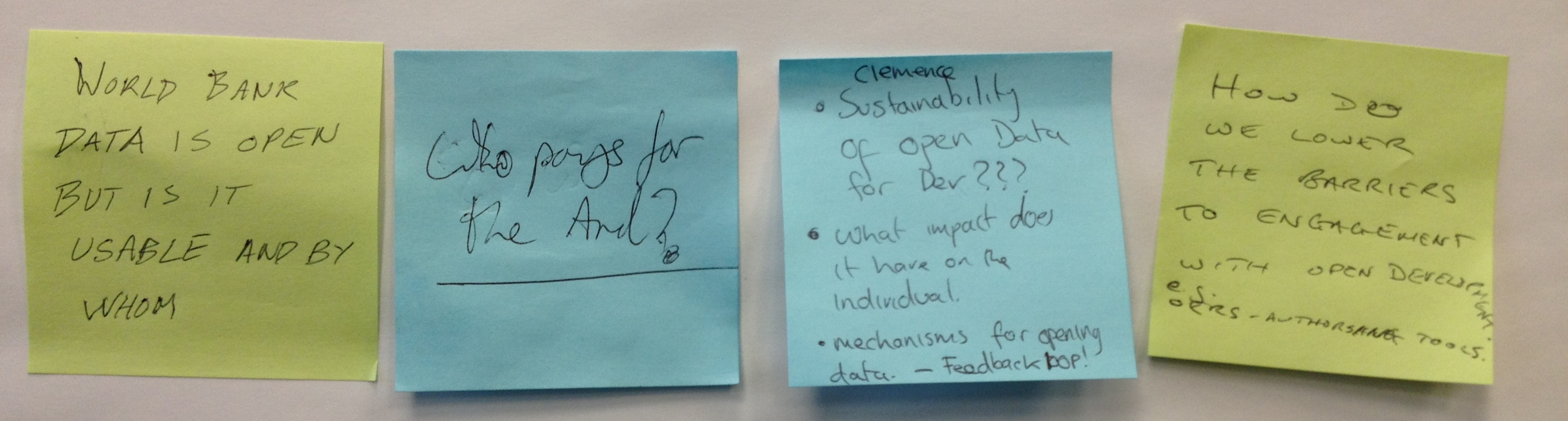
How to ensure it’s not data for data’s sake? How do we broker it? How do we translate it into knowledge? How does it lead to change? ‘A farmer in Niger doesn’t care about the country’s GDP,’ commented one participant. It’s important to hold development principles true when looking at ‘openness’. Power relations, gender inequities, local ownership, all these aspects are still something to think about and look at in the context of ‘openness’.
The general consensus was that it is important to fight the good fight, yes, but don’t lose sight of the ultimate goal. Open for whom? Open for what?
As organizers of the session, we were all quite pleased at the turnout and the animated debate and high level of interest in the topic of ‘open development’. A huge thanks to the panelists and the participants. We are hoping to continue the discussions throughout the coming months and to secure a longer session (and a larger room) for the next ICTD conference!
I work on digital development research, strategy and evaluation with an emphasis on responsible data use, inclusion, gender, and children and young people. I support organizations to develop, implement, and engage staff and partners in responsible data policy and practice. I enjoy facilitating and moderating convenings, workshops and learning-focused events.
I’m affiliated with:
The MERL Tech Initiative: I founded The MERL Tech Initiative, which sits at the intersection of digital technology and the social sector. We support thoughtful tech-enabled program design, implementation, and monitoring, evaluation, research and learning (MERL). We convene communities to share good practice and improve programmatic outcomes. We advocate for responsible, ethical, realistic approaches that center people, communities and societies. My consulting practice is under The MERL Tech Initiative umbrella.
Technology Salon:Technology Salon is an intimate, informal, and in person, discussion among information and communication technology experts and international development professionals. Technology Salons happen in various cities. I convene the NYC Technology Salon. Technology Salon is the non-profit arm of The MERL Tech Initiative, enabling The MERL Tech Initiative to accept 501c3 funding.
This is a personal blog that does not represent official views of my current, past or future employers, affiliates or other organizations with whom I engage. Any opinions expressed herein are my own, and I take responsibility for them.




 Wait... What?