Feeds:
Posts
Comments

Posts Tagged ‘development’

birds 2I spent the weekend working on a paper about “Children on the Move.” I’m not even close to done with it yet, but the topic is fascinating. Some reports say that 1/3 of migrants are between the ages of 12 and 25, including millions of children under the age of 18. The number of children and youth who migrate is difficult to pin down with certainty, given that migration is often within country, seasonal, across porous borders, and because most child migrants don’t have legal means to migrate or they lack identification, leaving them under the radar and uncounted.

Children move for all kinds of reasons, from and into all kinds of situations. The push-pull factors that cause them to migrate vary a great deal from situation to situation. Often the movement of children is lumped under trafficking and child labor, and all children who move are considered victims, and all those who support children to move are labeled criminals or traffickers and all parents who allow their children to move are lambasted for not caring about them. If you read what children and parents involved in migration say, it’s clear that this is not the case.

One person I interviewed for the paper noted off the record that sometimes those working with children who migrate are forced to put them in the category of “trafficked” or “at risk of trafficking” because there is no real category (or funding) to support children who are “seeking better opportunity” or “fleeing domestic violence” or “scared for my life because of the gangs in my community, and traveling across several countries up to the US seems like less of a risk.”

Just like adult migrants, children often move of their own will to seek opportunity in other places. Their movement in and of itself is not negative, but moving without protection mechanisms and support can indeed put them at risk. Policies and systems that don’t talk to each other also put children and youth in peril, whether it is when children themselves move, or when their parents move with them.

For the report I’m doing, I’m looking at how ICTs are being used by children and youth to make their journey safer, and ways that communities, local child protection committees, institutions, governments and NGOs are using or could use some of these new ICT tools to better support and protect children and youth who move for any reason.

Some interesting efforts are happening, including some ingenious local networks in West Africa that work across communities to help ensure children’s paths and travels are as safe as possible; and a radio and SMS project in Tanzania that is building up a pro-child protection constituency by encouraging people to tell stories about when and where they have supported or helped a child.

It’s been heartbreaking to read about Afghan youth who are forcibly returned to a country they can barely remember because they have turned 18 and are no longer supported by the UK child welfare system, yet at least a tiny bit encouraging that a UK organization is working on a mobile app that could provide these youth with at least a map and some information about their ‘homeland’ so that they know where to go for help when they step off the plane in what is now a foreign country.

Reading about migrant parents in the US losing their children to foster care because they have been detained for migration violations and are unable to show up to court to keep their children, or they lack critical information about how the system works, or they are not allowed more than one phone call makes my blood boil. Having been married to a Salvadoran, I’ve experienced my own fair share of migration difficulties and horror stories. They are not pretty, and family separation hurts, no matter what color or nationality the family is. It seems that the root of some countries’ inability to deal with migration in a dignified way is an underlying devaluation of people from other places and an inability to see them as human. Can ICTs play a role in changing attitudes at the broad scale? Or can we at least enable migrants in detention more communication with families so that they don’t lose contact with their children? A few initiatives are looking at storytelling as a way to bring more humanity into the migration debate.

As both Duncan Green (Why is migration a Cinderella issue in development) and Owen Barder (Is migration too toxic for development) have written recently, migration has not been a hot topic on the development agenda, and it’s only now starting to get some play.

Why is that? I think Owen’s comment is pretty good to spark some thought:

Migration is a Cinderella issue in development because there is nobody to speak for the people who are disadvantaged by the current rules.  Domestic civil society organisations which work on migration are mainly focused on the rights of immigrants, not on improving the impact of migration on development or creating opportunities for people in poor countries. DFID is largely in retreat from non-aid issues. The big development NGOs at best speak for their own visions of development, and at worst promote the aid industry of which they are part. As a result, people in developing countries are denied some of the most powerful and inexpensive ways in which they could improve their lives.

We need to find a way to look at all angles and aspects of migration, including that of child migration, in a holistic way that involves all these different actors. I think that one reason migration is not talked about  enough in the development debate is because it is a touchy political issue that might make a donor base freak out. It also tends to makes agencies that work with children a bit uncomfortable – If we protect children who migrate, will we be seen to be encouraging illegal migration? Will we be seen as supporting child labor? Are we liable if we give children safety tips or information, and then something happens to them? How can we do no harm? What about unintended consequences?

More recently, many child-focused agencies have started to better come to grips with the realities that children are going to migrate, and it’s altogether possible that staying in their home community is actually not in their best interest. These are thorny questions, however, that are difficult to deal with, especially in the open when the political debate around migration has been so traditionally ugly.

Perhaps framing migration as an economic issue will help bring it into the debate, but I do hope we don’t lose touch with the human side of migration.
Read Full Post »

September’s mEducation Alliance Symposium included a special track around mobile technologies for youth workforce development (mYWD) as well as a session to discuss a new mYWD Working Group,  which is now up and running online. (Join by first registering at the mEducation Alliance website, then clicking here to join the mYWD Working Group.)

If the topic of mobile technologies and youth workforce development is of interest, don’t miss the October 15th event Innovations in Mobiles for Youth Workforce Development.  Among others, we’ll have the brilliant Phil Auerswald (@auerswald) helping us frame what we mean by ‘innovation’ in the mYWD space. RSVP info here.

In the meantime, here are some highlights from the mYWD sessions at Symposium:

Session 1: Mobiles for Youth Workforce Development (mYWD): Taking Stock of mYWD started with a presentation on the GSMA’s ‘Shaping the Future report by Lauren Dawes.  Then we heard from Theo Van Rensburg Lindzter (M-UBUNTU) and Thabang Mogale (Millenials as Mobile Educators).

  • The GSMA report found that education was a key priority in the lives of the young people surveyed, preceded only by family and health. Respondents also prioritized a good career and noted that they need to improve their skills to find better work. Only 25% of the young people surveyed listed the classroom as their primary source of education. Word of mouth was their main source of information on employment. The single largest barrier to educational information noted was lack of funds; meaning services need to be affordable if aiming to reach the majority of young people. Mobiles are an important asset for young people, ranking above clothing and shoes. Voice is a favored service among youth; most do not use their mobiles to access data. Key recommendations for mLearning and informal education include that youth are enthusiastic about the possibility and potential of learning and improving their chances of finding meaningful work via their mobiles. Linking mLearning to existing activities and behaviors will bring better results. Targeting the whole family is important as youth may not always be owners of mobiles, and parental gate-keepers may not see value in a handset. The youth surveyed expressed willingness to receive advertising in return for access to content and services.
  • The Millennials as Mobile Education Providers project takes place in South Africa. The pilot project grew out of a partnership between Durban University of Technology (S Africa), the M-Ubuntu Project (Sweden, S Africa, US), Sprint Re:Cycle (US), and six rural and township schools in S Africa. A key part of the program is working to shift attitudes from “youth as a problem” to “youth as untapped resources who can engage, lead and contribute to training initiatives.” The project includes subsidized internships for unemployed or out of school youth that tie vocational skills training to related community service; service learning as a credit-bearing component of university degree programs; in school service learning opportunities for secondary school students; service that meets an identified community need and upfront training accompanied by ongoing support and mentorship. The program utilizes recycled devices as platforms for curriculum-aligned educational content. University students serve as literacy/numeracy coaches for students in under-performing rural and township high schools, especially students who are preparing for graduation exams, and where there is typically a very low rate of passing. Young people like Thabang serve as mobile tech apprentices at schools, handing device charging, repair and content transfer for teachers. Thabang has found incredible personal success through the program, finding a useful skill. He emphasized the numerous global connections made through the program which have motivated him to keep working and striving to be his best.

Session 2 was Connections and Content for Out of School Youth, facilitated by Kimberley Kerr from the MasterCard Foundation. It featured Scott Isbrandt from Education Development Center talking about PAJE-Nieta and the Stepping Stone mobile content authoring platform (video) and Jonathan McKay from Praekelt Foundation talking about: the Ummeli job portal.

  • PAJE-Nieta is aimed at increasing literacy and entrepreneurship skills among 14-25 year olds in small rural villages with few services. The hope is that by increasing those skills, the youth can access market information systems which can then lead to enhanced livelihoods. Scott noted that local youth may produce, but they run into difficulties when it comes to knowing where to sell. There is a database of information available, but it is not accessible unless a person is literate. The challenge is taking the wealth of what has been done with ICTs to places with no electricity and no connectivity, and making it affordable and accessible. EDC determined which handsets were widely available, cheapest, run on Java, could run simple multimedia,had a speaker, and were within the purchasing power range of youth. Then they built Stepping Stone for this model so that teachers could create and push out local content. Stepping Stone includes digital text books, learning assessments, direct feedback capability and an interactive audio that is pre-loaded onto phones. A concern is what happens when the grant is over, so EDC is looking at ways to work with kiosks, pre-loading content on micro SD cards, and thinking about membership fees as something that would enable people to continue to load additional content. Stepping Stone will be released as an open source platform so that others can use it.
  • Ummeli is a mobile platform created because youth who participate in Praekelt’s Young Africa Live initiative expressed that finding meaningful work was a higher priority even than HIV prevention.  Praekelt worked with Vodacom to ensure that there would be no cost, because youth, in marginalized and/or rural communities normally cannot cover data charges. Ummeli has a CV builder that youth can fill out and fax to a potential employer for free. They can also fill out surveys that gain them points that they can use to cover the cost of faxes. Ummeli was designed specifically for mobile and as a community rather than as an individual tool. It is the first purely mobile job platform in South Africa. Rather than only listing job opportunities, Ummeli enables users to create their own opportunities and has extensive supplemental support such as career advice, life skills and peer networking. Youth can geocode or do other small microtasks to earn points that they can use in the Ummeli system. Rather than only looking at ‘finding employment’, Ummeli is set up to help youth find ‘meaningful work.’ This can be in their communities, volunteering or interning, all of which give youth experience, help them make contacts, and help them build their resumes. Ummeli hopes to turn depression into action by positioning youth’s free time as an asset that can be used for positive things like helping their communities. Ummeli is looking at taking existing course work and enhancing it for low-end handsets; they are looking at how to get around the verification and accreditation issue so that these opportunities will be seen as credible. Ummeli currently has 87,000 unique users.

Session 3 was facilitated by Suzanne Philion (U.S. Dept. of State) and looked at mYWD: Mobiles for Youth Skills Development. Speakers were Michael Carrier (British Council) on “Using mobile devices to strengthen educational systems, specifically in English for Basic Education and supporting workforce readiness;” Bhanu Potta from Nokia on “Nokia Life Education services – mLearning at scale of millions;” and Shayan Mashatian from Appexiom – Petanque, with A demonstration of a mobile learning pilot and findings from its implementation.

  • The British Council’s Learn English Apps focus on applications that can help youth to learn English via mobile to increase their chances to obtain employment.  One point that Michael brought up was that people can use their short bits of downtime to learn English on their phone rather than go on a cigarette break or check their Facebook. The Council’s programs are available on different devices from iPhone, Nokia, Samsung, Ovi and the Android OS. Apps include podcasts, a soap opera, pronunciation exercises and games to improve grammar and vocabulary
  • Nokia Life provides education, youth empowerment and lifelong learning; health, agriculture and entertainment services. Nokia has developed software that makes a very cheap mobile look more like a data-enabled phone because, as Bhanu noted, all levels of consumers wish to have a data-like experience. This includes a dynamic home screen with a rotating menu for high discoverability, integration with voices services, a dynamic inbox that highlights new content, and new content channels that can be added using just SMS. Social elements available include ‘ask an expert’, share, and ‘respond to polls’. Nokia Life is currently available in India, Indonesia, China, Nigeria and some additional countries in Middle East and Africa. Nokia Life will provide curated content rather than offer access to all the information available on the Internet via Google. Nokia Browser, a cloud based service will make this information easier to access by compressing the information by 85% making it 3 times faster to download and much cheaper for people to access.
  • Appexiom-Petanque allows for educational content creation via a simple set-up where creators can drop in content, making it easy to publish. This helps overcome some of the current failures of distance learning and addresses the need to see learning differently. Rather than try to put textbooks onto a phone, Sayan commented, m-Learning needs to be re-organized, re-formatted and re-engineered for the mobile phone. It needs to focus on the user experience and provide interactive content, allowing people to choose, multi-task and integrate social media.

Session 4. The final mYWD session shared some initial findings from the mYWD Landscape Study (in process) and looked at setting the foundations of the mYWD Working Group, brainstorming some priorities and topics for the group to tackle, and discussing what makes for a successful community of practice or working group. From this session came the idea for the October 15 Learning Series event on Innovations in mYWD. If you’d like to attend, either let me know or RSVP directly to MFrench at JBSInternational dot com.

Read Full Post »

This week the mEducation Alliance* will host its second symposium, bringing together institutions and organizations that are interested in and/or supporting the use of mobile technologies in education.

The main theme for this year’s Symposium is partnership, and sessions fall into the following categories: public-private partnerships, mobiles for reading, mobiles for inclusive education and assistive technology, mobiles for education system strengthening, mobiles for youth workforce development, and mobiles for education in crisis and conflict settings.

One reason I’m excited about the Symposium is that I’ll be sharing preliminary findings and seeking input on some research around mobiles and youth workforce development (mYWD) that I’m working on for the mEducation Alliance. The research will culminate in a landscape review published around this time next year. The topic is timely considering the so-called ‘youth bulge’ in many countries, the huge numbers of young people (including those of all education levels) unable to find or create sustainable livelihoods, and the increasing ubiquity of mobile devices.

In general, youth workforce development programs seek to identify the skills and knowledge that specific industries need and to support youth to improve their education and develop the hard and soft skills required to work in those industries. Mobile technologies are being integrated in a number of ways in YWD; from mobile phone repair training to the use of ‘pico’ projectors for training to micro-tasking.

The mYWD landscape review will revolve around key questions such as: Which organizations are working on mYWD? How are mobile technologies currently being used in youth workforce development programming? Are there additional areas where they could be considered? What factors hinder or facilitate the use of mobile technologies in YWD programs and what are some of the challenges? Is there any evidence that mobile technology is having a positive or negative impact on youth workforce development? One important aspect of the study will be its consideration of the intersection of gender and mYWD from a few different angles, including how gender impacts access to mobile youth workforce development programs, how mobiles affect access to youth workforce development programs, and whether mYWD programs have a differential impact on young men and young women.

A working group will be formed to delve more deeply into the topic of mYWD. At the Symposium, we’ll be gathering initial input about what the working group’s priorities should be and what are the best channels and means to discuss topics and share mYWD-related learning. The working group will be open to a wide range of organizations and institutions interested in a more in-depth examination of mYWD.

In connection with the working group and the landscape review, five learning events will take place over the next several months on mYWD sub-themes. These will be documented for sharing and on-line discussion on the mEducation website. I’ll also be doing some key informant interviews and constant scanning of the literature and the field in general over the next several months. If you have something to share, please be in touch!

If you are attending the mEducation Symposium and you are interested in youth, mobile technologies, and workforce development, be sure to check out the mYWD track. (And don’t forget to RSVP for ICT4Drinks on Thursday evening!)

If you’re not attending the Symposium or are otherwise unable to attend the mYWD sessions, keep an eye out for the upcoming Learning Series events or contact Matt French (MFrench [at] jbsinternational [dot] com) or me (lindaraftree [at] gmail [dot] com) for information on the landscape review or to join the working group.

I’m still casting the net far and wide for information on mYWD, so any relevant information is most welcome!

—-

*The Mobiles for Education (mEducation) Alliance is an international collaborative effort between bilateral and multilateral donors, NGOs, foundations, private sector partners, academic researchers, and implementing organizations. Our collective agenda is to explore cutting‐edge intersections between mobile technologies, education and development, to reduce duplicative efforts, and promote collective knowledge‐sharing. The increasing ubiquity of mobile phones and coverage and the current and possible utilization of other mobile devices, including e‐Readers, tablet computers, flash memory, micro/ “pico” projectors, and audio/visual devices among other technologies, provide valuable opportunities for supporting quality education impact in developing countries.

Read Full Post »

In the INGO sector, we often discuss ways that development organizations can better bridge development and ICTs. If you ask me, this video shows one of the best ways to achieve it: Hire people like David.

Hire young, local folks who have spent time in communities, who understand local realities, who are passionate about helping make things better, and who are hungry to do new things that make sense. Hire people who are humble; people who listen and who ask questions when they don’t know the answer.

Hire people who are curious, who seek out information, who are self starters, and who are not afraid to work hard, to try, to take risks and to fail. Hire people with creative fire who know how to work in a team, how to collaborate with others and how to learn from those around them. Hire young people who use and understand new technologies and who spend enough time out of the office to know how they can realistically be applied to development issues in difficult settings.

Hire people like David.

But don’t only hire them.

Once you hire them, make sure that they have the conditions to thrive and achieve to their fullest.

Make sure people like David have access to opportunities. Make sure that they get to attend regional and global internal and external meetings to share what they know, to learn, and to make contacts and connections.

Notice people like David. Reward them, honor them, and congratulate them regularly, even if they are too busy getting the job done to spend lots of time on self-promotion or office politics.

Make sure people like David have mentors and managers who can take roadblocks out of their way. Listen to them. Respect them. Question them, yes, but do so with the honest belief that they have the capacity to come up with ideas that can work even if they are not the ideas you would have come up with. Don’t feel threatened by people like David when they know more than you do about something. We can all learn from each other if the space for dialogue is open and sincere.

People like David are the present and future of development efforts.

People like David are the reason I have a hard time giving career advice to folks in the US who are looking for jobs overseas. I’d rather see people like David in these positions.

David recently won the “Most Promising Newcomer” award for the Americas region during Plan International’s Global Awards. Follow David at @2drodriguez and learn more about what he’s up to at the website Mis Derechos Ante Desastres (My Rights in the Face of a Disaster), the project Facebook page, or at @deantede.

**Version Español

Read Full Post »

The Open Knowledge Festival (OKFest) happens this September 17-22 in Helsinki, Finland with the theme Open Knowledge in Action. OKFest will explore the benefits of opening up knowledge and information, look at the ecosystems of organisations that can benefit from openness, and discuss the impact that more transparency can have in our societies. OKFest will run 13 key Topic Streams, one of which will focus on the topic of ‘Open Development’.

So what does ‘open knowledge’ have to do with ‘open development’? And why are people putting the word ‘open’ in front of everything these days?

Well, in addition to being a bit of a buzz word or trend, the idea behind ‘open’ is that making data and information more accessible and less restricted can enhance transparency, accountability, sharing, and collaboration. This in turn can benefit development processes. (See this post for ideas on how openness and information literacy links with participatory governance, for example.)

As Matthew Smith, a strong proponent of ‘open development,’ says, ‘openness’ is not a new concept, especially with respect to development theory. Democracy and participation represent an opening up of decision-making processes to more people. Transparency and accountability are about opening up organizations, people and processes to scrutiny and feedback.

The Internet and new ICTs such as mobile phones play a big part in the idea of ‘open’ since these platforms and tools can allow data and information to be shared more freely and widely. The concept of ‘open development’ according to Smith is enhanced by ICTs when it favors:

  • Universal over restricted access to communication tools and information. For example, access to the telecommunications infrastructure through a mobile phone or access to online [educational] content or government information.
  • Universal over restricted participation in informal and formal groups/institutions. For example, the use of SMS to mobilize political protests or new e-government implementations that provide increased transparency and new accountability arrangements.
  • Collaborative over centralized production of information, cultural content, and physical goods. For example, collaborative production of school textbooks, co-creation of government services, mesh networks.

Attitudes and behaviors also play a part in ‘openness.’ Smith notes that egalitarianism and sharing are two core concepts within ‘openness:’

  • Egalitarianism suggests an equal right to participate (access, use and collaborate).
  • Sharing is embedded in the idea of enhanced access to things that were otherwise normally restricted. This enhanced access is often motivated by the normative desire to share – whether through an obligation to contribute to the common good or to participate in a coordinated or collaborative activity.

Policies, practices and philosophies that allow data and information to be shared are also a part of ‘open’. Tim Davies explains ‘open data‘ as:

  • a set of policies and practices – open data should be accessible (online); standardized (in a common format) and reusable (open licenses)
  • a response to how tech and society is changing –  bandwidth is growing, there is more capacity to share and analyze data, people want to do things for themselves and analyze information for themselves rather than have someone do it for them.
  • a tendency towards new combinations of data – seen in ‘mash-up’ websites where people pull data from different sources, combine them with other sources, add crowd-sourced information and maps, etc.
  • a philosophy or movement – there is a push to open information and access to knowledge because information is power; there is a tendency toward greater collaboration, transparency and collaboration

The Open Development stream at OKFest will explore ways that openness can help address key development challenges, from reducing poverty to improving access to education and healthcare to mitigating climate change and managing natural resources to improving transparency, accountability and governance. One of the most important aspects of the Open Development stream will be the participation of development practitioners and thematic experts on development.

As guest program planners for the Open Development stream*, we are determined to support two-way learning about how open data and open knowledge can benefit development. We know that ICTs and new technologies cannot work in a vacuum and that open information on its own is not enough. We know that creating ICT tools and applications without basing them on real needs and local context is not helpful, useful or sustainable. We also know that traditionally excluded and marginalized populations are the ones that most often do not have access to information and new ICTs, and therefore open access to information and knowledge needs to be part of a broader and more holistic development approach that takes care to include those who are often marginalized and excluded.

Within the Open Development stream, we will offer space where those working with new technologies and those working on development issues can learn more about each other and work on joint solutions that are based on local realities and that take advantage of new opportunities that new ICTs and ‘open knowledge’ can offer.

The Open Development stream will bring together key thinkers and doers in the ‘open’ movement and the development sector via a panel discussion. We are also organizing 3 working sessions to explore:

Open development and aid flows.  Here we will look more internally at ways that greater openness in aid and development funding, activities and impact (such as the  International Aid Transparency Initiative – IATI) can help make aid more transparent, accountable, coordinated and effective. What are the new opportunities Open Data and Open Knowledge provide? How can aid and aid organizations be more open, transparent and accountable?

Open = accessible? In this session we will explore practical issues and the realities of access to and use of open information in low-resource settings. We will hear opinions and realities from development practitioners regarding a series of critical questions such as: Open for who? Open for what? Is open data enough? How can we design for accessibility in communities with lower resources and access and/or in ‘developing’ countries? Who are the new information intermediaries (aka ‘infomediaries‘)? How can we ensure that ‘open’ is not replicating existing exclusions, creating a new middle-class or benefiting already well-off sections of communities and societies?

Technologies for open development In this session we will focus on the role that ICTs and open technologies, from open source to open hardware, can play in development. We will hear ideas from development workers, technology evangelists and those who bridge the two fields.

In addition to these sessions, there will be an ‘Open Development Hack Day‘ where development practitioners can share development challenges with the OKFest community to create mobile and other ICT applications.

Events like OKFest can be overwhelming the first time you participate in them, but we are committed to making sure everyone who attends OKFest can join the discussions, contribute ideas, and learn from the wealth of keynotes, sessions and workshops. The organizers of the Open Development Stream will be on hand to support participants working in development and those who are new to the Open Knowledge World to navigate the conference via daily birds-of-a-feather gatherings, catch-up sessions and more.

In order for our stream to be a success, we need the participation of development practitioners and development workers!  The core OKFest team has made a number of travel bursaries available to help potential participants with the costs of getting to Finland, and the open development stream team are also working hard to encourage development organisations to support staff and associates from projects in the ‘global south’ to take part. If you need help securing support from your organization or funders to take part, then get in touch with the team (okfest-dev@practicalparticipation.co.uk) and we will do what we can to help.

UPDATE (July 19, 2012) – copied from the OK Fest website:

Sida, the Swedish International Development Cooperation Agency, offers travel bursaries to a number of development practitioners and coders taking part in the Open Development topic stream. These travel bursaries will cover all reasonable flight costs and accommodation for the duration of the conference core days. A week ticket to the festival is also included. Transportation to/from airport and within Helsinki and food costs are not covered by travel bursaries. 

Who are these Bursaries For?

The Sida travel bursaries are for development practitioners and coders who can make a significant contribution to the festival, but who are not able to take part without financial aid. People who are taking an active part in the Open Development topic stream will be prioritised. We will also prioritise those who truly cannot make it to Helsinki on their own without financial help, e.g. people from developing countries

Be sure to fill out the application form here before the deadline on August 8!

For more on OKFest, watch the slideshow:

*Tim Davies from AidInfoSarah JohnsMika Valitalo and I from Plan

Read Full Post »

I’ve been told that mention of the term ‘governance’ makes people want to immediately roll over and fall asleep, and that I’m a big weirdo for being interested in it. But I promise you governance is *so* not boring! (I’m also fairly sure that whatever my teacher droned on about as I slept through my ‘Government’ class senior year of high school was not ‘governance’.)

If you get excited about the concepts of ‘open’ or ‘transparent’ or ‘accountable’ or ‘sustainable’ or ‘human rights’ or ‘politics’ then you need to also get pumped about ‘governance’ because it includes elements of all of the above.

I am just back from a week-long workshop where, based on our different practical and strategic and thematic experiences, internal and external evaluations and reviews of good practice, videos and documents from other organizations, input from children and youth in several countries (and with the support of a fantastic facilitator), several of us from different Plan offices worked to define the basic elements for a global program strategy on Youth, Citizenship and Governance (to be completed over the next several months).

At the workshop, we got a copy of A Governance Learning Guide, which I’m finding very useful and am summarizing below.

Why is governance important?

Our focus is on children and youth, but many of the reasons that governance is important for them extend to governance overall.

From Plan UK’s Governance Learning Guide, chapter 1.

So what exactly do we mean by the term “governance”? 

In our case, we link governance work with our child-centered community approach (a rights-based approach) and in this particular strategy, we will be focusing on the processes by which the state exercises power, and the relationships between the state and citizens. We have separate yet related strands of work around child and youth participation in our internal governance structures (here’s one example), effectiveness of our institutional governance overall (see this discussion on International CSO governance, for example), and the participation of children and youth in high level decision-making fora.

Our concept of governance for the youth, citizenship and governance strategy is based on the following governance concepts*:

Accountability and responsiveness.  This includes formal government accountability as well as citizen-led accountability. Opportunities for children and youth to participate in formal accountability processes are often limited due to their age — they cannot participate in elections, for example. Citizen-led accountability can open new opportunities for children, youth and other more marginalized groups to hold those in power more accountable.

‘People no longer rely on governments alone to improve governance. All over the world we are seeing experiments in ‘participatory governance’. People and organisations are grasping the opportunities offered by decentralisation and other reform processes to demand more of a say in the public policy and budget processes that affect them. These ways of holding the state to account are often called ‘social accountability’. Examples include participatory budgeting, monitoring electoral processes, using online and mobile technology, and citizen evaluation of public services. These forms of citizen engagement and social accountability are particularly promising for young people, who often face challenges in getting their voices heard in formal policy and governance processes.’ (from the call for submissions for the Participatory Learning and Action Journal (PLA) special issue on Young Citizens: youth and participatory governance in Africa, published in December, 2011)

Accountability is also linked with openness and sharing of information such as local government budgets and plans (this is also referred to as ‘transparency’). Responsiveness, in our case, refers to ‘the extent to which service providers and decision makers listen, meet and respond to the needs and concerns of young people.’ Responsiveness includes the willingness of those in power to engage seriously with young people and a government’s commitment to ‘be responsive’ to the issues raised by citizens, including children and young people. Responsiveness entails also the administrative and financial capacity to respond concretely to a population’s needs, rights and input.

Voice and participation.  This refers to the capacity of young people to speak, be heard and connect to others. Voice is one of the most important means for young people to participate. Within the concept of ‘voice’ we also consider voice strategies for raising and amplifying voices, capacity to use voice in a variety of ways to bring about change, space to exercise the raising of voices, and voice as a means to participate and exercise citizenship rights. (We consider that every child has citizenship rights, not only those who hold citizenship in a particular country). It’s also important to qualify the use of the term participation. In the case of young people’s participation in governance, we are not referring to the participatory methods that we commonly use in program planning or evaluation (we are also not discounting these at all – these are critical for good development processes!). In governance work, we are rather taking it further to refer to the meaningful inclusion of children and young people in decision-making processes.  

Power and politics. These are key in governance work. It is essential to be aware of and understand politics and power dynamics so that children and young people (and other oft-excluded groups) are not overlooked, manipulated, intimidated or disempowered.

Image captured from Plan UK’s Governance Learning Guide, chapter 2 page 14.

A key question here is what children and young people are participating in, and what for. Another important question is where are children and young people participating? Is it in special events or spaces designated just for them or are they participating in adult spaces? How does the place and space where children and young people are participating impact on their ability to influence decisions?

It’s important to note the 4 types of power that are typically considered in power analyses (from VeneKlasen, 2007): power over (domination or control), power within (self-worth), power to (individual ability to act, agency) and power with (collective action, working together). These need to be analyzed and understood, including their social, cultural and historical factors that create and sustain different power dynamics in different situations and spaces.

Capacity. We refer here to the capacity of both decision-makers and young people. Decision makers need to have the ability to perform their duties and ensure services are delivered. This, in our case, includes the abilities of decision makers to interact, engage and listen to children and young people and to take them seriously and to be responsive (see above) to their views, needs and rights. Young people also need to have the capacity to hold decision makers to account and to express their concerns and their views, including the views of other children and young people who may be excluded and marginalized from the decision making process or from participating fully. Information literacy and the capacity to access, interpret and analyze information is a critical skill for children and young people.

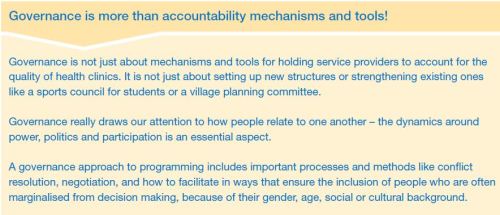
Interactions between children and young people and decision makers. These spaces encompass critical aspects of participation, power and politics. An example of a space for interaction would be where children and young people, local government and school leaders come together to discuss budget plans and available resources for school infrastructure. These spaces are shaped by a number of factors, including social, economic, cultural ones. They are also not free of personal agendas, desires, intentions and prejudices. It’s critical to remember this in governance work — ‘tools’ and ‘mechanisms’ are not enough. (ICT4Governance and Tech for Transparency friends, I’m looking at you! Though I think most of us see this point as ‘beating a dead horse’ by now.)

From Chapter 2 of the Governance Learning Guide by Plan UK

*Summarized from Chapter 1 and Chapter 2 of Plan UK’s extremely useful and easily downloadable A Governance Learning Guide. The guide also has a number of practical use cases on different governance initiatives as well as an extensive section on additional resources.

Here’s a follow-up post (since governance is so clearly *not* boring and I’m sure there is high demand for more!) called 15 thoughts on good governance programming with youth.


Read Full Post »

This is a cross-post by Laura Pohl who works at the Bread for the World. The post is a summary of the latest Humanitarian Photography group meeting. The meetings are part of a series of meetings about photography in humanitarian work organized by CORE Group. (The original is posted here)

An employee at the Yemi Hanbok factory near Yanji, China, examines a traditional Korean skirt she is dyeing.The factory’s unique geographic position in China, near North Korea, means it can have work done cheaply in both countries and then sell to customers in South Korea. Photo © Laura Elizabeth Pohl

One of the most common questions I get asked at work is, “Can I use this picture?”

Oh, there are so many answers — and we talked about most of them at our latest Humanitarian Photography Group meeting this past Tuesday. Jim Stipe of Catholic Relief Services, Ann Hendrix-Jenkins of CORE Group and I organized the meeting. I led it, starting off with a talk on figuring out whether a photograph is yours or not. Sounds easy, right?

Well, if someone on your staff shot the picture then yes, the answer is easy: you can use it. But should you use it? (More on that later.) If your organization hired a freelancer to shoot pictures for you, then yes, you can use the pictures but possibly with restrictions. It depends on the type of contract between you and the photographer. The main point here is that the photographer usually still retains copyright to the picture and your organization is licensing the pictures. If this all sounds complicated and legalistic, don’t worry; we’ll be delving into copyright, contracts and licensing in a future meeting. Finally, if you don’t know who shot the photograph, where it came from or who owns the copyright, it’s best not to use the picture.

Next I talked a bit about Creative Commons licenses, which photographers use when they want to let the public publish their pictures without paying a licensing fee. CC-licensed photos abound on Flickr, a frequent source of pictures for nonprofit organizations. Just be sure the picture editor at your organization (or the person in this role) understands all six CC licenses and when a picture is fully copyrighted, all rights reserved. When I was a freelance photographer, an NGO once published my copyrighted photographs from Flickr without my permission. I found the copyright violation and sent the organization a stern letter and invoice for the pictures. The organization paid up. They never apologized, though. The organization had tasked their intern with finding pictures. It turns out he didn’t understand copyright.

Finally, I talked about content and technical criteria for publishing pictures, showing about 20 “bad” photos that Jim and I found. There are many reasons photographs shouldn’t see the light of day but I think the best way to summarize the photo usage criteria listed below is, “Do unto others as you would have them do unto you.” That out-of-focus photograph of 10 bored-looking people sitting in a meeting? You don’t have to use it. That portrait of a person with a strange expression on his face? Just don’t publish it. As Jim often says, “It’s better not to use a photograph than to use a bad photograph.”

  • Dignity – No emaciated children, flies in eyes, violence or stereotypical images.
  • Safety – Could the picture put the photo subjects in danger, even if they agreed to be photographed?
  • Context – No pretending photos of one thing are of something else. Sometimes photos published as a collection make sense together but one photo on its own from the collection doesn’t make sense.
  • Caption – Who’s in the picture? Where was it taken? Why is this picture important? Even if you can’t publish this information because of safety concerns, it’s important to have the information for your internal records.
  • Credit – Who took the picture? It’s just like attributing a quote.
  • Third effect – Two pictures paired together can take on a new meaning.
  • Focus – Is the picture sharp or blurry?
  • Framing – Is the photo framed well?
  • Exposure – Is the picture properly exposed?
  • Color – Does it look natural?

People had great comments and questions at the end. (By the way, Jim did a nice job tweeting the meeting at #NGOphoto.) A woman named Aubrey said her organization works on a lot of construction projects, roads, latrines, etc. They often shoot before and after photographs to show the impact of their projects. Another person asked about setting up or staging shots. Some people wanted to know more about contracts and how to work with country programs to set up photo shoots. These are all meaty topics. I can’t wait to get into them more in future meetings. We’re taking a break for the summer but we’ll meet again in September, so get in touch if you’d like to join us.

You can find summaries of other meetings here:

April: On the ethics of photos in aid and development work

May: Aid, ethics, photography and informed consent

Read Full Post »

  1. Share
    Looking forward to group conf call with CORE today ref: Photos, ethics, values and INGO/NGO work.
    Tue, Apr 03 2012 06:55:44
  2. This morning I participated in a massive conference call about photography in aid and development, and the ethics and values that surround photos taken and used by NGOs. The call was organized by CORE Group (@coregroupdc). Now maybe I’m exaggerating here, but the call organizer, Ann Hendrix-Jenkins, read off a list of participants that went on forever. I’m estimating that there were something like 40 or 50 people listening in from as many organizations. This topic has always been important for a strong segment of NGO staff and it seems to be gaining steam again.

    After I started tweeting about it, a couple of people asked if I’d be writing a blog post. So here it is. I’ve ‘Storified’ it since I was tweeting instead of taking notes, and because there was a nice side conversation happening with folks on Twitter too. (See the Storify here – it looks a little bit nicer there than it does here.)
  3. Share
    “Humanitarian photography is a hot button issue.Touches on dignity, how we do our jobs, & our ideas about ourselves, others & our work.”
    Tue, Apr 03 2012 11:08:52
  4. The call organizers had earlier conducted a survey about NGO images, policies, consent, and operational processes around photographers and photography and shared it with participants ahead of the call. The organizers also suggested a couple of links to check out beforehand, including an Aid Watch post (“Adorable child in NGO fund-raising photo sues for royalties“) and a link to a photo  that appeared in the New York Times. These two links and other similar “poverty porn images” had sparked the discussions that led to the decision to organize today’s call. [update: here is the original discussion thread on Linked In]
  5. Share
    Jeez – like 50 orgs on this CORE call re: photography, ethics and values. Discussing: @aidwatch post ht.ly/a3gYA & more
    Tue, Apr 03 2012 11:06:19
  6. Share
    I’m reminded that these discussions happen all the time among INGOs, even when they are not documented on Twitter or a blog.
    Tue, Apr 03 2012 11:10:46
  7. Share
    Second photo touching off this conversation is NYT image from last year re Somalia famine. ht.ly/a3i0s #povertyporn
    Tue, Apr 03 2012 11:13:32
  8. Share
    Also reminded that blogs can and do touch off broader and wider discussions that often we never know are happening….
    Tue, Apr 03 2012 11:14:45
  9. Share
    @meowtree I think too many people online forget that about a lot of issues. Not all discussions are necessarily open for outside viewing.
    Tue, Apr 03 2012 11:16:09
  10. Share
    @meowtree Shoot, I forgot about the call! Are you going to write a post about it?
    Tue, Apr 03 2012 11:28:06
  11. Share
    @meowtree Would have loved to be there but couldn’t… Will you report?
    Tue, Apr 03 2012 11:36:40
  12. Laura Pohl (@lauraepohl) from Bread for the World gave a short introduction to the topic along with some points to think about.
  13. Share
    What considerations do NGOs (and journos/freelancers) need to go through before publishing a photo? Appropriate use? Consent? What else?
    Tue, Apr 03 2012 11:16:15
  14. After this introduction, Jim Stipe from Catholic Relief Services gave a quick summary of the survey highlights, and we had a group discussion around some of the key issues detected in the survey and additional ones sourced from the participants on the call. 
  15. Heartening to know most INGOs have photo policies saying images must show dignity, & image usage is restricted/protected to some staff.
    Tue, Apr 03 2012 11:21:54
  16. Share
    Hearing: INGOs don’t seem to have policies stating photo must match/relate to/be part of story or have policies re: copyright of photos.
    Tue, Apr 03 2012 11:23:38
  17. Share
    Hearing: often pgm staff are taking photos, but many INGOs don’t train staff on policies or good techs for photos or on photo ethics.
    Tue, Apr 03 2012 11:25:47
  18. Share
    Hearing: What about consent for photos? We need to discuss this much more. It’s key to a good photo policy.
    Tue, Apr 03 2012 11:26:57
  19. Share
    @meowtree Unable to keep up today, busy. But have you asked @irinnews input? I use their photo service. Will catch up soon. Thanks for topic
    Tue, Apr 03 2012 11:28:38
  20. Share
    My question: what is ‘informed consent’? what are different ways to get it? how to ensure ppl rlly understand use of their image and story?
    Tue, Apr 03 2012 11:37:41
  21. Share
    @meowtree you can’t ensure that ppl understand use of their image unless they know context in which it will be used & understand its nuances
    Tue, Apr 03 2012 11:40:12
  22. Share
    Re: informed consent – how not to intimidate ppl with consent forms? Also – shd we be applying US consent laws to local settings? or not?
    Tue, Apr 03 2012 11:39:02
  23. Share
    @meowtree @jcdonner thanks brilliant, parallel questions for researchers being encouraged in IDRC SIRCAII programme, spread it
    Tue, Apr 03 2012 11:40:34
  24. Share
    Also: how does consent differ when children/under 18s are involved? what about difference btwn traditional and social media use of images?
    Tue, Apr 03 2012 11:40:32
  25. Share
    @meowtree What I learned from ethnography: entirely contextual and subjective. Even when you’ve succeeded, you’ve failed. But you must try
    Tue, Apr 03 2012 11:41:52
  26. Share
    @meowtree When in doubt, err on the side of caution.
    Tue, Apr 03 2012 11:42:32
  27. Share
    Someone asks: What about before and after pictures in the case of malnutrition? is it better to show the “after” picture to show progress?
    Tue, Apr 03 2012 11:42:41
  28. Share
    Another Q: what about when working with images of people in conflict settings? where use of their images may endanger them?
    Tue, Apr 03 2012 11:43:25
  29. Share
    Comment: Takes a lot more ppl, resources and planning than we think to do this right. We seldom put enough emphasis on ethical image/video.
    Tue, Apr 03 2012 11:44:51
  30. Share
    @meowtree In the West we focus on “informed consent” re: the individual–but in other cultures, the community consent is more important
    Tue, Apr 03 2012 11:40:28
  31. Share
    .@meowtree good discussion of photos in #ict4d vs journalism here is.gd/G4oGsC
    Tue, Apr 03 2012 11:20:44
  32. Share
    Comment: Need to work with US media also to help have more ethical use of images.
    Tue, Apr 03 2012 11:46:26
  33. Share
    Re. #povertyporn conversation @meowtree is tweeting: all humanitarian/devt agencies should have comms ombudspersons to defend those depicted
    Tue, Apr 03 2012 11:47:19
  34. Share
    @meowtree I’ve always found Photovoice UK’s ethical guidelines useful in regard to some the issues at your discussion photovoice.org/images/uplo…
    Tue, Apr 03 2012 11:47:47
  35. Share
    [ 1] MT @meowtree Comment: Takes a lot more ppl, resources, planning than we think… We seldom put enough emphasis on ethical image/video
    Tue, Apr 03 2012 11:48:29
  36. Share
    Interesting commentary on INGO photo policies & the ethics of humanitarian photography by @meowtree.
    Tue, Apr 03 2012 11:48:35
  37. Share
    @meowtree @giantpandinha I really like the ombudspersons idea but they would need to be local?
    Tue, Apr 03 2012 11:49:28
  38. Share
    @miskellaneous @meowtree Anybody with an empathetic impulse would be a good start. But yes, eventually, why not local?
    Tue, Apr 03 2012 11:50:32
  39. Share
    @meowtree photos and ethics such a big topic. I find the whole issue of people coming back from mission trips and volunteering with these
    Tue, Apr 03 2012 11:49:52
  40. Share
    @meowtree photos equally disturbing. Take a snap of a poor kid and then put on facebook – where’s the dignity and ethics in that? Volunteer
    Tue, Apr 03 2012 11:50:36
  41. Share
    @meowtree eduction is equally important, but so hard!! At the very least, if you wouldnt want a similar image of your mum/child/bro etc to
    Tue, Apr 03 2012 11:51:35
  42. Share
    @meowtree be shown are the world or usesd in the same way, then think twice. (this concept doesnt go down well when I mention it to people).
    Tue, Apr 03 2012 11:52:16
  43. Share
    .@meowtree One challenge – a Western audience that is eager to consume #povertyporn. Many INGOs seek to reach out to that audience.
    Tue, Apr 03 2012 11:51:08
  44. Share
    Comment: tension btwn fundraising people, program people. What is the concept of what the org is doing? Charity? solidarity?
    Tue, Apr 03 2012 11:55:08
  45. Share
    @meowtree @miskellaneous I find the “golden rule” goes a long way. Would I want my child, my niece/nephew depicted this way? Ever?
    Tue, Apr 03 2012 11:54:02
  46. Share
    @giantpandinha @meowtree yes it’s my golden rule too though there are somethings it misses like cultural understandings of modesty
    Tue, Apr 03 2012 11:57:06
  47. Share
    @miskellaneous @meowtree I remember a moment with my agency’s graphic designers when we cropped a woman’s belly peaking out from her t-shirt
    Tue, Apr 03 2012 11:58:00
  48. Share
    @miskellaneous @meowtree Again, the golden rule worked there. (But you are right @miskellaneous, might not work in every situation.)
    Tue, Apr 03 2012 11:59:46
  49. Share
    Comment: can we look at studies on the use of photos and impact on donors & learn. Also look at ethics vs what works w fundraising?
    Tue, Apr 03 2012 12:07:06
  50. Share
    Comment (mine) and what about participatory media? How often do we promote people’s own photos/videos of themselves/their communities?
    Tue, Apr 03 2012 12:07:55
To finalize the call, we heard a summary from Jim of some of the areas that the group could consider forming smaller groups to dig into and work on further, including: 
  • Issues around consent, alternative ways to obtain consent, release forms, and how to get truly informed consent.
  • Ethics of both taking photos and ethics of using photos – these are related yet separate issues.
  • What makes for a good NGO photo? What’s a good vs bad photo? What works and what doesn’t?
  • How do you grow your options for getting more high quality photos? How to train your staff on good photography? How to find and work with good freelance photographers? How to plan out a shoot and put the right amount of time into it? How to ensure photos are taken ethically?
  • Creating a photo policy, what does a good photo policy look like? what should it contain?
  • How to tell better stories? You can document your programs with photos and you can tell visual stories – these are 2 different things….
  • Getting good photo captions. If you don’t have good captions, photos are less useful.
  • Other places to source photos; eg., if you don’t have the photos you need, where can you go to get them?
  • Photo journalism vs NGO photography – similar yet different, different approaches and goals. Let’s discuss this.
  • Vocabulary for talking about photos in order to articulate to staff why one photo better than another. Turning gut sense into language and tools.
  • Looking at studies on the use of photos and their impact on donors, what can we learn from that? How to reconcile the different set of ethics that we may find in terms of ‘what works’ for fundraising and what is ethical?
  • What about participatory media and people portraying themselves and their own images
  • An Ombudsperson within INGOs who can defend the rights of those being photographed
  • The question of how people perceive you when you go from doing program work to becoming a photographer in the same afternoon. 
  • The related question about what happens when your organization makes you do both things? Who owns the photos? Do you get paid if your organization uses them? What if you are using your own equipment? How is your organization using you if that’s not your job in the first place? What are you expected to do and how much of this should you actually be doing?
  • Budgeting. We need to begin inserting budget into the conversation. How much can we pay photographers, or do we invest in training our own staff?
  1. Share
    Well pointed out by @miskellaneous: our “golden rule” re. depiction of “the Other” sometimes “misses cultural understandings of modesty”.
    Tue, Apr 03 2012 12:08:55
  2. Share
    However, I still believe some “golden rule” is better than none, and the bottom line should be: err on the side of caution.
    Tue, Apr 03 2012 12:10:15
  3. Share
    Comment: What about when you’re asked to be both a “program” person and also take comms/PR photos? How does community view you?
    Tue, Apr 03 2012 12:08:59
  4. Share
    Comment: what are the rules when your focus is pgm, but ‘photographer’ is added to your task list before you go out to ‘the field’?
    Tue, Apr 03 2012 12:10:10
  5. Share
    @meowtree @julienne_l I work with youth and struggle with this a lot. How do you keep integrity and get ppl to pay attention? #povertyporn
    Tue, Apr 03 2012 12:04:39
  6. I’m looking forward to continuing the discussions as this is an issue that constantly jumps out at me. It’s fantastic to know that there is such a strong contingent of NGO staff who are keen to address the issues around how we take and how we use photographs of the people that we work with.
  7. Share
    That’s it for tweets from @coregroupdc conversation on #povertyporn, photos, ethics and values. More later – discussions will continue.
    Tue, Apr 03 2012 12:11:55

Read Full Post »

Whydev and Development Crossroads, are launching a peer coaching matching service. The idea is that young professionals, graduate students, and others starting out in international development could benefit from peer coaching. So the two organizations are collaborating to develop a matching service.

Why peer coaching? According to whydev, “If you have worked in international development, you have probably experienced isolation. It seems to be a fact of life in this industry. Field-based expat staff may be the only person at their level in their local office, or the only expat on the team (or one of very few), separated from their local staff counterparts by cultural, language, and organisational barriers. Even people working in the home office may feel isolated. Perhaps they don’t feel comfortable sharing their struggles with their boss.  Or maybe the boss him/herself is the problem.”

When you’re having work issues, you tend to unload them on those closest to you, and this can cause additional stress. Peer coaching offers a way to discuss and vent about these issues, taking some strain off of your close relationships.

“While not trained as a coach, [a peer coach] is willing to coach you according to a simple (yet effective) peer coaching model. This involves actively listening without judgment, reflecting back what he/she is hearing, asking probing questions, and helping you generate concrete action steps to move you forward.”

In order to design a peer coaching service that meets people’s needs, whydev and Development Crossroads are looking for some input.

“Would you want a peer coach? What would you like to get out of such a relationship? How often would you keep in touch? How much input and oversight would you want from us? These are the type of questions we would love to get your thoughts on.”

Head on over to whydev’s site to learn more about peer coaching and give your input through a quick survey!

Read Full Post »

I had the great pleasure of participating and serving as a moderator* for TechChange’s Mobiles for International Development course from October 15-November 4, 2011, along with a great group of people interested in how mobile phones can support development processes.

Course topics included mMoney; mHealth; mobiles for monitoring, evaluation and data collection; mobiles and radio; and mobiles in education.

The first week of the course went both broad and deep via a compilation of blogs, videos and longer documents from a range of thinkers and doers in the mobile space.

The second week introduced participants to a number of mobile tools, including MPesa (Mobile Money Transfer Platform), InSTEDD GeoChat and Riff (Mobile Collaboration and Data Stream Analysis Software), RapidSMS/Souktel (Mass Texting Software Interface), Sana Mobile (Mobile Diagnostics Platform), Medic Mobile, TxtEagle, FreedomFone.

The third week offered a number of chats with well-known practitioners and thinkers in the above mentioned areas or developers of particular tools that had been covered in week 2.

Things I liked about the course:

  • Platform. The TechChange platform is really nice. It’s engaging and well-designed. Things are easy to find making participation smooth. It took me a day or so to learn where to find things, but after that, it was easy to join in and access the course materials.
  • Format. This was my first ever on-line course and I found it very energizing and thought-provoking. I loved that the first week was an in depth overview on ICTs and development in general. We were exposed to a huge range of thinking from very positive to very wary and critical of the use mobiles and ICTs in development work. Long and short videos, blogs, guides and research were made available and these really stimulated a lot of discussion around development models and frameworks, the role of NGOs and corporations, e-waste, top down vs bottom up, innovation and local capacities, and all kinds of issues. The second week dove deeper into particular areas and many of these discussions continued, but now with different groups as people began self-selecting according to their particular interests (health, education, etc.) Unfortunately I missed most of the 3rd week because I was out at another conference, but the roster of experts who came onto the platform to chat with the group was stellar and according to participant feedback, quite stimulating as well.
  • Discussions. The format was conducive to great discussions, from small group Skype discussions (each participant was assigned to a small group at the beginning, and these groups held a few discussions over the course period), to random chats, to forums and sometimes Twitter. These discussions were very useful to generate new ideas and dig into topics and tricky issues.
  • Participants. On the one hand it might be nice to have courses aimed at levels of experience, but on the other hand I liked that there were all levels of expertise chatting and discussing, and people from a wide range of backgrounds. This enriched the group discussions and the variety of inputs.
  • Organizers. The organizers did a stellar job of engaging and encouraging the group and being responsive to any technical difficulties encountered.

Things I would like to see in future courses:

  • Less hours per week. It was hard for me to clear my schedule to participate in everything as I would have liked. Dispersing the activities over 4 rather than 3 weeks (as the organizers are planning for the future) might help with that. Of course this might be an issue with me, not with everyone. The good thing is that course materials are available for a few months after the course has closed.
  • Short sessions on setting up specific tools. I was really glad that Tech Change took the full first week to look at the big picture before focusing in on tools and  I was super impressed with the wide range of materials they pulled together to get people thinking and discussing all the different aspects that need considering before deciding on a technology tool or “solution.” I think it would be really helpful, following the big picture thinking, to offer some short courses or sessions focusing on the actual technical use of particular tools so that participants can get hands-on experience also.
  • General courses as well as in-depth courses. This course was fantastic for getting a general overview, and good for both people with little experience with mobiles in development and for those who already have technical or practical experiences with programs with a mobile or ICT element. It would be great to also have courses that focus an entire 2-3 weeks on one aspect such as ICTs in Education, mHealth or mMoney. I certainly could have spent 2-3 weeks learning about and discussing a single aspect of “m” something. I’m sure TechChange has their hands full with new course offerings, but as they expand, this would be great to see.
Overall, I really enjoyed the course and hope to participate in another one in the future. I’d definitely recommend these courses to others interested in ICTs and development.
.
*Note – I attended the course gratis in exchange for helping TechChange shape the content and curriculum and serving as a moderator during the course. (Thank you, social media. Thank you, barter system!)
.
A few other posts related to development of the course:
.

Read Full Post »

« Newer Posts - Older Posts »