Feeds:
Posts
Comments

Archive for the ‘ICTs, mobile and technology’ Category

On January 11, 2011 from 11-12am, TechChange and I co-hosted a tweet chat on ICT for Development (ICT4D) distance learning. The idea came up after Ernst Suur and I spent a few months lamenting the irony that we couldn’t find any good on-line training around ICT4D, nor did we see ourselves being able to quit our jobs or reduce our work-related travel, move to where a university offering ICT4D is located, and accumulate a huge debt by going back to get an advanced university degree the traditional way. We wrote a post asking “Where’s the ICT4D Distance Learning” and had a few conversations with the guys at TechChange and a few others who are working on developing some solutions to that issue.

During the Twitter chat, we asked a set of questions about topics, timing, accreditation, skills, and delivery models to get a sense of what might appeal to potential learners. We had almost 60 people participate in the chat, and apparently our hashtag, #ICT4DDL, was even a top trending topic in Washington DC at around 11:30. Here’s the archive.

—–

I had a chance to meet in person with Mark, Nick and Jordan from TechChange last week while I was in DC and these guys are smoking! They are seriously moving on creating visually attractive, stimulating and engaging e-learning in the area of ICT4D. I’m looking forward to collaborating more with them as they develop courses and methodologies that can help people from different backgrounds and with different needs to access ICT4D training and learning. I like their approach of involving practitioners, looking at ICT4D strategically (eg, integrating it to achieve goals, learning how to choose the right technology and decide if technology is necessary at all) and supporting on the practical side (how to use specific ICT tools) and I think this type of training, if all goes well, will be a great opportunity for us all to get trained up in those areas we feel we are still missing.

Mark wrote up the following summary of the themes and highlights from the chat [the original post is here on TechChange’s site: Recap of ICT4D Tweet Chat (#ICT4DDL)].

Course Topics: Some of the most popular ideas for courses included: social media for social change, sustainability, mobiles for development, and a course on ways to create and sustain collaboration through an online community. It was pointed out that users needs would be different based on access to and familiarity with technology. @fiona_bradley mentioned the need for strategic thinking and project planning for veteran change agents, because “tools change fast”.

Delivery: There was a desire expressed for blended learning models (face-to-face and online) and a sentiment that ICT4D face-to-face training was important. (list of existing ICT4D programs). There was also a feeling that experienced practitioners should be part of the course experience and that more needs to be done to engage them (@ICT_Works). Others stressed the fact that distance learning is the only option for those working in remote areas.

Credit vs. Certification: People generally preferred courses for credit, but some acknowledged that they had neither the time nor the funding for a full university degree course. Shorter-term certificate courses on specific topics appealed to many in the group.

The feedback we received throughout the tweet chat was quite useful, and as expected there was a wide variety of opinions expressed. As TechChange moves forward, we look forward to tailoring our courses to the needs of these and other users. We’re in the process of developing a 10-week online flagship course on Technology for Social Change. Everyone will be able access Unit 1 for free. From there we will develop more specialized courses and certification programs on subjects such as Technology for crisis response, Social media for social change, mHealth, and the Future of mobile devices for development. We are also working with individual organizations such as FrontlineSMS to create learning tools tailored specifically for their applications.

I’m really looking forward to taking some of the courses that TechChange comes up with and helping develop materials for some of them too.

Read Full Post »

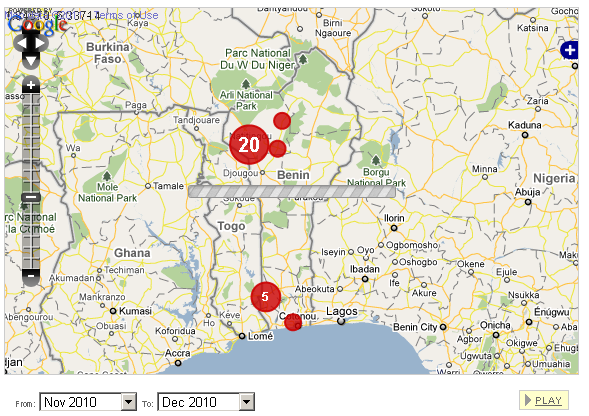
Last year, I spent some time in Benin piloting an SMS reporting system to track and respond to Violence against Children (VAC). After almost a year developing the idea and thinking it through to see if it was potentially feasible (see 7 or more questions to ask before adding ICTs), in February 2010 we conducted 2 workshops with youth, staff and local authorities in Couffo and Atacora, Benin, to design a system with their input (see Finding Some ICT answers in Benin). The main pieces of the reporting system are FrontlineSMS and Ushahidi. A few months after, staff reported back on some of the challenges with implementation (see Tweaking: SMS Violence Reporting System in Benin).

Romeo Essou, project coordinator

Since then, many of the issues have been resolved, and we’ve improved outreach so that communities are more aware of the SMS reporting system and how to use it. We’ve also been looking at the system itself, continuing testing, and seeing what improvements are needed. We didn’t have resources to dedicate someone fully to the program at first, but after seeing the potential, Plan Benin assigned Romeo (see photo) to manage the pilot project full-time in Benin. It’s been quite a pleasure working with the team there, and Romeo is no exception. Having someone dedicated full-time to working with communities and staff in the two districts has really made a difference. From November to mid-January, several additional violence cases were reported and a good number of them have been followed up on and closed.

Last week, Romeo shared what we still need to find solutions for. Some of these are issues that we’d identified last year and others are additional things that Romeo has suggested as he’s gotten down to business.

Some people still call instead of texting, or they send “call me back” texts

Cases are now coming in

  • The team is fairly certain this is due to illiteracy. Plan will involve more school-going youth in the initiative because they have higher literacy levels and can support others with reporting if needed.
  • Romeo and the team will continue doing outreach and education on how the system works both at community meetings and via radio broadcasts in French and local languages.
  • To address the calls that may continue to come in, a voice mail will be set up on the phone that links up to the FrontlineSMS laptop, with a message explaining that people have to send in a text. Romeo will do some research to determine which languages to use in the message for the best result (French and the 2 main local languages….).
  • If that doesn’t resolve the issue, Romeo and the staff will call back anyone who phones in.
  • Cost of an SMS continues to be a discouraging factor for people in terms of reporting. Often when Romeo or other staff visit a community, community members take advantage of their physical presence to report additional cases of violence.  This is not necessarily negative, considering that we want to increase the number of incidents reported and followed up on; however, if it turns out that awareness around violence is high but the cost of the SMS is a deterring factor in reporting, more inexpensive channels to report also need to be offered. We are still negotiating with the local operators to get a free SMS line.

Spam

  • Some 50 spams a day are coming in. This is an issue on all mobile phones in Benin. Much of the spam comes from the mobile service providers themselves.
  • If the spam is coming from the same number, it’s possible that a workaround script could be written up at the point where FrontlineSMS forwards to Ushahidi. The messages can also be marked on Ushahidi as spam, but they will still be arriving via FrontlineSMS, unfortunately, unless numbers can be blocked somehow.
  • Needs further thought on how it might be overcome.

The Violence Tracking Platform (Ushahidi):

Ushahidi platform

  • We need to be 100% sure that any personal or identifying information coming in via the SMS reports is scrubbed so we do not put any children or witnesses at risk or falsely accuse anyone of violence against children by publishing the reports to the Ushahidi platform.
  • Romeo will develop a Privacy and Protection Checklist and train those administering the Ushahidi system to be sure to remove identifying information thoroughly before allowing it to be published on the Ushahidi site.
  • The identifying information still needs to be stored somewhere on the system to support with follow-up on the cases that come in. We may need additional development work on the platform to allow for that.
  • We hope to integrate the Ushahidi map into the Violence against Children website, which has educational material, videos and cartoons done by youth, and a discussion forum. However if the information poses a risk to anyone, we may decide to make the Ushahidi site private and keep it as a management tool rather than a public site.

Categorizing:

  • The staff who administer the Ushahidi website are not always clear which type of violence an incident should be categorized as (physical violence? sexual violence? psychological violence?).
  • Romeo will create short guidelines to help people to categorize the incidents properly. He’d like these to be incorporated into the Ushahidi platform.
  • Often a reported  incident can fit into more than one category – eg., both physical and sexual violence. If it’s categorized in two categories, then we lose the sense of how many incidents there have been overall, and we’re unable to properly chart the data. We need to find a way to manage this on the system so that we have proper statistics.

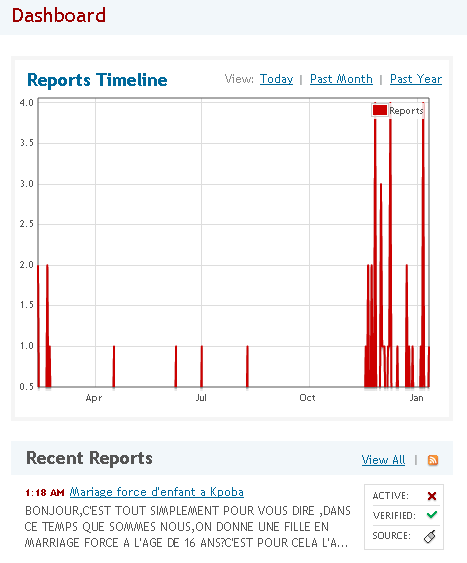
Recent reports of physical violence, sexual violence, forced marriage and exploitation

Follow up on reported cases:

  • We still want a way to track response and follow-up on cases within the Ushahidi platform, as often a report requires more than one verification visit.
  • We need someplace within the platform to store this type of information to keep records of follow-up.
  • This will require work by a developer, but it might be helpful for other institutions using Ushahidi as well. It’s also possible that FrontlineSMS Medic could be used for case management rather than Ushahidi, but it might prove confusing for staff to have to store and act on the same kind of information using two different tools.

Names of villages, hamlets, etc:

  • We would like to have a listing on the map of the various hamlets, villages, etc. They do not currently appear on the map since there is no record of them on Open Street Maps or Google Maps. Plan has this detailed information in its internal systems and we want to add it to the base maps so that it’s easier for administrators to locate the incident in the right community.
Coordination and outreach:
  • In addition to the technical work on the system, Romeo will continue to coordinate and share information with local partners and other organizations working on violence against children. There are similar initiatives already in place and we don’t want to duplicate efforts. Combining and sharing help line numbers and taking reports by both phone and SMS is one option.
Related posts on Wait… What?

Read Full Post »

A little more than a month ago, I wrote a post asking ‘Where is the ICT4D distance learning.’ Ernst Suur and I had been trying to figure that out since last July.

A bunch of ideas and information came in via the comments section that helped us to figure out what is happening in the space, including info about ICT4D advanced degrees options, short courses, related courses, etc.

In addition to following up with a couple established universities to see if (and when) they might be offering Masters level ICT4D programs, Ernst and I had a skype meeting with Mark Weingarten and Nick Martin, the folks over at TechChange (the Institute for Technology and Social Change).

TechChange is a new organization dedicated to training practitioners and students to effectively leverage emerging technologies for social change. They are building tools and courses for ICT4D and have already partnered with a number of universities — eg., American University, George Washington University, the UN University for Peace — to deliver face-to-face courses in topics like ‘technology for crisis response’ and ‘social media for social change.’ They also have upcoming projects planned with U4UshahidiSouktel, and FrontlineSMS. In addition to in-person trainings, TechChange is designing learning tools for use in online courses and degree programs.

As Mark commented, ‘We are developing curricula for practitioners (including those working in the field), and recognizing that needs and schedules vary. Some people and organizations might want to quickly learn how to use specific ICT tools, but others may want a more in-depth understanding of the entire ICT4D ecosystem, its successes, its failures, and where things are headed in the future. We want to better understand this range of needs and tailor our courses. We’re also interested in knowing more about what else is being done in this space and what other examples we can learn from.’

In order to get some wider input, we invite you to join us for a twitter chat on ICT4D Distance Learning on Friday, January 14th at 11 am EST. The hashtag will be #ICT4DDL.

We will cover 5 questions:

  1. Topics: What sorts of courses would interest you most? What topics are most relevant?
  2. Timing: What timeframe for distance learning courses would best suit your schedule and needs? Short-term courses on specific topics (or tools) vs. more in-depth courses?  3 hr modules or ten week facilitated trainings?
  3. Credit: How important are things like credit or degree programs? Are certifications enough?
  4. Skills: What skills would you like to gain as a participant – considering 1) university students just entering the field and 2) practitioners taking professional development courses.
  5. Delivery: How does connectivity affect your ability to take courses? What about in the case of others who might be interested in this type of training but are not on Twitter/online as often? Is a mobile option a good idea?

Tips for a good Twitter Chat:

  • Login 5 mins ahead of time and be ready with a short introduction (eg, Cathy here, I manage maternal health pgms at XYZ in Malawi, we’re just getting started with ICT4D).
  • Tools like TweetChat which automatically add the hashtag and refresh often are helpful to keep up with the conversation.

We look forward to chatting on Friday, January 14th at 11 am EST and welcome any questions or comments before then!

Related posts on Wait… What?

Where is the ICT4D Distance Learning?

3 ways to incorporate ICTs into development work

Demystifying Internet

ICT4D in Uganda: ICT does not equal computers

It’s all part of the ICT4D jigsaw: Plan Mozambique ICT4D workshop

Read Full Post »

I got a great comment from Gareth on my last post Why aid and development workers should be reading blogs:

Do you know of any good blogs from local aid workers? I enjoy reading all these blogs from western-educated aid workers like myself, but we do tend to have a fairly similar way of looking at things, so it’d be great to read something from a different perspective. Any suggestions?

He’s right of course.  It would be nice to add some local perspectives to the lists of aid and development bloggers that float around.

Two well-known sites to find ‘local’ voices are Global Voices and Rising Voices. There is also Maneno which is (used to be?) a platform for bloggers in Africa, but it seems to be under maintenance while an open source platform is developed. I’m not sure how many of the bloggers on those platforms technically work at aid or development organizations, but regardless of that minor detail, you will get great local perspectives on aid and development issues there.

But the question stands – where can we find local aid and development worker blogs?

Suggestions please!

Read Full Post »

Dave Algoso, a grad student at NYU, just published a great post called A Grad Student’s Guide to the International Development Blogosphere wherein he explains why grad students should be reading blogs. It struck me that many of the reasons he recommends students read blogs are similar to why I recommend that you, my dear colleagues and friends who are development or aid practitioners or who sit in headquarters or fundraising or regional offices, or who make policy decisions, read blogs.

I’m a bit hesitant to share these tips because then you will realize that I’m not really all that smart, I just read a lot of blogs and discuss them a lot on Twitter…. On the other hand, I’m fairly confident that no matter how much I recommend blogs and Twitter, most of you will say you don’t have time, and I’ll still come out looking like a genius for knowing what’s going to hit the New York Times 2-3 days ahead of when you read it and forward it to me asking me if I’ve seen it!

You can read Dave’s post here and I encourage you to do so – so that he will get additional hits to his site and because he deserves the credit for writing the original post.

Below, I’ve taken Dave’s post (note: with permission) and substituted “development and aid workers” for “grad student” and switched it up just a bit to make it fit that context.

Here’s Dave’s post with my changes in italics:

Several friends have recently asked me which blogs I read and how I manage my reading. This post is targeted at my fellow aid and development practitioners, but those of you who work on policy, advocacy, customer service, grant writing and technical support, communications, marketing, and anyone who wants to know what’s happening in aid and development should find it useful as well. Let’s start with why to read blogs, then move on to the how, and finally the what.

1. Why should I read blogs? I do plenty of reading for work already…

I’m a fan of reading blogs. No big surprise there. Reading blogs should be part of how you get smart about your field. You read the news, right? New York Times or the Economist or People Magazine (you know who you are!) or whatever? Well newspapers write for general audiences. They won’t get very far into the complexity and nuance. You read a bunch of internal reports for work too? Well most reports are written for donors. They generally won’t tell you about what the theories and the practical work have to do with the larger picture of development. They also won’t critique the way you do business or offer you a cross cutting picture of where development and aid are headed across sectors and across organizations.

Blogs cover many of the same issues as both newspapers and journals and project reports, but with an eye toward what they mean for practitioners and policy makers. You’ll get stories from the field, scathing critiques of the latest development fads, and heated debates on everything from microfinance to conflict minerals. The blogosphere is the one place where geography is no barrier to the conversation. Academics, journalists, donors, Washington think tank-ers, UN or NGO staff — they all bounce ideas around here.

For a development worker, blogs also provide a check on what the experts, your bosses, top government officials, donors, advocates, marketers, policy-makers and celebrity spokespersons say. You’ll find out pretty quickly which issues are actually top-of-mind for practitioners and which issues only matter to the Ivory Tower types, those sitting in offices making policies, and those making things up. And if work, work meetings, conferences and discussions around the water cooler don’t allow you to delve far enough into an issue you care about, blogs can make up for that.

2. Blogs can be overwhelming. How do I manage the information flow?

First and foremost: You do not need to visit every blog’s website to check for new posts. In fact, you shouldn’t. You can subscribe by email if you like (most blogs have a button on the right hand side where you can subscribe by email) but even that can be overwhelming as blog posts mix with your normal emails.

There’s an easier way to read blogs. Instead of subscribing by email, you subscribe to the blog’s RSS feed. RSS means “really simple syndication.” You just subscribe to the RSS feed using a feed aggregator, and you’ll get all of your blogs in one place.

Some email programs (e.g. Outlook) can act as feed aggregators. I prefer to use Google Reader; if you have a Google Mail account, then you already have a Google Reader account. If you are on the road someplace with spotty internet connections, you can use a free program called FeedDemon; it’s a little clunkier than Google Reader, but it can download posts for viewing when you’re offline. On your iPhone, you can use another free program called MobileRSS. Both FeedDemon and MobileRSS sync with Google Reader, so your RSS subscriptions or starred items will always be the same in all three. (There are also many other options for feed aggregators.)

Once you have a feed aggregator, start subscribing. Most sites with feeds will have a link that looks like this orange square. Click on it to subscribe. Often you can just type the site’s URL into the feed aggregator, and it will figure out the rest.

The practical upshot of this feed aggregator stuff is that you can go to one place and see all of the new posts from all the blogs you follow. You can also “follow” your normal news (more on this below). This keeps you from being overwhelmed, so you’re more likely to keep up with them.

3. Okay, I’m sold. What should I be reading?

In my opinion, there are seven must-read blogs for any one working in the field of aid and development.

Following these seven will keep you up to speed with the debates of the day, and you’ll get links to the most interesting posts from other blogs. Seriously, if you read nothing else, at least subscribe to these seven.

4. C’mon. Only seven? I can handle a few more.

I hoped you’d say that. Here are some others that I highly recommend.

Most of the blogs above are pretty general, though everyone brings different perspectives and interests. There are also many issue/region-specific blogs you may want to check out. Here are a few that I recommend.

(Note from Linda here: I also have a list of blogs I read regularly – you can see it here on the right hand side bar under the title ‘blogroll’. Check some of them out when you have a chance. Or if you have a particular area of development or aid that you are interested in, let me know and I’m happy to give you some recommendations on specific blogs on that topic to get you started.)

I generally steer away from the blogs of NGOs and donor agencies. The content tends to be fluff. Of course, if you work for (or want to work for) a particular organization, it might be worth following them. There are two that I would recommend as generally thoughtful and interesting:

Finally, there’s news. Almost every news website does RSS feeds, so you can subscribe to them through Google Reader. I get the Economist, the New York Times Africa feed, the East AfricanForeign Policy, and others bundled together with my blogs. I also subscribe to TED talksxkcdGallup World polls, and more. If a site publishes regular content, it probably has an RSS feed. I barely even go to websites anymore.

5. But hey, you forgot about…

Am I missing anything? Feel free to fill the comments section here and on Dave’s post with suggestions.

Please don’t be offended if I failed to include you or your favorite blog above. This isn’t meant as a definitive list. Here are some more blogs I think are worthwhile. The full list of what I follow is longer still. The above is simply meant to get people started — and I don’t want to scare off the newcomers.

*****

Thanks to Dave for the great post, and hopefully some of you colleagues who haven’t caught the blog bug yet will get motivated!

Hopefully some more of you will start writing blogs too…. here are a couple links that talk about some of the reasons that blogging and other kinds of social media can be helpful in thinking about our program work:

Working and living out loud

Social media and humanitarian response

Read Full Post »

I spent a few days in Nairobi early last week with our education and our ICT staff from Ghana, Uganda, Senegal, Mozambique, Kenya, Egypt and a few other folks, including the brilliant Mika Valitalo from our Finnish office and people from regional and headquarters levels. We were looking at goals and challenges in our education programs and thinking about where ICTs might play a role.

The process was really interesting. Starting a few months back, each country shared their education context analysis onto a wiki. In a second round they narrowed down to a specific area in education, looked at the information and communication flow and gaps, and identified areas where there might be an ICT solution. They focused mostly on mobiles, but in many cases mobiles were supported by computers, servers and laptops as well as non-digital information and communication tools and also solar technologies. Each country team met by Skype with Mika and an external consultant to discuss the concepts and get ICT advice and support. Then they updated their concepts and got additional feedback. For the third round, they added rich pictures to show what the specific ICT solutions might look like. Everyone had an opportunity to give input into everyone else’s ideas via the wiki.

At the meeting in Nairobi, we spent a day sharing the concepts with each other for clarification and focused input. Colleagues shared the broader education context in their countries and specifically in the communities where they are working. Then they illustrated the specific education issues and the ICT solutions that they were suggesting and/or the places they felt ICTs could help. Some of the ICT solutions focused on a very specific technology or device. Others showed how different types of ICTs could be integrated at different points in the process. Others required development of a totally new ‘solution’.

Some of the areas where colleagues thought ICTs could support education included: teacher training for those working in remote communities, adult literacy (especially literacy retention post literacy training), improving exam scores, livening up and improving in-class curriculum, and transparency and accountability in education. We spent 2 days then working in different small groups on the concepts, cross-pollinating ideas and deciding which of the concepts were most relevant to all 6 countries (in order to make it more possible to scale them) and which were most feasible and do-able.

The ideas were all a good fit with our global education strategy (see page 9) which focuses on service delivery (in partnership with local governments and communities); organizing and empowering rights holders; and grassroots participatory advocacy to influence education policies, financing and practice. The strategy prioritizes actions around equal access to education, quality of education, and education governance (see page 10).

Accountability and transparency in education

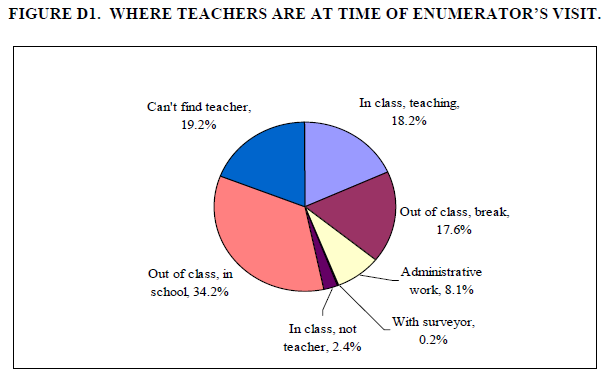
One of the concepts that captured the most interest from the whole group was that of using ICTs to improve accountability and transparency in education. Education is one of the areas where “Quiet Corruption” is often found. ‘Quiet corruption, which can take the form of absenteeism among teachers or doctors, the distribution of fake drugs, or the sale of diluted fertilizers to poor farmers, is having a damaging effect on people in Africa, according to the African Development Indicators report released by the World Bank….’ (March 18, 2010 article)

It's time for class.... where is the teacher to be found?

Edison, Charles and Erik, our colleagues from Uganda, did a short skit illustrating the different points in the primary education system where corruption happens. Their points correlated well with this summary of quiet corruption in education from a July 5, 2010 article in the Independent:

‘Early this year, the Transparency International (TI) Africa Education Watch Programme report: Africa Education Watch: good governance lessons for primary education showed that the government’s perception that massive enrollment is a sign of success of the UPE [universal primary education] programme must be revised to address the problem of overcrowding in classrooms, studying under trees, poor financial management, illegal fees, and lack of school inspection. The report exposes irritating embezzlement of UPE funds and abuse of authority by head-teachers who charge illegal fees, make students offer labour on teachers’ projects, sexual harassment, and systematic teacher absenteeism. The report noted that 85% of schools surveyed had either deficient accounting systems or none at all. In most cases, financial records were either unavailable or incomplete. The survey found limited financial documentation at district education offices and at schools. Most people who handle school grants had no training in basic finance management.

Another survey titled, The Efficiency of Public Education in Uganda, conducted in 2007 by the Ministry of Education to determine efficiency in provision of education services found an average rate of teacher absenteeism of 27% in Uganda, compared to other countries like Zambia (17%), and Papa New Guinea (15%). The aggregate loss caused by this absenteeism constituted 19% which translates into Shs 53 billion out of the Shs276 billion of the Education ministry’s wage bill.

In a swift headcount at the beginning of this year, the Education ministry established that the number of pupils listed in primary school registers was 25% higher than those actually studying. Similarly, the report established that the number of students in lower secondary schools had been exaggerated by 12%. For instance at Amaji Primary School last year, the school register had 816 pupils. But when the headcount was conducted the school administration could not account for 302 pupils.

It is reported that many districts’ chief administrative officers have failed to show proper accountability for the UPE and USE funds.’

The Uganda team also explained that:

  • Parental interest in education is very low because since Universal Primary Education launched, parents feel it’s the government’s responsibility. Some youth we were working with in Kenya last year made a short film about poor performance in primary schools covering the same issue  (see below).
  • Teachers’ salaries are paid directly to their bank accounts, and there is no way to punish them if they don’t show up.
  • There are mechanisms to ensure that donor funds go from the national level to the district level and then on to the school, but no accountability mechanisms to ensure that they get from the school to the classroom and are translated into quality education for children.
  • District level government authority and accountability ends when they transfer funds to the schools; school directors can report to them that they have received funding and that everything is going fine when it’s really not.
  • Local school committees are often made up of people who are not neutral and who do not have the best interest of the children in mind. In some cases, school committee positions are used for personal gain and to launch individual political careers and political campaigns.
  • Lack of parental and community involvement in the education process and in school governance means that no one is demanding accountability from teachers and schools.
  • Sexual and physical violence in schools is very common and underreported. When it is reported, often nothing is done about it.
(Start playing the video, then click the small ‘cc’ button to turn on captions in English)

Colleagues from the other countries face the same challenges in their work and in their own children’s education.

Can ICTs play a role?

What is the solution then? Colleagues suggest that motivating parents and the community to get more involved in school governance and demanding transparency and accountability can begin to change the situation. This obviously requires a lot more than ICTs. So several different actions would be taken to engage and motivate parents and the community to take a bigger role in their children’s education. Then ICTs can be integrated into and support the process for sharing education information with parents, such as student absenteeism, grades, parent-school meetings, exam dates and scores, etc. Parents and students would also be able to report when teachers do not show up or suspected corruption. Students could also report abusive teachers, absent teachers, and other issues they are not happy with at the school. A neutral party would manage and hold the information that flows in and out to protect students from reprisal and to protect teachers from any abuse of the system in case fraudulent or incorrect information is reported. Commitment from those responsible for overseeing education to respond to the issues raised and take serious action is also needed, and this may be the biggest challenge overall. Plan can play a role there, leveraging existing relationships with local and national governments and Ministries.

The idea needs quite a bit of further work, a closer look at feasibility, and more research and input from local communities and parents. As mentioned, the ICTs are actually a small, but potentially very important, part of a much larger initiative to get parents and communities involved in school governance to demand transparent, accountable and quality education and budget spending.

Challenges in the process

Some of the challenges that we had to manage well during this initial piece of the longer process included:

  • We needed to ensure that we were starting with the context and the need for better information and communications, not starting with the technology and devices and building initiatives around them. Yet we also had to avoid getting lost in the overall context and missing the opportunity to pinpoint potential ICT solutions at specific places within the context. Role play and flip chart illustrations of the  ‘problem’ and the ‘solutions’ were very useful for getting more concrete (“So, Kofi is here in his community and he wants to …. So he uses xxx to do this, and then this happens and then….).
  • Though we wanted to specifically look at places that mobiles and other ICTs could support, it was important to list out all the factors that needed to be in place in order for the ICTs to work and to think clearly about the constraints we might face during implementation. One good question to help with that was, after seeing an idea or ICT solution presented, to ask “What needs to be in place in order for that to happen?” Then you start to remember critical things like community motivation, government interest to actually resolve a problem, electricity, someone to set up and manage a server, a strong enough network to download multimedia content, mobile versions of websites, educational content re-design for mobiles, teacher training on how to integrate ICTs in the classroom, limitations of SMS for doing something other than rote learning, higher versions of a mobile operating system, a smart phone, etc.
  • We had input from a potential corporate partner during the process. We learned that corporations are thinking several years ahead to what will be coming down the line; however non-profit are normally working within existing constraints and trying to find solutions that work here and now in the resource poor places where we work or ways to get around those constraints. Multi-level solutions seemed to be a good possibility; eg., ideas that can rely on SMS today, but have potential to expand as networks expand and data enabled mobiles become more available.
  • A corporation tends to think in terms of vendors, results, timelines, launch dates, price points, return on investment whereas a non-profit (at least ours) tends to think in terms of community members, organizations, process, participation, local context. Our facilitator even told us that a corporation normally does a presentation by starting with the solution, and then spending the rest of the presentation showing why that is the right solution. A non-profit usually starts a presentation by sharing all the context and background, and showing the process that led to eventually reaching the potential solution, including every step along the way, how ownership was achieved in the process, why different decisions were made and who participated in them. So keeping corporate vs non-profit cultures and languages in mind is also important when working on joint initiatives.
  • We need to remember to establish measurable indicators of success so that we can tell if this new type of intervention has a different/ better/ greater / lesser impact than carrying out a similar process without ICTs or with a different set of ICTs. This is something we will address once the full idea is developed. Impact measurement is very important to both corporate partners and development organizations.
  • This was the first time many were involved a process of this kind, so keeping the balance between technology and development goals was a constant challenge. We sometimes veered too far towards focusing on all the details of the context and then back to focusing too much on that piece of the context where a potential technology solution was seen. I think we were moving toward a pretty healthy mix of both. The process is nowhere near complete, and as we continue to work on the ideas and look at feasibility and actual implementation, we should find the sweet spot.
The work above was guided by Plan Finland’s recent publication ICT Enabled Development – Using ICT strategically to support Plan’s work.  On the whole, it was a great learning process for everyone involved, and we came up with some good ideas that we will flesh out in the coming months. Having the opportunity to patiently and carefully think through areas and ways that ICTs can support program goals around education and discussing the ideas at length with colleagues was a capacity strengthening exercise for all involved and will mean that we will be more prone in general to thinking about incorporating ICTs in our work going forward.

Resources

ICT-Enabled Development

Plan’s Education Strategy 2010-2013

African Development Indicators Report by the World Bank

Africa Education Watch: Good Governance Lessons for Primary Education by Transparency International

The Efficiency of Public Education in Uganda by the World Bank

Learn without Fear Report on School Violence by Plan. Summary and Full Report (also available in French and Spanish).

Painful lessons: the politics of preventing sexual violence and bullying at school by the Overseas Development Institute

Expel violence! A systematic review of interventions to prevent corporal punishment, sexual violence and bullying in schools by the International Observatory on Violence in Schools

School violence in OECD countries by Karen Moore, Nicola Jones and Emma Broadbent

Update: Owen Barder published an interesting post called Development 3.0 – is social accountability the answer, which refers to social accountability in education in Uganda and links to 2 other quite interesting papers: Fighting corruption to improve schooling: evidence from a newspaper campaign in Uganda; and a 2007 paper by the Center for Global Development challenging the findings of that paper: Putting the Power of Transparency in Context: Information’s Role in Reducing Corruption in Uganda’s Education Sector

Related posts on Wait… What?

Community-based child protection

New Plan report on ICT-enabled development


Read Full Post »

Ivan and Massilau working on some mapping in Inhambane, Mozambique.

I had the pleasure of working with Iván Sánchez Ortega in Mozambique earlier this month, and I learned a ton about the broader world of GIS, GPS, FOSS, Ubuntu and Open Street Maps from him. We also shared a few beers, not to mention a harrowing plane ride complete with people screaming and everyone imagining we were going to die! But I suppose it’s all in a day’s work.

Below is a cross-post by Iván about Maps for Mozambique. You can find the original post here, and a version in Spanish here. Note: the opinions expressed below belong to Iván and not to his former, current or future employeers…..

*****

Last week was a small adventure. I went to Mozambique to make maps, as part of the Youth Empowerment through Arts and Media program. The main goal was to train youngsters in order for them to make a basic cartography of the surrounding rural communities.

This travel is part of the Humanitarian OpenStreetMap Team activities. After the successes of Kibera and Haiti, we want to check how much we can help by providing cartography.

Cartography in developing areas provides a great amount of situational awareness – in order to help, one needs to know where the help is needed. In the case of Mozambique rural communities, we’re talking about knowing who has a water well and access to healthcare and education, and who doesn’t.

The problem with rural Mozambique is that the population is very disperse. Each family unit lives in an isolated set of huts, away from the other families in the community. There is so much land available that the majority of the land is neither used or managed.

Which leads to think that, maybe, the successes at Kibera and Haiti are, in part, due to them being dense urban areas, where a kilometer square of information is very useful.

It has been repeated ad nauseam that geographic information is the infrastructure of infrastructures. Large-scale humanitarian problems can’t be tackled without cartographic support – without it, there isn’t situational awareness, nor will coordinating efforts be possible, something very important in an era when aid can get in the way of helping. However, even with agile surveying techniques and massively crowdsourced work, the cost of surveying large areas is still big. And, as in all the other problems, technology isn’t the silver bullet.

—-

That said, the way one has to go to reach the rural communities doesn’t have anything to do with the occidentalized stereotypical image of rural sub-Saharan Africa. There are no lions, nor children with inflated bellies due to starvation.

There is, however, the image of a developed country but in which the public agencies work at half throttle. Mass transit, garbage collection, urbanism, civil protection, environment, job market, education, social security. Everything’s there, but everything works at a much lower level than one could expect. To give out an example, the Administraçao Nacional de Estradas (national roads administration) plans switching of one-way lanes over hand-drawn sketches.

The reasons that explain the situation of the country are not simple, not by far, but in general terms they can be resumed in two: the war of independence of 1964-1975 and the civil war of 1977-1992. Living is not bad, but also not good, and part of the population is expecting international humanitarian aid to magically solve all of their problems.

When one stops to think, the situation eerily reminds of the Spanish movie Welcome, Mr. Marshall. Only that everyone’s black, they don’t dance sevillanas, and instead of railroads they expect healthcare and education.

Wait a moment. A reconstruction 20 years after a civil war, external aid, and the need of cartography for a full country. This reminds me to the 1956-57 Spain general flight, popularly known among cartographers as the American flight.

These aerial photographs, made in collaboration with the U.S. Army Map Service, had a great influence in the topographic maps of that period, and even today they are an invaluable resource to study changes in land use.

—–

Which is, then, the best solution? To inject geospatial technology may be a short-term gain, long-term pain in the form of 9000€/seat software licenses. Mr. Marshall won’t come with a grand orthophotogrameric flight. Military mapping agencies won’t implement SDIs (spatial data infrastructures) overnight. Training aid workers and locals into surveying is possible, but slow and expensive, although it might be the only doable thing.

Related posts on Wait… What?

Mapping Magaiça and other photos from Mozambique

Being a girl in Cumbana

Putting Cumbana on the map — with ethics

Inhambane: land of palm trees and cellular networks

It’s all part of the ICT jigsaw — Plan Mozambique ICT4D workshops

Read Full Post »

I spent the first 2 weeks of November in Mozambique working on the continuation of the Youth Empowerment through Arts and Media project. This year, we are piloting digital mapping in addition to the other ICT tools that we’ve been integrating into the project. We weren’t able to find anyone locally in Mozambique who could train on Open Street Map but luckily were able to link up with Portuguese-speaking Iván Sánchez Ortega from OSM in Spain. (In case you didn’t catch the link – the official language in Mozambique is Portuguese…)

Iván was a great trainer and the youth from the two associations (Vuneka and Litanga) that we are working with really took to the idea of digital mapping and learning some new skills in the area of painting, theater, print journalism, radio, video and blogging. See some of Ivan’s thoughts on this Maps for Mozambique post.

Here are some photos of the work we did while in Mozambique….


Read Full Post »

Last summer I had the chance to meet with War Child in Holland to talk about our shared excitement and common challenges in using social media and ICTs in program work (eg., to further program goals and as enablers in community level work with children and youth). I met Ernst Suur there, and over the past several months we’ve been trying to find an on-line Masters Degree in ICT4D. There are a couple places that are considering this type of course in the future, but we were not able to lay our fingers on anything concrete at this point.  As Ernst says: Isn’t it funny that you can learn online how to knit, but ICT4D isn’t taught much online yet?

The constraints that both Ernst and I have are that we work full-time (and then some) at jobs that require a lot of travel so it’s impossible to attend a normal schedule of university classes. We also live on salaries that don’t leave extra for furthering our education and we don’t want to spend the rest of our lives in debt. We would like a program that is not completely focused on the technology, but that instead really goes into depth on how ICTs can enable better processes, results and outcomes in development work. We are both working on program initiatives that would benefit from focused ICT4D research and deeper thinking that a guided process of shared learning and discussion could provide. We work with colleagues across our organizations who, like us, are interested in and would benefit from more systematic learning and focused ICT4D capacity strengthening but who are also not in a position to attend traditional university courses (or these courses are simply not offered where we live).

We are assuming that there are others out there from other organizations in similar conditions with similar interests. For example, at the October 2010 International Conference on Crisis Mapping (ICCM) in Boston there was mention of the need for further education opportunities on ICTs in Crisis Situations.

After doing some on-line research to find options and contacting some individuals, Ernst and I thought a next step would be to do a bit of crowd sourcing to find out if there is something that already exists that we are missing. As Ernst said: Better well stolen than badly invented.

If anyone has any thoughts, please share them in the comments section or contact me at lindaraftree at gmail.

For example:

  • Are there existing on-line masters level courses that we have missed out on in our desktop research?
  • If you could design an on-line ICT4D masters program that would fit your needs, what would it look like – eg, would there be face-to-face meetings? How often and for how long? Where?
  • What are the key topics/areas/disciplines that would be covered in an on-line ICT4D course?
  • What would some of the required courses be and who could teach us?
  • What would a reasonable cost be?
  • Who might be willing to offer scholarships for this type of study course? Eg., in whose interest is it to strengthen these capacities?

Please share your thoughts and ideas so we can build a strong case, because we believe that ICT4D should walk the talk and talk the walk and make online higher education and distance learning available for everyone.

Read Full Post »

There’s a new Youth and Participatory Governance initiative that I’m going to be supporting from the social media and ICT side, and I’m really excited about.

My colleague Jess in our UK Office gives an overview:

Plan UK is working with the Institute of Development Studies (IDS) and the International Institute for Environment and Development (IIED) to produce a Special Issue of the journal Participatory Learning Action (PLA) focusing on Youth and Participatory Governance in Africa. The Special Issue will capture and share experiences of the different ways young people in African countries are engaging with government to participate in public policy, planning and budgeting processes at local, national, regional, and international levels.

Key details about the Special Issue:

  • What is the theme? Contributions should capture practical experiences of governance work involving youth. Contributions should include: the processes young people have been engaged in; innovations, achievements and challenges; lessons and ways forward. Each article should be around 2,500 words. (Note: this includes innovative ways that youth are engaging with support of ICTs.)
  • Who can contribute? We are seeking submissions from adults and young people working in the field of youth and governance who would like to contribute an article to this Special Issue. You might be a youth activist, a practitioner from an NGO or international agency, or a member of government, for example.
  • How will contributors be supported? Support will be provided to contributors throughout the drafting process, including a writing workshop (a ‘writeshop’) in Nairobi in March next year during which contributors will receive one-to-one support and meet with others working on participatory governance to discuss and share their experiences
  • When do articles need to be written? Anybody interested in contributing needs to submit a 500 word summary by December 5th. Articles will be selected in December. Authors will submit a first draft of their article in February 2011 and, after further drafting, a final draft in June/July 2011.

Download further information on the Special Issue and the PLA journal here. Download the Call for Proposals here if you think you’d like to submit something or to support youth you are working with to submit.

Why I’m excited about being involved…

I had the chance to talk with Jess (the project coordinator) at Plan UK about my role last week. I’ll be supporting with dissemination (starting here with this post) to help get as many good submissions as possible. I’ll also be reviewing submissions that have ICT components to them; supporting participating youth with writing drafts and at the writeshop in Nairobi this March; and looking at how we can use social media to support the initiative throughout.

I’m really happy to be involved because this is something I want to dig into into and the process will offer a chance to learn about methodological innovations in this area that can be replicated and shared within some of the other programs I’m supporting. I also love that young people are encouraged to submit ideas for the journal and that they will be involved in writing and documenting their experiences. Sometimes their voices are really missing in these debates because they are not in the habit or don’t have time to write and document their work, or because of other factors like language or access. (And we all know that if it’s not on the Internet, to many of us it ‘doesn’t exist’).

To be honest, I’m also excited because it will give me a ton of new stuff to share here, and maybe during the process we’ll be successful in getting some more young people and practitioners blogging.

Another reason I’m keen to participate was this bit in the concept note: Youth and governance efforts have been ‘largely unsystematic and often constrained by the vague and paternalistic parameters of the UN Convention on the Rights of the Child (McGee, forthcoming 2010). However this is changing and there are calls for new models, tools and approaches that enable young people to take a more meaningful role in decision-making.’ Looking forward to the discussions around that.

Submit a concept!

If you are working on programs around youth and governance, youth and transparency, youth and accountability and related areas or know of young people or young people’s organizations who are, please check out this link on how to submit a concept or contact me (lindaraftree at gmail) or Jess (Jessica.Greenhalf at Plan-International dot org). If the youth you’re working with are more comfortable in a language other than English or French, please let us know so that we could see how to support them to engage.

Please share this call for submissions through your own networks – we are hoping for a real variety of contributions to what should be a great Special Issue!

Read Full Post »

« Newer Posts - Older Posts »