Feeds:
Posts
Comments

Archive for the ‘wait… what?’ Category

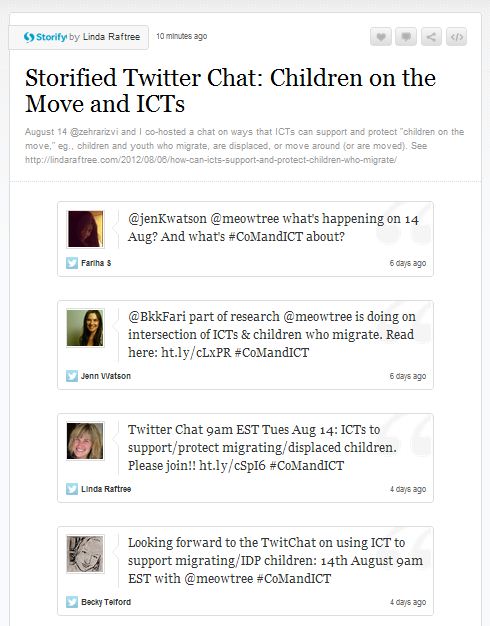
On August 14, @zehrarizvi and I co-hosted a Twitter chat on ways that ICTs can support and protect “children on the move,” eg., children and youth who migrate, are displaced, or move around (or are moved). Background information on the issue and the research.

We discovered some new angles on the topic and some resources and studies that are out or will be coming out soon, for example an upcoming Girls Count study on Girls on the Move by Population Council, a UNHCR paper on ICTs and urban refugee protection in Cairo, and Amnesty’s Technology, People and Solutions work.

Thanks to everyone who participated – whether you were actively tweeting or just observing. We hope it was as useful to you all as it was to us! If you think of anything new to add, please tweet it using #CoMandICT or email me at linda.raftree [at] planusa.org.

Read the Storify version here (with a bonus picture of @chrisalbon holding up a ‘burner’ phone). Don’t know what a ‘burner’ phone is? Click and take a look.

Read Full Post »

New technologies are opening up all kinds of possibilities for improving monitoring and evaluation. From on-going feedback and crowd-sourced input to more structured digital data collection, to access to large data sets and improved data visualization, the field is changing quickly.

On August 7, the Rockefeller Foundation and the Community Systems Foundation (CSF) joined up with the Technology Salon NYC for the first in a series of 3 Salons on the use of ICTs in monitoring and evaluating development outcomes. Our lead discussants were: Erica Kochi from UNICEF Innovations; Steven Davenport from Development Gateway and John Toner from CSF.

This particular Salon focused on the use of ICTs for social monitoring (a.k.a. ‘beneficiary feedback loops’) and accountability. Below is a summary of the key points that emerged at the Salon.

1) Monitoring and evaluation is changing

M&E is not only about formal data collection and indicators anymore, one discussant commented, “It’s free form, it contains sentiment.” New ICT tools can help donors and governments plan better. SMS and other social monitoring tools provide an additional element to more formal information sources and can help capture the pulse of the population. Combinations of official data sets with SMS data provide new ways of looking at cross-sections of information. Visualizations and trend analysis can offer combinations of information for decision making. Social monitoring, however, can be a scary thing for large institutions. It can seem too uncontrolled or potentially conflictive. One way to ease into it is through “bounded” crowd-sourcing (eg., working with a defined and more ‘trusted’ subset of the public) until there is comfort with these kinds of feedback mechanisms.

2) People need to be motivated to participate in social monitoring efforts

Building a platform or establishing an SMS response tool is not enough. One key to a successful social monitoring effort is working with existing networks, groups and organizations and doing well-planned and executed outreach, for example, in the newspaper, on the radio and on television. Social monitoring can and should go beyond producing information for a particular project or program. It should create an ongoing dialogue between and among people and institutions, expanding on traditional monitoring efforts and becoming a catalyst for organizations or government to better communicate and engage with the community. SMS feedback loops need to be thought of in terms of a dialogue or a series of questions rather than a one-question survey. “People get really engaged when they are involved in back and forth conversation.” Offering prizes or other kinds of external motivation can spike participation rates but also can create expectations that affect or skew programs in the long run. Sustainable approaches need to be identified early on. Rewards can also lead to false reports and re-registering, and need to be carefully managed.

3) Responsiveness to citizen/participant feedback is critical

One way to help motivate individuals to participate in social monitoring is for governments or institutions to show that citizen/participant feedback elicits a response (eg., better delivery of public services).  “Incentives are good,” said one discussant, “But at the core, if you get interactive with users, you will start to see the responses. Then you’ll have a targeted group that you can turn to.” Responsiveness can be an issue, however if there is limited government or institutional interest, resourcing or capacity, so it’s important to work on both sides of the equation so that demand does not outstrip response capacity. Monitoring the responsiveness to citizen/participant feedback is also important. “Was there a response promised? Did it happen? Has it been verified? What was the quality of it?”

4) Privacy and protection are always a concern

Salon participants brought up concerns about privacy and protection, especially for more sensitive issues that can put those who provide feedback at risk. There are a number of good practices in the IT world for keeping data itself private, for example presenting it in aggregate form, only releasing certain data, and setting up controls over who can access different levels of data. However with crowd-sourcing or incident mapping there can be serious concerns for those who report or provide feedback. Program managers need to have a very good handle on the potential risks involved or they can cause unintended harm to participants. Consulting with participants to better understand the context is a good idea.

5) Inclusion needs to be purposeful

Getting a representative response via SMS-based feedback or other social monitoring tools is not always easy. Mandatory ratios of male and female, age groups or other aspects can help ensure better representation. Different districts can be sampled in an effort to ensure overall response is representative. “If not,” commented one presenter, “you’ll just get data from urban males.” Barriers to participation also need consideration, such as language; however, working in multiple languages becomes very complicated very quickly. One participant noted that it is important to monitor whether people from different groups or geographic areas understand survey questions in the same way, and to be able to fine-tune the system as it goes along. A key concern is reaching and including the most vulnerable with these new technologies. “Donors want new technology as a default, but I cannot reach the most excluded with technology right now,” commented a participant.

6) Information should be useful to and used by the community

In addition to ensuring inclusion of individuals and groups, communities need to be involved in the entire process. “We need to be sure we are not just extracting information,” mentioned one participant. Organizations should be asking: What information does the community want? How can they get it themselves or from us? How can we help communities to collect the information they need on their own or provide them with local, sustainable support to do so?

7) Be sure to use the right tools for the job

Character limitation can be an issue with SMS. Decision tree models, where one question prompts another question that takes the user down a variety of paths, are one way around the character limit. SMS is not good for incredibly in-depth surveys however; it is good for breadth not depth. It’s important to use SMS and other digital tools for what they are good for. Paper can often be a better tool, and there is no shame in using it. Discussants emphasized that one shouldn’t underestimate the challenges in working with Telco operators and making short codes. Building the SMS network infrastructure takes months. Social media is on the rise, so how do you channel that into the M&E conversation?

8) Broader evaluative questions need to be established for these initiatives

The purpose of including ICT in different initiatives needs to be clear. Goals and evaluative questions need to be established. Teams need to work together because no one person is likely to have the programmatic, ICT and evaluation skills needed for a successfully implemented and well-documented project. Programs that include ICTs need better documentation and evaluation overall, including cost-benefit analyses and comparative analyses with other potential tools that could be used for these and similar processes.

9) Technology is not automatically cheaper and easier

These processes remain very iterative; they are not ‘automated’ processes. Initial surveys can only show patterns. What is more interesting is back-and-forth dialogue with participants. As one discussant noted, staff still spend a lot of time combing through data and responses to find patterns and nuances within the details. There is still a cost to these projects. In one instance, the major project budget went into a communication campaign that was launched and the work with existing physical networks to get people to participate. Compared to traditional ways of doing things (face-to-face, for example) the cost of outreach is not so expensive, but integrating SMS and other technologies does not automatically mean that money will be saved. The cost of SMS is also large in these kinds of projects because in order to ensure participation, representation, and inclusion, SMS usually needs to be free for participants. Even with bulk rates, if the program is at massive scale, it’s quite expensive. When assuming that governments or local organizations will take over these projects at some point, this is a real consideration.

10) Solutions at huge scale are not feasible for most organizations 

Some participants commented that the UN and the Red Cross and similarly sized organizations are the only ones who can work at the level of scale discussed at the Salon. Not many agencies have the weight to influence governments or mobile service providers, and these negotiations are difficult even for large-scale organizations. It’s important to look at solutions that react and respond to what development organizations and local NGOs can do. “And what about localized tools that can be used at district level or village level? For example, localized tools for participatory budgeting?” asked a participant. “There are ways to link high tech and SMS with low tech, radio outreach, working with journalists, working with other tools,” commented others. “We need to talk more about these ways of reaching everyone. We need to think more about the role of intermediaries in building capacity for beneficiaries and development partners to do this better.

11) New technology is not M&E magic

Even if you include new technology, successful initiatives require a team of people and need to be managed. There is no magic to doing translations or understanding the data – people are needed to put all this together, to understand it, to make it work. In addition, the tools covered at the Salon only collect one piece of the necessary information. “We have to be careful how we say things,” commented a discussant. We call it M&E, but it’s really ‘M’. We get confused with ourselves sometimes. What we are talking about today is monitoring results. Evaluation is how to take all that information then, and make an informed decision. It involves specialists and more information on top of this…” Another participant emphasized that SMS feedback can get at the symptoms but doesn’t seem to get at the root causes. Data needs to be triangulated and efforts made to address root causes and end users need to be involved.

12) Donors need to support adaptive design

Participants emphasized that those developing these programs, tools and systems need to be given space to try and to iterate, to use a process of adaptive design. Donors shouldn’t lock implementers into unsuitable design processes. A focused ‘ICT and Evaluation Fail Faire’ was suggested as a space for improving sharing and learning around ICTs and M&E. There is also learning to be shared from people involved in ICT projects that have scaled up. “We need to know what evidence is needed to scale up. There is excitement and investment, but not enough evidence,” it was concluded.

Our next Salon

Our next Salon in the series will take place on August 30th. It will focus on the role of intermediaries in building capacity for communities and development partners to use new technologies for monitoring and evaluation. We’ll be looking to discover good practices for advancing the use of ICTs in M&E in sustainable ways. Sign up for the Technology Salon mailing list here. [Update: A summary of the August 30 Salon is here.]

Salons run by Chatham House Rule, thus no attribution has been made. 

Read Full Post »

The use of social media and new technologies in disaster and crisis situations will likely be framed forevermore as ‘Before Haiti’ (BH) and ‘After Haiti’ (AH). The terrible earthquakes that devastated the country and the resulting flood of humanitarian interventions that followed mark the moment that the world woke up to the role that new technology and new media can and do play in the immediate local response to a crisis as well as the ongoing emergency response once international volunteers and aid organizations arrive to the scene.

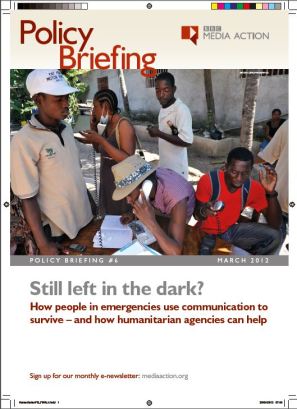
Still left in the dark? How people in emergencies use communication to survive — and how humanitarian agencies can help,’ is a new policy briefing by BBC Media Action. It does a fantastic job of highlighting the ways that new media is changing disaster response and the fact that the humanitarian industry is not doing enough to keep pace.

The briefing asks: ‘Are humanitarian agencies prepared to respond to, help and engage with those who are communicating with them and who demand better information?’ As the report shows, the answer is ‘not really’.

Many humanitarian agencies continue to see ‘communication’ as something done to raise money or boost the profile of their own efforts, says the report. Yet the sector increasingly needs a clear, strategic focus that responds to the information and communication needs of disaster-affected populations. ‘While responders tend to see communication as a process either of delivering information (‘messaging’) or extracting it, disaster survivors seem to see the ability to communicate and the process of communication itself as every bit as important as the information delivered.’ Communicating with affected populations can improve programming and response, not to mention, as highlighted in the Listening Project and referred to in the BBC report, ‘Listening is seen as an act of respect.’

The briefing is not one-sided, however, and it does a good job of understanding some of the common perceptions around the use of new technologies. There is ICT and social media hype on the one hand (often the position of international ICT specialists, based on very little hard evidence). And there is strong questioning of the value of these tools at all on the other hand (often the position of aid workers who are turned off by the hype and want to see proven practice if they are to consider investing time and resources in new ICTs). The briefing paper provides examples that may serve to convince those who are still unconvinced or uninterested.

Many of us see the reality that social media tools are still quite out of reach of the poorest members of a community or country. But writing new media and technologies off entirely is ‘too crude an analysis,’ says the briefing paper, ‘and one that is being challenged by data from the field.’ In Thailand, for example, use of social media increased by 20 percent in both metropolitan and rural areas when the 2010 floods began. ‘Communities now expect — and demand — interaction,’ the paper emphasizes.

Throughout the paper there are good examples of ways that in the immediate aftermath of a disaster local individuals and companies are quickly creating and rolling out communication platforms that are more relevant, feasible and sustainable than some of the initiatives that have been led by international agencies.

An important point that the report makes is that the most successful use of new media in disaster response combines multiple communication channels — new and old — allowing information to flow in and out, to and from different populations with different media habits and levels of access. For example, local journalists and radio stations may pull information from Twitter and Facebook and broadcast it via the radio. They may also be broadcasting online, meaning that they not only reach their local population, but they also reach the diaspora community. ‘Good communication work,’ the paper notes, ‘is, by definition, multi-platform. It is about integrating media, non mass media and technology tools in a manner that is rooted firmly in an understanding of how communities approach information issues.’

So ‘while aid agencies hesitate, local communities are using communications technology to reshape the way they prepare for and respond to emergencies.’ This hesitation remains in the face of growing evidence, according to the paper, that agencies who invest in meaningful communication with disaster-affected communities garner a range of benefits. ‘The communication process becomes central to effective relationships, mitigating conflict and identifying and preventing rumours and misunderstandings.’ Doing it right, however requires good program design, which in turn, requires aid agencies to focus time and expertise on improving communications with affected populations, which, of course, requires budget allocated to these kinds of activities.

For those agencies that want to look more closely at integrating some of these tools and approaches, the report gives several great examples. The recommendations section is also very useful.

One of the recommendations I think it is especially good to highlight is ‘analyse the communications landscape’ (see InfoAsAid’s materials). I would, however, have liked to see mention of involving members of local communities in a participatory analysis of that landscape. In addition to the technical analysis, it’s important to know who trusts which information sources, and why. For example, the information sources trusted by men may be different than those that women trust. The same goes for children, youth and adolescents. Access is also a critical issue here, especially in terms of reaching more marginalized groups, as the population affected by a disaster is not homogeneous and there will be hierarchies and nuances that should be considered in order to avoid leaving certain people or groups out. I would have liked more mention of the need to take a specialized approach and make a focused effort regarding communication with children and adolescents, with women, with certain ethnic groups or persons with disability, as they may be left out if care is not taken to include them.

Another recommendation I found very useful was ‘think of the whole population, not just beneficiaries.’ The paper cautions that working only with the population that directly benefits from an individual agencies’ funding is a positive angle for transparency and accountability, but it ‘seems to have a profoundly limiting effect in practice.’ Beneficiaries need information about more than just one aid agency, and those who are not benefiting from a particular agency’s programs also have information needs.

The report mentions that sometimes in the aftermath of a disaster, when people use new media to communicate, confidentiality and privacy risks are not fully considered. I’d like to see this aspect addressed a bit more in the future as there is a lack of documented good practice around privacy and protection. (Note: I’ll be involved in some research on ICTs, migration and child protection over the next year, so watch this space if it’s a topic of interest.) Humanitarian agencies may have strong policies here, but this is an area that others may not consider in their rush to offer support following a disaster.

Overall the report is extremely useful for those considering how to improve two-way (or multi-way) communication in a post-disaster situation and I very much enjoyed reading it as it sparked learning and fresh ideas, and documented some good work being done by local as well as international groups.

I don’t have a lot of pity or patience for aid agencies who are ‘left behind’ because they refuse to move with the changing times or because their approaches are not effective or relevant. There are several forces that are ‘disrupting’ humanitarian work these days, and  the report does a great job of identifying some of them. It also highlights the importance of local actors, local private sector and diaspora communities who have always played an important role in aid and development but have only recently been given more recognition.

International agencies still play a critical role in the humanitarian space, but they need to understand and adapt to the changes happening around them. This report can serve as a discussion piece and offer guidance for those agencies who want to use new media and technology to enable them to do a better job of listening to, working with and being accountable to disaster affected populations.

In summary, highly recommended reading!

Read Full Post »

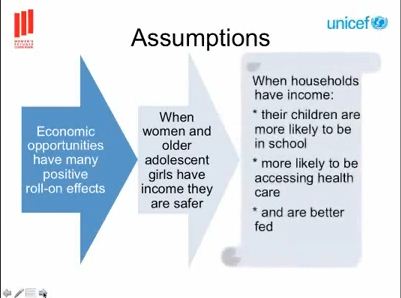
When working with women and girls in conflict or displacement situations (actually, when working with anyone, in any situation), we often make assumptions. In this case, the assumption is that “economic opportunities for women and adolescent girls have positive roll-on effects”, according to Mendy Marsh, UNICEF’s Gender Based Violence (GBV) Specialist in Emergencies.

Slide from Marsh’s presentation.

We assume that when women and older adolescent girls have income, they are safer. We assume that when households have income, children are more likely to be in school, that they are accessing healthcare, and that they are better fed, says Marsh.

But do we know whether that is true or not? What does the evidence say?

I took an hour today to listen to Marsh along with Dale Buscher, Senior Director for Programs at the Women’s Refugee Commission (WRC), talk about WRC’s “Peril or Protection: Making Work Safe” Campaign (watch the recording here).

GBV happens in all communities, including stable ones. But when situations become unstable, Marsh noted, a number of additional factors combine to make women and adolescent girls in conflict or displacement settings vulnerable to violence.

Slide from Marsh’s presentation.

These factors include:

  • Inadequate legal frameworks –eg., impunity for those committing GBV and a lack of awareness of rights
  • Lack of basic survival needs  — eg., food, non-food items, fuel, water, safe shelter
  • Lack of opportunities – eg., women’s and girls’ financial dependence, potential for exploitative work
  • Sociocultural aspects – eg., harmful practices, domestic violence, early and forced marriage
  • Insecurity – eg., flight and displacement, no lighting, no safe shelter, non-separate latrines or hygiene facilities for men, women, boys and girls, or facilities that don’t lock or are insecure; dependency on males for information

Emphasis during conflict situations tends to focus on response not prevention, said Marsh. Different agencies and sectors often work in isolation, but no single agency or sector can address GBV. It needs to be addressed across all sectors with strong community participation, including that of men and boys.

Often, she noted, livelihoods programs are brought in as a response to women’s needs and based on the assumptions above. There can be unintended negative effects from these programs and we need to be aware of them so that they can be mitigated.

Following Marsh’s introduction, Busher explained that because WRC wanted to better understand any potential unintended consequences from livelihoods programs aimed at women in conflict or displacement situations, in 2009 they conducted research and produced “Peril or Protection: The Link between Livelihoods and Gender-Baed Violence in Displacement Settings.

There is a very weak evidence base in terms of the links between gender based violence and livelihoods programming, he said.

WRC found that in some cases livelihood programs implemented by NGOs actually increased women’s and adolescent girls’ risks of GBV because of factors such as their entering the public sphere, going to market, using unsafe transportation and domestic conflict. The economic opportunities heightened the risks that women and girls faced. Providing them with income generation opportunities did not necessarily make women and girls safer or give them more control over resources.

Slide from Buscher’s presentation.

The answer is not to stop creating economic opportunities, however. Rather it is to design and implement these kinds of programs in responsible ways that do no harm and that are based on in-depth consultations with women, girls and their communities, livelihoods practitioners and GBV specialists.

Based on their research and with input from different stakeholders, WRC designed a toolkit to help those creating livelihoods programs for and with women and adolescent girls to do so in a way that lessens the risk of GBV.

The process outlined in the toolkit includes secondary research, safety mapping, a safety tool, and a decision chart.

Based on the secondary research, practitioners work with adolescent girls, women and the wider community to map the places that are important for livelihoods, explained Buscher. For example, the bus, a taxi stand, a supply shop, the fields.

Community members discuss where women and girls are safe and where they are not. They describe the kinds of violence and abuse that girls and women experience in these different places.

They identify strategies for protection based on when GBV takes place in the different locations. For example, does it happen year-round? At certain times of year? Only at night? Only on weekends?

They identify and discuss the most risky situations. Is a girl or woman most at risk when she is selling by the side of the road? Alone in a shop?

They also discuss which relationships are the most prone to GBV. Bosses? Suppliers? Buyers? Intimate Partners? Together the women and girls share and discuss the strategies that they use to protect themselves.

An additional tool identifies the social safety net that a women or adolescent girl has, considering that social networks are important both for livelihoods as well as for protection. Ways to strengthen them are discussed.

Finally, a decision chart is created with a list of livelihood activities and the information from the previous charts and discussions to determine the levels of risk in the different kinds of livelihood activities and the potential strategies for mitigating GBV.

Decisions are also made by the adolescent girls and women regarding which risks they are willing to take for which levels of livelihoods.

Marsh and Buscher concluded that safe, dignified work may be the most effective form of protection because it can help mitigate negative coping strategies such as transactional sex, child labor, pulling children out of school, and selling rations.

Livelihoods, however, should not be thought of as a little bit of money to supplement daily rations. They should be sustainable and help meet basic needs in an ongoing way; and they should lead to dignified work. The amount earned and the risks involved for women and girls need to be worth it for them, considering all the other domestic chores that they are required to do. NGOs need to consult with and listen to girls and women to better understand their needs, coping strategies.

If you’d like to learn more about the research, and the toolkit, WRC offers a free e-learning tool on how to make work safe.

You can also follow the #safelivelihoods conversation on twitter.

Read Full Post »

English version here

A menudo, en el sector de las ONGs, se discute cómo podemos integrar de una mejor manera, las TICs en el proceso de desarrollo de las comunidades. Para mí, este video muestra una de las mejores maneras para lograrlo: contratar a personas como David.

Contratar gente joven y que provienen de las comunidades, personas que entiendan las realidades locales y que además son apasionados/as por mejorar las cosas de su entorno y tienen ganas de hacer cosas nuevas. Contratar personas no pretenciosas, personas que escuchan y que preguntan cuando no tienen la respuesta.

Hay que contratar a personas curiosas, que buscan información y están llenas de motivación propia. Aquellas que no tienen miedo al trabajo duro y que sienten la necesidad de tomar riesgos y además, no le  temen a la posibilidad de fallar. Hay que contratar gente con chispa creativa. Aquellas personas que saben trabajar en equipo, colaborar con otros y aprender de las personas a su alrededor.

Se debe contratar gente joven, que entiendan y usen las nuevas tecnologías y que pasen suficiente tiempo fuera de la oficina para saber cómo se pueden utilizar las TICs como herramienta en el desarrollo y/o en circunstancias difíciles.

Para eso hay que contratar gente como David. Pero no basta solo contratarla.

Una vez contratada, se debe asegurar que tengan las condiciones para crecer y logar su plenitud.

También se debe garantizar que tengan acceso a oportunidades, que participan en reuniones y eventos internos y externos, locales, regionales y globales para compartir sus conocimientos y así  aprender y para hacer contactos y conexiones.

A las personas como David se debe premiarlas, honrarlas y felicitarlas regularmente, aún si están muy ocupadas cumpliendo su trabajo, fuera de la autopromoción y de la política de la oficina.

Se debe asegurar que personas como David, tengan mentores y gerentes que les quiten las barreras para que puedan avanzar con su trabajo y en su desarrollo profesional. Escucharlas y respetarlas. Si, también debe cuestionárseles – pero con la certeza que ellas tienen la capacidad de inventar ideas que pueden funcionar, aún si no son las ideas que usted hubiera inventado. Los mentores y gerentes no deben sentirse amenazados por las personas como David, cuando sepan más que usted sobre algo. Todos y todas pueden aprender del uno al otro si el espacio para el diálogo es abierto y sincero.

Las personas como David son el presente y el futuro de los procesos del desarrollo.

Por las personas como David, me cuesta dar consejos de carrera a las personas en los EEUU que buscan trabajo en otros países. Preferia ver a las personas como David ocupando estos puestos.

David recién ganó el premio del Empleado Nuevo con Mayor Promesa en la región de las Américas durante los Premios Globales de Plan Internacional. Sigue a David al @2drodriguez y aprende más sobre los proyectos que esta hacienda aca: Mis Derechos Ante Desastres, en la pagina del proyecto de Facebook, o al @deantede.

(Gracias a Max Rodriguez por revisar y corregir mi traducción del post)

Read Full Post »

In the INGO sector, we often discuss ways that development organizations can better bridge development and ICTs. If you ask me, this video shows one of the best ways to achieve it: Hire people like David.

Hire young, local folks who have spent time in communities, who understand local realities, who are passionate about helping make things better, and who are hungry to do new things that make sense. Hire people who are humble; people who listen and who ask questions when they don’t know the answer.

Hire people who are curious, who seek out information, who are self starters, and who are not afraid to work hard, to try, to take risks and to fail. Hire people with creative fire who know how to work in a team, how to collaborate with others and how to learn from those around them. Hire young people who use and understand new technologies and who spend enough time out of the office to know how they can realistically be applied to development issues in difficult settings.

Hire people like David.

But don’t only hire them.

Once you hire them, make sure that they have the conditions to thrive and achieve to their fullest.

Make sure people like David have access to opportunities. Make sure that they get to attend regional and global internal and external meetings to share what they know, to learn, and to make contacts and connections.

Notice people like David. Reward them, honor them, and congratulate them regularly, even if they are too busy getting the job done to spend lots of time on self-promotion or office politics.

Make sure people like David have mentors and managers who can take roadblocks out of their way. Listen to them. Respect them. Question them, yes, but do so with the honest belief that they have the capacity to come up with ideas that can work even if they are not the ideas you would have come up with. Don’t feel threatened by people like David when they know more than you do about something. We can all learn from each other if the space for dialogue is open and sincere.

People like David are the present and future of development efforts.

People like David are the reason I have a hard time giving career advice to folks in the US who are looking for jobs overseas. I’d rather see people like David in these positions.

David recently won the “Most Promising Newcomer” award for the Americas region during Plan International’s Global Awards. Follow David at @2drodriguez and learn more about what he’s up to at the website Mis Derechos Ante Desastres (My Rights in the Face of a Disaster), the project Facebook page, or at @deantede.

**Version Español

Read Full Post »

I spent last week at the International Open Government Data Conference (IOGDC), put on by Data.gov, the World Bank Open Data Initiative and the Open Development Technology Alliance. For a full overview, watch some of the presentations and read the liveblog.

A point made by several presenters and panelists is that the field has advanced quite a bit in terms of getting data open, and that what really matters now is what people are doing with the data to improve and/or change things.

One of the keynoters, David Eaves, for example, commentedthe conferences we organize have got to talk less and less about how to get data open and have to start talking more about how do we use data to drive public policy objectives. I’m hoping the next International Open Government Data Conference will have an increasing number of presentations by citizens, non-profits and other outsiders [who] are using open data to drive their agenda, and how public servants are using open data strategically to drive to a[n] outcome.” 

There were some great anecdotal examples throughout the conference of how open data are having impact, especially in 4 key areas:

  1. economic growth/entrepreneurship
  2. transparency, accountability and governance
  3. improved resource allocation and provision of services
  4. connecting data dots and telling stories the public needs to know

There was also quite a bit of recognition that we need more evidence to back up the anecdotal success stories told around open data, and that it’s difficult to trace all the impact that open data are having because of the multiple and unintended impacts.

On the other hand, the question was raised: “is open data part of the public’s right to information? Because if we conceive of open data as a right, the framework and conceptualization change as do, perhaps, the measures of success.

Several panelists mentioned some of the big challenges around engaging citizens to use open data for social change, especially in areas with less resources and low access to the Internet.

If one of the key next steps is engaging citizens in using open data, we all need to think more about how to overcome barriers like language, literacy, who owns and accesses devices, low education levels, low capacity to interpret data, information literacy, power and culture, apathy, lack of incentive and motivation for citizen engagement, and poor capacity of duty bearers/governments to respond to citizen demand. (For more on some of these common challenges and approaches to addressing them, see 15 thoughts on good governance programming with youth.)

On the last day of IOGDC we had the opportunity to suggest our own topics during Open Space. I suggested the topic “Taking Open Data Offline” because it seems that often when we imagine all the fantastic possibilities of open data, we forget how many people live in remote, rural areas (or urban areas with poor infrastructure) where there is no broadband and where many of the above-mentioned barriers are very high. (See a Storified summary of our conversation here: #IOGDCoffline.)

The solutions most often mentioned for getting data into the hands of ordinary citizens are Internet and mobile apps. Sometimes when I’m around open data folks, I do a double take because the common understanding of ‘infomediary’ is ‘the developer making the mobile app’. This seems to ignore that, as Jim Hendler noted during the IOGDC pre-conference, some 75% of the world’s population is still offline.

We need to expand the notion of ‘infomediary’ in these discussions to think about the range of people, media, organizations and institutions who can help close the gap between big data and the average person, both in terms of getting open data out to the public in digestible ways and in terms of connecting local knowledge, information needs, feedback and opinions of citizens back to big data. There will need to be a wide range of infomediaries using a number of different communication tools and channels in order to really make open data accessible and useful.

Though things are changing, the majority of folks in the world don’t yet have smart phones. In a sense, the ‘most marginalized’ could be defined as ‘those who don’t have mobile phones.’ And even people who do have phones may not choose to spend their scarce resources to access open data. Data that is available online may be in English or one of only a few major languages. Most people in most of the world don’t purchase data packages, they buy pre-paid air time. The majority don’t have a constant connection to the cloud but rather rely on intermittent Internet access, if at all.

In addition, in areas where education levels are low or data interpretation skills are not strong, people may not have the skills to make use of open data found online. So other communications tools, channels and methods need to be considered for making open data accessible to the broader public via different kinds of intermediaries and infomediaries, multi-direction information sharing channels, feedback loops and combinations of online/offline communication. People may even need support formulating the questions they want answered by open data, considering that open data can be a very abstract concept for those who are not familiar with the Internet and the use of data for critical analysis.

    https://twitter.com/prefontaine/status/223502308435165185

Some great ideas on how to use SMS in open data and open government and accountability work exist, such as Huduma, UReport, I Paid A Bribe, and more. Others are doing really smart thinking about how to transform open data into engaging media for a general audience through beautiful graphics that allow for deep analysis and comparison and that tell compelling stories that allow for a personal connection.

We need to think more, however, about how we can adapt these ideas to offline settings, how to learn from approaches and methods that have been around since the pre-Internet days, and how to successfully blend online-offline tools and contexts for a more inclusive reach and, one hopes, a wider and broader impact.

‘Popular Education’ and ‘Communication for Development (C4D)’ are two fields the open data movement could learn from in terms of including more remote or ‘marginalized’ populations in local, national and global conversations that may be generated through opening up data.

I remember being on a 10-hour ride to Accra one time from the Upper West Region of Ghana. The driver was listening to talk radio in a local language. At one point, someone was reading out a list. I couldn’t understand what was being said, but I could tell the list contained names of communities and districts. The list-reading went on for quite a long time. At one point, the driver cheered and pumped his fist. I asked what he was happy about and he explained that they were reading the list of where the government would be constructing schools and assigning teachers in the next year. His community was going to get a secondary school, and his children would not have to travel far now to continue their education. Radio is still one of the best tools for sharing information. Radio can be combined with activities like ‘Listening Clubs’ where groups gather to listen and discuss. Integrating SMS or call-in options make it possible for radio stations to interact more dynamically with listeners. Tools like FrontlineSMS Radio allow tracking, measuring and visualization of listener feedback.

I lived in El Salvador for the 1990s. Long and complicated Peace Accords were signed in 1992 after 12 years of civil war. A huge effort was made to ‘popularize’ the contents of the Peace Accords so that the whole country would know what the agreements were and so that people could hold the different entities accountable for implementing them. The contents of the Peace Accords were shared via comics, radio, public service announcements, and a number of other media that were adapted to different audiences. Local NGOs worked hard to educate the affected populations on the rights they could legally claim stemming from the Accords and to provide support in doing so.

When the Civil War ended in Guatemala a few years later, the same thing happened. Guatemala, however had the additional complication of 22 indigenous languages. Grassroots ‘popular education’ approaches in multiple languages were used by various groups across the country in an effort to ensure that no one was left out, to help develop ‘critical conscience’ and critical thinking around the implementation of the Peace Accords, and to involve the public in the work around the Truth Commission, which investigated allegations of human rights violations during the war and opened them to the public as part of the reconciliation process. Latin America (thanks to Paolo Freire and others) has a long history of  ‘popular education’ approaches and methods that can be tapped into and linked with open data. Open data can be every bit as complicated as the legalistic contents of the Peace Accords and it is likely that data that is eventually opened will link with issues (lack of political participation, land ownership patterns, corruption, political favoritism, poor accountability and widespread marginalization) that were the cause of conflict in past decades.

The Mural of the People / O Mural do Povo from Verdade in Mozambique. “The marvelous Mozambican public will attribute each year the ‘Made in Frelimo Oscar of Incompetence’…  The 2012 candidates are…”

In Mozambique, 75% of the population live on less than $1.25 a day. Newspapers costing between 45 and 75 cents are considered a luxury. The 20,000 issues of the free and widely circulated Verdade Newspaper, which comes out once a week, reach an estimated 400,000 people in Maputo and a few other cities as they are read and passed around to be re-read. Verdade reaches an additional audience via Facebook, Twitter and YouTube, and a ‘Mural of the People’ where the public can participate and contribute their thoughts and opinions old-school style — on a public chalkboard. The above February 7, 2012, mural, for example, encouraged the population to vote in the ‘Incompetence Oscars – Made in Frelimo [the current government party]’. Candidates for an Incompetence Oscar included the “Minister of Unfinished Public Works.” (More about Verdade here.) This combination of online and offline tools helps spread news and generate opinion and conversation on government performance and accountability.

Social accountability tools like community scorecards, participatory budget advocacysocial auditsparticipatory videoparticipatory theater and community mapping have all been used successfully in accountability and governance work and would be more appropriate tools in some cases than Internet and mobile apps to generate citizen engagement around open data. Combining new ICTs together with these well-established approaches can help take open data offline and bring community knowledge and opinions online, so that open data is not strictly a top-down thing and so that community knowledge and processes can be aggregated, added to or connected back to open data sets and more widely shared via the Internet (keeping in mind a community’s right also to not have their data shared).

A smart combination of information and communication tools – whether Internet, mobile apps, posters, print media, murals, song, drama, face-to-face, radio, video, comics, community bulletin boards, open community fora or others – and a bottom-up, consultative, ‘popular education’ approach to open data could really help open data reach a wider group of citizens and equip them not only with information but with a variety of channels through which to participate more broadly in the definition of the right questions to ask and a wider skill set to use open data to question power and push for more accountability and positive social change.

Related posts on Wait… What?:

ICTs, social media, local government and youth-led social audits

Digital mapping and governance: the stories behind the maps

What does ‘open knowledge’ have to do with ‘open development’?

15 thoughts on good governance programming with youth

Governance is *so* not boring

Young Citizens, Youth and Participatory Governance in Africa

A practitioners’ discussion on social accountability and youth participatory governance

Can ICTs support accountability and transparency in education?

Orgasmatron moments

Listening and feedback mechanisms

Read Full Post »
USAID has been busy lately with a redesign and roll-out of the new USAID.gov.

You can now access first-generation interactive maps at the country level for 40 missions (see screen capture below).

Screen capture from http://map.usaid.gov/ on July 5, 2012.

In addition, as part of the USAID evaluation policy that ‘sets ambitious standards for the quality and transparency of evaluation to demonstrate results, generate evidence to inform decisions, promote learning and ensure accountability’ the page that houses the Development Evaluation Clearinghouse (DEC) has been revamped. You can now search 50 years of international aid records, submit reports, and ‘get social’ by sharing, rating, tagging and blogging. Introduction videos are available to help you get started.

Not only is there better looking and more accessible information on-line, you can get two mobile applications (available for iPhone and iPad):

  • The DEC mobile app provides access to a subset of USAID Development Experience Clearinghouse (DEC) documents (recent evaluations).
  • The Portfolio Map mobile app allows you to browse the USAID portfolio for a subset of the countries in which USAID is working, access general country overviews at a glance and get more detailed information as needed.

In other news, alongside their own new website, on June 25th, 2012, USAID together with the Department of State announced publication of USAID’s foreign assistance obligation and expenditure data for Fiscal Year 2009-2011 on the Foreign Assistance Dashboard.

As explained during the DC Technology Salon on ‘How will IATI impact international development,’ the Dashboard is the US Government’s main tool for improving foreign aid transparency. It will play a key role in US Government reporting of foreign assistance data to the international community, one of the measures agreed on when the US Government signed onto the International Aid Transparency Initiative (IATI) in November 2011.

According to the June 25th press release, ‘the Dashboard also has budget planning data for the Department of State and USAID, as well as the Millennium Challenge Corporation (MCC)’s foreign assistance budget planning, obligation, and expenditure data.  Data on the site can be manually queried, filtered, and downloaded by users for further analysis.

The Dashboard is designed to allow a range of stakeholders, including U.S. citizens, civil society organizations, Congress, U.S. Government agencies, donors, and partner country governments; to examine, research, and track foreign assistance data in an accessible and easy-to-understand format. It aims to allow users to explore the impact of U.S. foreign assistance funding by country, sector, initiative, and agency by presenting data in a standard and user-friendly way.

According to USAID, ‘as the lead agency in implementing U.S. foreign assistance activities around the world, the launch of USAID obligation and expenditure data on the Foreign Assistance Dashboard represents a significant step forward in the U.S. Government’s efforts to make foreign assistance more transparent.’ (For additional discussion on this point, see the summary post from the aforementioned Technology Salon.)

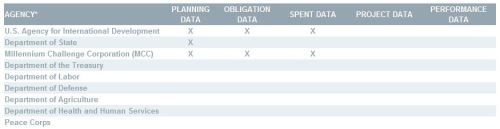
The Dashboard is currently in an early stage of development. The site eventually plans for the incorporation of ‘budget, financial, program, and performance data in a standard form from all U.S. Government agencies receiving or implementing foreign assistance, humanitarian, and/or development funds.’ (See the table below for an idea of what is currently done and what is coming up.)

For more information about the Dashboard, see the Top Ten Things You Should Know page.

With all this information being made more accessible to everyone, it will be interesting to see if and how it’s used by different people and institutions for different purposes, especially in terms of improving coordination, program planning, transparency, accountability and aid effectiveness.

Read Full Post »

The Open Knowledge Festival (OKFest) happens this September 17-22 in Helsinki, Finland with the theme Open Knowledge in Action. OKFest will explore the benefits of opening up knowledge and information, look at the ecosystems of organisations that can benefit from openness, and discuss the impact that more transparency can have in our societies. OKFest will run 13 key Topic Streams, one of which will focus on the topic of ‘Open Development’.

So what does ‘open knowledge’ have to do with ‘open development’? And why are people putting the word ‘open’ in front of everything these days?

Well, in addition to being a bit of a buzz word or trend, the idea behind ‘open’ is that making data and information more accessible and less restricted can enhance transparency, accountability, sharing, and collaboration. This in turn can benefit development processes. (See this post for ideas on how openness and information literacy links with participatory governance, for example.)

As Matthew Smith, a strong proponent of ‘open development,’ says, ‘openness’ is not a new concept, especially with respect to development theory. Democracy and participation represent an opening up of decision-making processes to more people. Transparency and accountability are about opening up organizations, people and processes to scrutiny and feedback.

The Internet and new ICTs such as mobile phones play a big part in the idea of ‘open’ since these platforms and tools can allow data and information to be shared more freely and widely. The concept of ‘open development’ according to Smith is enhanced by ICTs when it favors:

  • Universal over restricted access to communication tools and information. For example, access to the telecommunications infrastructure through a mobile phone or access to online [educational] content or government information.
  • Universal over restricted participation in informal and formal groups/institutions. For example, the use of SMS to mobilize political protests or new e-government implementations that provide increased transparency and new accountability arrangements.
  • Collaborative over centralized production of information, cultural content, and physical goods. For example, collaborative production of school textbooks, co-creation of government services, mesh networks.

Attitudes and behaviors also play a part in ‘openness.’ Smith notes that egalitarianism and sharing are two core concepts within ‘openness:’

  • Egalitarianism suggests an equal right to participate (access, use and collaborate).
  • Sharing is embedded in the idea of enhanced access to things that were otherwise normally restricted. This enhanced access is often motivated by the normative desire to share – whether through an obligation to contribute to the common good or to participate in a coordinated or collaborative activity.

Policies, practices and philosophies that allow data and information to be shared are also a part of ‘open’. Tim Davies explains ‘open data‘ as:

  • a set of policies and practices – open data should be accessible (online); standardized (in a common format) and reusable (open licenses)
  • a response to how tech and society is changing –  bandwidth is growing, there is more capacity to share and analyze data, people want to do things for themselves and analyze information for themselves rather than have someone do it for them.
  • a tendency towards new combinations of data – seen in ‘mash-up’ websites where people pull data from different sources, combine them with other sources, add crowd-sourced information and maps, etc.
  • a philosophy or movement – there is a push to open information and access to knowledge because information is power; there is a tendency toward greater collaboration, transparency and collaboration

The Open Development stream at OKFest will explore ways that openness can help address key development challenges, from reducing poverty to improving access to education and healthcare to mitigating climate change and managing natural resources to improving transparency, accountability and governance. One of the most important aspects of the Open Development stream will be the participation of development practitioners and thematic experts on development.

As guest program planners for the Open Development stream*, we are determined to support two-way learning about how open data and open knowledge can benefit development. We know that ICTs and new technologies cannot work in a vacuum and that open information on its own is not enough. We know that creating ICT tools and applications without basing them on real needs and local context is not helpful, useful or sustainable. We also know that traditionally excluded and marginalized populations are the ones that most often do not have access to information and new ICTs, and therefore open access to information and knowledge needs to be part of a broader and more holistic development approach that takes care to include those who are often marginalized and excluded.

Within the Open Development stream, we will offer space where those working with new technologies and those working on development issues can learn more about each other and work on joint solutions that are based on local realities and that take advantage of new opportunities that new ICTs and ‘open knowledge’ can offer.

The Open Development stream will bring together key thinkers and doers in the ‘open’ movement and the development sector via a panel discussion. We are also organizing 3 working sessions to explore:

Open development and aid flows.  Here we will look more internally at ways that greater openness in aid and development funding, activities and impact (such as the  International Aid Transparency Initiative – IATI) can help make aid more transparent, accountable, coordinated and effective. What are the new opportunities Open Data and Open Knowledge provide? How can aid and aid organizations be more open, transparent and accountable?

Open = accessible? In this session we will explore practical issues and the realities of access to and use of open information in low-resource settings. We will hear opinions and realities from development practitioners regarding a series of critical questions such as: Open for who? Open for what? Is open data enough? How can we design for accessibility in communities with lower resources and access and/or in ‘developing’ countries? Who are the new information intermediaries (aka ‘infomediaries‘)? How can we ensure that ‘open’ is not replicating existing exclusions, creating a new middle-class or benefiting already well-off sections of communities and societies?

Technologies for open development In this session we will focus on the role that ICTs and open technologies, from open source to open hardware, can play in development. We will hear ideas from development workers, technology evangelists and those who bridge the two fields.

In addition to these sessions, there will be an ‘Open Development Hack Day‘ where development practitioners can share development challenges with the OKFest community to create mobile and other ICT applications.

Events like OKFest can be overwhelming the first time you participate in them, but we are committed to making sure everyone who attends OKFest can join the discussions, contribute ideas, and learn from the wealth of keynotes, sessions and workshops. The organizers of the Open Development Stream will be on hand to support participants working in development and those who are new to the Open Knowledge World to navigate the conference via daily birds-of-a-feather gatherings, catch-up sessions and more.

In order for our stream to be a success, we need the participation of development practitioners and development workers!  The core OKFest team has made a number of travel bursaries available to help potential participants with the costs of getting to Finland, and the open development stream team are also working hard to encourage development organisations to support staff and associates from projects in the ‘global south’ to take part. If you need help securing support from your organization or funders to take part, then get in touch with the team (okfest-dev@practicalparticipation.co.uk) and we will do what we can to help.

UPDATE (July 19, 2012) – copied from the OK Fest website:

Sida, the Swedish International Development Cooperation Agency, offers travel bursaries to a number of development practitioners and coders taking part in the Open Development topic stream. These travel bursaries will cover all reasonable flight costs and accommodation for the duration of the conference core days. A week ticket to the festival is also included. Transportation to/from airport and within Helsinki and food costs are not covered by travel bursaries. 

Who are these Bursaries For?

The Sida travel bursaries are for development practitioners and coders who can make a significant contribution to the festival, but who are not able to take part without financial aid. People who are taking an active part in the Open Development topic stream will be prioritised. We will also prioritise those who truly cannot make it to Helsinki on their own without financial help, e.g. people from developing countries

Be sure to fill out the application form here before the deadline on August 8!

For more on OKFest, watch the slideshow:

*Tim Davies from AidInfoSarah JohnsMika Valitalo and I from Plan

Read Full Post »

Image captured from page 19 of the Polis report.

Who cares? Challenges and opportunities in communicating distant suffering: a view from the development and humanitarian sector, a study conducted by Polis, (the journalism think-tank within the Department of Media and Communications at the London School of Economics- LSE) with Plan UKlaunched yesterday in London.
.
The study complements several pieces of research released over the past year or two on the UK public’s perception of foreign aid, development, giving, and the NGO sector; including Intermedia’s Building Support for International Development, the UK Public Opinion Monitor/Institute of Development Studies’ What Does the Public Think, Know and Do about Aid and Development? report, the Oxfam/Bond/DfID Finding Frames report and the Overseas Development Institute’s Understanding Public Attitudes to Aid and Development.

Whereas the other reports focus on various aspects of how the public sees charity, development and foreign aid, the Polis report gives a window into the debates and challenges of those working in advocacy, marketing, campaigning, fundraising and communication departments at INGOs. As my Plan UK colleague, Leigh Daynes, writes in the introduction:

‘…Our work to inform, to educate, to campaign for change and to recruit long-term supporters to fund change is valid. Often it is life-saving. Yet the least understood area of our work often is the impact of our communications on public understanding of and support for aid and development. The public are telling us they are saturated with suffering, that we are charming or disarming them into acts of compassion, and that we are abusing their emotions….

…Understanding the impact of the “lingua franca” of our industry matters because it has fuelled a template approach to the media reporting of suffering. It matters because the exponential growth in access to mobile and social media technology and platforms means we are no longer the de facto guardians we once were. And it matters because it speaks to the power between us and them, and you and me.’

As more and more research is done, the ways that the sector is shifting become clearer and I hope we will start to see some positive changes in the aid and development industry and the way it communicates with the general public.

Some angles and voices that could help round out the discussion are still missing, however. I would like to see research on the opinions of local and international staff managing programs on the ground. Most organizations have fierce internal discussions on how marketing and fundraising is done, as program staff often feel that some marketing and fundraising approaches are demeaning, disrespectful and undignified in their portrayal of program participants.  (For more on this, ask Talesfromthhood to share some of his blog posts with you, join some of the discussions on AidSource, or follow the #smartaid hash tag on Twitter). Some program staff worry that the long-term impact of media and fundraising shock tactics and overly simplistic messaging ‘cancels out’ the short-term gains achieved through program or emergency aid funding – a point that is raised in some of the research above – and that this contributes to two-dimensional views on aid and development and to the negative stereotypes about certain countries in Africa, Latin America and Asia that deter longer-term development and self-determination. It would be interesting to know more from this perspective.

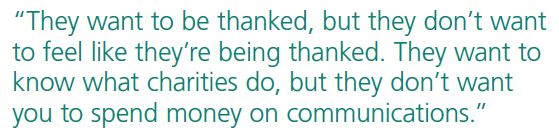
What do donors want? Image captured from page 9 of the report.

At the same time, INGOs are hard-pressed to come up with different and viable ways of funding their work, so this type of campaigning and fundraising continues. Although I’m familiar with some of the challenges my marketing colleagues face, I was struck seeing the kinds of donor demands that INGOs are expected to meet listed in the report. I was reminded of something a marketing colleague once said: ‘Poverty porn. That’s a good term. It is a lot like real porn. People don’t like to publicly admit to watching and responding to it, but in private it’s another story. People say they don’t like poverty porn and sad, desperate stories, but when you look at the numbers, it’s what makes them reach into their pockets and give.’

I would also like to see some research with the subjects (unfortunately often presented as ‘objects’) of INGO aid and marketing materials.  How do program participants feel about how they are portrayed? What impact does it have on them and their own perspectives and self-determination, if any? Strong voices on this come from diaspora communities and from blogs such as Africa is a Country, Uganda 2012: Trending Our Own Stories, and great projects like My Africa Is; but I’d also like to see some in-depth research and objective focus groups that talk with those who are most often shown in INGO marketing. Are people aware of how they are being represented? Do they care? Many of us speculate about this when we bash ‘poverty porn’ but I’ve yet to see published research that involves actual ‘beneficiaries’ of INGO programs or people and communities appearing in INGO marketing and fundraising pieces in this discussion. (Maybe I’ve missed it – if you know of  any, please share!)

The ‘Who Cares’ report notes in the conclusion that:

  • transparency, accountability, ‘value for money,’ and impact are becoming more important to the donor public
  • public trust is a central concern for NGOs in their work and their communications
  • the sector needs to assume more collective responsibility for ethically appropriate portrayal of disaster victims (eg, in compliance with Article 10 of the Red Cross Red Crescent Code of Conduct)
  • new technologies and competition mean that fundraisers are seeking supporters outside of their traditional constituencies
  • traditional gatekeepers of aid are being challenged by new media’s ability to put donors and ‘beneficiaries’ in more direct contact

As INGO institutional leadership space opens up to more people from ‘the global South’, diaspora communities grow, social media allows for commercials and fundraising appeals to reach global audiences (including people in the countries where INGOs implement their programs), attention is paid to the ‘new bottom billion‘ and new fundraising mechanisms arise (for example, INGOs raising funds within countries where they are implementing programs), it will be interesting to see how the conversations and approaches shift and change — or if they remain the same with new actors taking on the same challenges.

Stay tuned for further research and reporting over the next couple of years from Polis and download the report here.

Read Full Post »

« Newer Posts - Older Posts »