Feeds:
Posts
Comments

Archive for the ‘social media’ Category

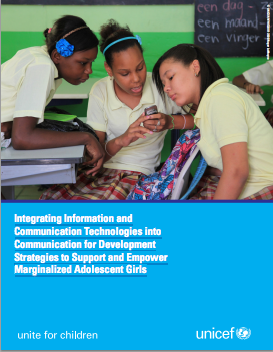
Screen Shot 2013-10-11 at 7.24.48 AMA paper that Keshet Bachan and I authored for Unicef is now available for your reading pleasure!

Here’s a  summary of what we talk about in the paper:

Social, cultural, economic and political traditions and systems that prevent girls, especially the most marginalized, from fully achieving their rights present a formidable challenge to development organizations. The integration of new Information and Communication Technologies (ICTs) to the Communication for Development (C4D) toolbox offers an additional means for challenging unequal power relations and increasing participation of marginalized girls in social
transformation.

We examine ways that ICTs can strengthen C4D programming by:

  • enhancing girls’ connections, engagement and agency;
  • helping girls access knowledge; and
  • supporting improved governance and service delivery efforts.

We reflect and build on the views of adolescent girls from 13 developing countries who participated in a unique discussion for this paper, and we then provide recommendations to support the integration of ICTs in C4D work with marginalized adolescent girls, including:

  • Girls as active participants in program design. Practitioners should understand local context and ensure that programs use communication channels that are accessible to girls. This will often require multi-channel and multiple platform approaches that reach more marginalized girls who may not have access to or use of ICTs. Programs should be community driven, and real-time feedback from girls should be incorporated to adjust programs to their needs and preferences. Mentoring is a key component of programming with girls, and holistic programs designed together with girls tend towards being more successful.
  • Privacy and protection. Every program should conduct a thorough risk analysis of proposed approaches to ensure that girls are not placed at risk by participating, sharing and consuming information, or publicly holding others to account. Girls should also be supported to make their own informed choices about their online presence and use of ICT devices and platforms. A broader set of stakeholders should be engaged and influenced to help mitigate systemic and structural risks to girls.
  • Research and documentation. The evidence base for use of ICTs in C4D programming with marginalized adolescent girls is quite scarce. Better documentation would improve understanding of what programs are the most effective, and what the real added value of ICTs are in these efforts.
  • Capacity building. Because the integration of ICTs into C4D work is a relatively new area that lacks a consistent methodological framework, organizations should support a comprehensive training process for staff to cover areas such as program design, effective use of new ICT tools in combination with existing tools and methods, and close attention to privacy and risk mitigation.
  • Policy. Programs should use free and open source software. In addition, child protection policies, measures and guidelines should be updated to reflect changes in technology, platforms and information sharing.

The paper was first shared at the 12th Inter-Agency Roundtable on Communication for Development in November 2011. It was then reviewed and updated in August 2012, and released in August 2013 under the title “Integrating Information and Communication Technologies into Communication for Development Strategies to Support and Empower Marginalized Adolescent Girls.”

Download it here!

Read Full Post »

Screen Shot 2013-07-14 at 2.40.51 PMLast week, 600 exceptional youth activists from 80 countries arrived to New York City for a UN Takeover, where they called for urgent action by member states to meet Millennium Development Goal 2 on education by 2015. The youth’s inputs will feed into setting the agenda for global education priorities post-2015. One of the highlights of the week was this inspiring talk by Malala Yousafzai, who made her first public address to the UN on June 12th, her 16th birthday.

Seven of the youth participating in the UN Takeover with the support of Plan joined us as lead discussants for our July 10th Technology Salon. Agung, Dina, and Nurul from Indonesia; Kamanda and Fatmata from Sierra Leone; Tova from Sweden; and Frank from Uganda told us about ICT access and use in their communities and countries. We also heard about their work as youth activists on issues of child marriage, school violence, good governance, and education, and whether ICTs are effective outreach tools for campaigning in their contexts.

The realities of access

In both Sierra Leone and Uganda Internet access is quite difficult. Traveling to Internet cafés in urban areas is too expensive for rural youth to do regularly, and it is unsafe for young women to travel in the evenings. There is not enough equipment in schools and universities, and youth have trouble affording and finding regular access. The majority of primary and secondary schools do not have ICTs, and non-governmental organizations are unable to reach everyone with their programs to supply equipment and training. Although there are often funds given to governments to build computer labs, these tend to benefit urban areas. In some cases projects and funds are used for political gain and personal favors. Even at university level, student access might be limited to 1-2 hours per week at a computer lab, meaning they end up doing almost everything on paper.

Lack of ICT access impacts on job prospects for youth, because jobs exist but employers are seeking people who know how to operate a computer. Many of these job applications have to be submitted online. This puts jobs out of reach of youth in rural areas. Basic infrastructure remains a problem in rural areas. Although telecommunication lines have been laid, electricity for charging mobile phones is still a problem and often electricity is dependent on a solar panel or a generator, making it difficult to run a computer lab or Telecenter.

ICTs are heightening the development divide, noted one Salon participant. In schools near urban areas, parents pay more in tuition and school fees and their children have better ICT access than rural children. This creates inequality. “Students going to these schools have access and they will even study computer science. But when you go to a rural village you might only see one small room where children can access a computer, if anything at all. Teachers themselves don’t know how to use computers.” In cities, parents know ICTs are important. In the rural villages, however, many people are skeptical of technologies. This inequality of access and education means that youth in rural areas and the poor are not able to meet requirements for jobs that use ICTs.

One discussant noted, “It is possible to access Internet through mobile phones. You can use some phones to access Internet, Facebook, etc. In the villages, however, you find that you can only receive calls and make calls. There is no Internet. When I went to Nairobi and saw everyone with smart phones, I wondered, ‘What is wrong with Uganda?’ We don’t have many smart phones.” Another discussant commented that her university has a wide area network, but it is only available to lecturers, not to students.

Most of the youth discussants considered that, among their peer groups, more girls than boys had mobile phones, and more girls were active on the Internet and Facebook.

Access brings concerns

In Indonesia, it was noted, Internet is very available, except for the more remote islands. In Java, commented one discussant, “every young person has a smart phone. They use Facebook and Twitter and can get all kinds of information, and those without smart phones can use Internet cafés.” Internet access, however, is creating new problems. “Parents are proud that their kids are going to the Internet shop to get information, but they also worry about increased access to pornography.” Internet is believed to contribute to an increase in child marriages. The youth discussants said they would like more guidance on how to filter information, know what is true and what is not, use Internet safely, and avoid exposure to offensive content. One discussant from Indonesia mentioned that parents in her community worried that if girls went to Internet cafes or browsed online, they would be exposed to inappropriate materials or prostitution through Facebook.

In Sweden, access to Internet and smart phones is universal. However, parents may buy children a smart phone even if they cannot really afford it. Although many children learn English early because they can easily access Internet, many also do not learn how to write properly because they only use computers.

When phones are available but there is no capacity to purchase them, additional problems also arise. According to one discussant, “Some girls want to have big things before their time.” This can lead to young women offering sex to older men in return for money, fancy phones and airtime.

ICTs in formal education

Youth discussants all said that they are increasingly expected to have access to the Internet and computers in order to complete their school assignments, and they felt this was not a realistic expectation. In one of the youth’s schools in Indonesia, computer class is offered for 4 hours per week and a computer lab is available with 30 desktop computers. In another school in Jakarta, however, every child is expected to have their own laptop. “Our problem is different than in the remote areas. Every teacher in Jakarta thinks that a smart phone or computer is ‘the world in our hands.’ They think we don’t need education about the computer itself. They think we can learn from the Internet how to use computers, and so we have to search and learn this all by ourselves with little guidance.” In Sweden, “if you don’t have Internet access, it will be very difficult to pass a course.”

Effective ways to reach and engage youth in campaigns

Discussants were asked about the communication channels that are most effective for campaigning or engaging youth and communities. In rural Sierra Leone and Uganda, face-to-face was considered the most effective outreach channel for reaching youth and communities, given low levels of access to computers, radios and mobile phones. “Most times our campaigns are face-to-face. We move to communities, we use local language to be sure everyone gets the message,” said one youth discussant. In Jakarta, however, “it’s easy to use online means, it never sleeps. Young people in Jakarta are too lazy to attend workshops. They don’t like to listen to speakers. So we share by social media, like Facebook and Twitter.”

Digital media is only useful in urban areas, said one youth discussant from Sierra Leone. “We mostly use radio to do advocacy and sensitization campaigns. We also do it face-to-face. For secondary schools, we do talks. We tell them about documents signed by government or NGOs, what is in place, what is not in place. We give advice. We talk straight about health, about sex education. You just wait for the light in their eyeball to see if they are understanding. We also do dramas, and we paste up wall bills. We do all of this in our local languages.” Youth groups and youth networks are also useful channels for passing along messages and building support.

Radio is effective in theory, but one discussant noted that in his district, there are only two radio stations. “You take your information or announcement there, and they say they will pass it, but you stay waiting… it’s a challenge.”

Campaigns must also involve engaging local decision makers, a participant noted. Often chiefs do not understand, and they may be the very ones who violate the rights of girls. Youth noted the need to be diplomatic however, or they risk being seen as impolite or trouble-makers. “You have to really risk yourself to do rights work in the community,” noted one discussant. Another commented that having support and buy-in from local leaders is critical in order to be taken seriously. “You need a ‘big voice’ to back you and to convince people to listen to you.”

INGO staff can help legitimize youth work in some cases, but there are also issues. “Local leaders always ask for money,” noted one discussant. “When they hear Plan, UNICEF, Care, Save the Children, they think these organizations gave us money and we’ve taken it for ourselves.” Youth often resort to using external INGO staff as their legitimizing force because “we don’t have other role models, everybody wants money. The politicians say they will help us but then they are always too busy. We have to take the lead ourselves.”

Conflicting information and messages can also be a problem, commented a Salon participant. “One year, it’s the ABC Campaign for HIV prevention, the next it’s condoms, and then it’s prevention. Sometimes youth don’t know who to believe. The NGO says something, the government says something, and local leaders say something else. We need consistency.” In addition, he noted, “INGOs come in with their big range rovers, so of course local leaders and communities think that there is money involved. INGOs need to think more carefully and avoid these conflicting messages.”

What would youth like to see?

Going forward, the youth would like more access, more ICT education, more transparency and accountability in terms of how governments spend funds directed to ICT programs, and more guidance on filtering information and ensuring it’s veracity so that children will not be taken advantage of.

*****

Thanks to the Population Council for hosting us for the Salon! Join us for our next Salon on July 25th: How can we scale Mobiles for Development initiatives? 

The Technology Salon methodology was used for the session, including Chatham House Rule, therefore no attribution has been made in this summary post. Sign up here to receive notifications about upcoming Salons in New York, Nairobi, San Francisco, London and Washington, DC. 

Read Full Post »
This is a cross-post from the always thoughtful and eloquent Ian Thorpe, who notes that fundraising is a means to help non-profit organizations fulfill their wider mission; it should not be mistaken as the end goal of non-profit organizations. Consistency in how we achieve our missions across all of our operations becomes ever more important in this age of growing transparency. Read the original post here.

by Ian Thorpe

I’ve been reflecting on a couple of interesting discussions lately on aid communication and fundraising.  In the first, Kurante organized a Google Hangout on “Poverty Porn” i.e. the use of negative, shocking images in aid campaigns (the recording and the twitter storify of the discussion can be found on Tom Murphy’s blog here). During the discussion @meowtree  shared a link to this rather discouraging blog post by a fundraising guru here that suggests that those who criticize the use of negative images are undermining the organizations they work for and should be fired!

A second twitter discussion concerned a new “buy one, give one” programme and whether or not it is harmful or helpful and on what basis this type of programme might be judged.

What comes out of both of these is the potential conflict between what makes good aid versus what makes good fundraising. It’s quite possible to raise money, a lot of money, if one is willing to do whatever it takes, use any kind of images and words and tactics in order to open their wallets. Marketers and fundraisers, to give them their due, make extensive use research and evidence in their work, perhaps more so than programme people, and much research backs up the claim that negative imagery is often more successful than positive imagery in evoking a response and getting out checkbooks.

If you were a private company then “maximizing shareholder value” by going where the money is might well be a great strategy. But aid agencies and civil society organizations are generally in place to serve a mission. The mission of the organization is a huge asset both in motivating staff and in generating support – but it’s also an important constraint in that in places limits around what you will be prepared to do to raise funds or attention. Essentially, if you exist to pursue a mission then all your activities need to be consistent with it. Generally an aid mission is not simply to raise as much money as possible, it’s to achieve a purpose such as reducing poverty or protecting children from harm. And it’s often more complicated to pursue this goal to maximize the amount of positive impact on your beneficiaries – you also need to do this in a principled way informed by your organization’s values such as in respecting the human dignity of the people of the people you aim to help and not exploiting them (even if with the aim of helping them).

I recall a conversation from when I worked on communication in UNICEF with our fundraisers about a similar topic (from more than 10 years ago so I’m not spilling any secrets). At that stage the organization was looking to move more into “upstream policy work” and on scaling back on “service delivery”, especially in middle-income countries. Programmatically this made a lot of sense, but the fundraisers were naturally concerned about the impact on their ability to talk about this shift in fundraising campaigns. It’s much easier to fundraise using images of nicely branded supplies coming in on trucks being handed out by aid workers to poor people than it is to “show” work on, or the results of influencing government policy, improving data collection and building capacity of civil servants.  But at the end of the discussion we were ready to say that while it might be harder to raise money for upstream work, and we might be able to raise less money as a result – if this is the work that needs to be done, then the task was to fund better ways of fundraising about this work, rather than changing the nature of the work to make it easier to raise funds.

Of course aid organizations rely on external funding (whether government, corporate or individual) and they need professional fundraisers to be able to get the resources they need to do their work. Professional fundraisers and communicators know better than programme staff, from their experience and research, how to put together effective fundraising communications in terms of who to approach, what approaches to use and what information is needed from programme staff to support it. That can include coming up with novel approaches to raising funds for something that is already a priority, even if these appear gimmicky to aid workers on the ground (such as sending a quarter coin to people to get them to send in donations or getting them to buy something to give something).

But it’s important to ensure that the fundraising is in service of the organization’s goals rather than the reverse. It can be easy to be tempted to do something because it’s popular with donors even if it isn’t fully consistent with your mission and values, and hard to forswear potential opportunities when aid funding is tight. In particular it can be tempting to agree to programmes which are appealing to donors but for which there isn’t a demand, or worse that do unintended harm. But if the organization exists to serve a mission – then it’s important to keep that front and centre in decision-making on what opportunities to pursue or what tactics to use to pursue them – in fundraising just as much as in programmes.

In fact in an age of increasing aid transparency it becomes ever more important to focus on your mission and values since it’s much more obvious if your communications, partnerships and programmes are not consistent with each other or with your mission, and your reputation will suffer as a result –as will the cause you are pursuing.

Greater transparency is also an opportunity to bring donors and beneficiaries closer together so that donors can see and hear the results of aid work directly from those being helped rather than via a “story” whether positive or negative constructed by the aid agency for the benefit of donors. Similarly donors can also hear more from those they are helping about what they want and need, seeing them more as individuals with dignity, aspirations and agency to improve their lives aided by donors rather than as passive objects of pity and charity. This way instead of going where donors give most now, you can change the discussion to educate and encourage them to give money to where it is really needed, and to understand better what their support really does and can do.

Read Full Post »

Imagery and stories used to frame issues of humanitarian development for advocacy and funding are often sensational and culturally disrespectful, representing those living in poverty as helpless victims in need, rather than as empowered and capable individuals.

Fueled by intense Twitter and blog discussions about this topic (which is often referred to as “Poverty Porn,”) a few years ago a number of us decided to work together to create a space for wider dialogue around issues of representation of the people that aid and development organizations support.

Screen Shot 2013-05-19 at 2.53.22 PM

Today we launch our multimedia platform Regarding Humanity or “Re: Hum.” The platform aims to engage practitioners, educators, and students in discussions on how to represent  communities we work with in relevant and respectful ways.

Re: Hum is a website and blog that explore how the way we see, listen and frame stories of “the poor” often strips individuals of their agency and creates a general sense of hopelessness and disempowerment. More respectful and relevant methods of seeing, listening and framing can help tell more nuanced stories that respect people and their complex realities.

The Re: Hum website will source content from a diverse set of authors and creators in order to bring a global perspective to the issue. It will serve as an educational resource and discussion forum to teach visual literacy, the importance of ethnography, and ways to maintain narrative integrity. We will be expanding to a discussion series, research, and an educational curriculum over time and as resources permit.

We invite you to take a quick look at Re: Hum (which is still a work-in-progress) and let us know your thoughts and suggestions on how to generate constructive conversation and learning on this issue!

Read Full Post »

CISCO is looking for stories about how people and organizations have used network services (mobile video and gaming, video conferencing, SMS, and social networking) to achieve different social or personal goals. The idea is to find stories not only about how technology developers are inventing things, but also about how different tools are enabling a range of things to happen and helping people to resolve challenges and achieve progress in their communities.

The application process is quite simple – just answer 5 questions through a form on the website to formulate the story. You can also download a form, fill it out, and then cut/paste into the form online if you are on slow internet. Contest and story submission information is here.

According to CISCO, by posting a story on how you’ve developed solutions, or used these services, you will be an inspiration to others and CISCO will help you promote your work through their social media channels thereby increasing your visibility. They hope that the stories help generate more conversation around the impact of Internet services.

They also hope the stories can help answer some questions around the benefits of increased connectivity. For example:

  • How will growth in Internet access impact global economies?
  • How can more communities and businesses take advantage of the significant growth in mobile services?
  • What new opportunities can be created for those least connected?
  • Why are there regional variations in adoption rates of certain networking services?

I know a lot of smaller local organizations – especially some great youth-led organizations – are doing some fantastic things, and a prize like this could help these organizations get to the next level. More information here.

The more academic folks out there may not want to submit stories, but you might be interested in the Virtual Network Indexing Forecast.

Read Full Post »

The February 5 Technology Salon in New York City asked “What are the ethics in participatory digital mapping?” Judging by the packed Salon and long waiting list, many of us are struggling with these questions in our work.

Some of the key ethical points raised at the Salon related to the benefits of open data vs privacy and the desire to do no harm. Others were about whether digital maps are an effective tool in participatory community development or if they are mostly an innovation showcase for donors or a backdrop for individual egos to assert their ‘personal coolness’. The absence of research and ethics protocols for some of these new kinds of data gathering and sharing was also an issue of concern for participants.

During the Salon we were only able to scratch the surface, and we hope to get together soon for a more in-depth session (or maybe 2 or 3 sessions – stay tuned!) to further unpack the ethical issues around participatory digital community mapping.

The points raised by discussants and participants included:

1) Showcasing innovation

Is digital mapping really about communities, or are we really just using communities as a backdrop to showcase our own innovation and coolness or that of our donors?

2) Can you do justice to both process and product?

Maps should be less an “in-out tool“ and more part of a broader program. External agents should be supporting communities to articulate and to be full partners in saying, doing, and knowing what they want to do with maps. Digital mapping may not be better than hand drawn maps, if we consider that the process of mapping is just as or more important than the final product. Hand drawn maps can allow for important discussions to happen while people draw. This seems to happens much less with the digital mapping process, which is more technical, and it happens even less when outside agents are doing the mapping. A hand drawn map can be imbued with meaning in terms of the size, color or placement of objects or borders. Important meaning may be missed when hand drawn maps are replaced with digital ones.

Digital maps, however, can be printed and further enhanced with comments and drawings and discussed in the community, as some noted. And digital maps can lend a sense of professionalism to community members and help them to make a stronger case to authorities and decisions makers. Some participants raised concerns about power relations during mapping processes, and worried that using digital tools could emphasize those.

3) The ethics of wasting people’s time.

Community mapping is difficult. The goal of external agents should be to train local people so that they can be owners of the process and sustain it in the long term. This takes time. Often, however, mapping experts are flown in for a week or two to train community members. They leave people with some knowledge, but not enough to fully manage the mapping process and tools. If people end up only half-trained and without local options to continue training, their time has essentially been wasted. In addition, if young people see the training as a pathway to a highly demanded skill set yet are left partially trained and without access to tools and equipment, they will also feel they have wasted their time.

4) Data extraction

When agencies, academics and mappers come in with their clipboards or their GPS units and conduct the same surveys and studies over and over with the same populations, people’s time is also wasted. Open digital community mapping comes from a viewpoint that an open map and open data are one way to make sure that data that is taken from or created by communities is made available to the communities for their own use and can be accessed by others so that the same data is not collected repeatedly. Though there are privacy concerns around opening data, there is a counter balanced ethical dilemma related to how much time gets wasted by keeping data closed.

5) The (missing) link between data and action

Related to the issue of time wasting is the common issue of a missing link between data collected and/or mapped, action and results. Making a map identifying issues is certainly no guarantee that the government will come and take care of those issues. Maps are a means to an end, but often the end is not clear. What do we really hope the data leads to? What does the community hope for? Mapping can be a flashy technology that brings people to the table, but that is no guarantee that something will happen to resolve the issues the map is aimed at solving.

6) Intermediaries are important

One way to ensure that there is a link between data and action is to identify stakeholders that have the ability to use, understand and re-interpret the data. One case was mentioned where health workers collected data and then wanted to know “What do we do now? How does this affect the work that we do? How do we present this information to community health workers in a way that it is useful to our work?” It’s important to tone the data down and make them understandable to the base population, and to also show them in a way that is useful to people working at local institutions. Each audience will need the data to be visualized or shared in a different, contextually appropriate way if they are going to use the data for decision-making. It’s possible to provide the same data in different ways across different platforms from paper to high tech. The challenge of keeping all the data and the different sharing platforms updated, however, is one that can’t be overlooked.

7) What does informed consent actually mean in today’s world?

There is a viewpoint that data must be open and that locking up data is unethical. On the other hand, there are questions about research ethics and protocols when doing mapping projects and sharing or opening data. Are those who do mapping getting informed consent from people to use or open their data? This is the cornerstone of ethics when doing research with human beings. One must be able to explain and be clear about the risks of this data collection, or it is impossible to get truly informed consent. What consent do community mappers need from other community members if they are opening data or information? What about when people are volunteering their information and self-reporting? What does informed consent mean in those cases? And what needs to be done to ensure that consent is truly informed? How can open data and mapping be explained to those who have not used the Internet before? How can we have informed consent if we cannot promise anyone that their data are really secure? Do we have ethics review boards for these new technological ways of gathering data?

8) Not having community data also has ethical implications

It may seem like time wasting, and there may be privacy and protection questions, but there are are also ethical implications of not having community data. When tools like satellite remote sensing are used to do slum mapping, for example, data are very dehumanized and can lead to sterile decision-making. The data that come from a community itself can make these maps more human and these decisions more humane. But there is a balance between the human/humanizing side and the need to protect. Standards are needed for bringing in community and/or human data in an anonymized way, because there are ethical implications on both ends.

9) The problem with donors….

Big donors are not asking the tough questions, according to some participants. There is a lack of understanding around the meaning, use and value of the data being collected and the utility of maps. “If the data is crap, you’ll have crap GIS and a crap map. If you are just doing a map to do a map, there’s an issue.” There is great incentive from the donor side to show maps and to demonstrate value, because maps are a great photo op, a great visual. But how to go a level down to make a map really useful? Are the M&E folks raising the bar and asking these hard questions? Often from the funder’s perspective, mapping is seen as something that can be done quickly. “Get the map up and the project is done. Voila! And if you can do it in 3 weeks, even better!”

Some participants felt the need for greater donor awareness of these ethical questions because many of them are directly related to funding issues. As one participant noted, whether you coordinate, whether it’s participatory, whether you communicate and share back the information, whether you can do the right thing with the privacy issue — these all depend on what you can convince a donor to fund. Often it’s faster to reinvent the wheel because doing it the right way – coordinating, learning from past efforts, involving the community — takes more time and money. That’s often the hard constraint on these questions of ethics.

Check this link for some resources on the topic, and add yours to the list.

Many thanks to our lead discussants, Robert Banick from the American Red Cross and Erica Hagen from Ground Truth, and to Population Council for hosting us for this month’s Salon!

The next Technology Salon NYC will be coming up in March. Stay tuned for more information, and if you’d like to receive notifications about future salons, sign up for the mailing list!

Read Full Post »

policy forum

This past Monday I had the opportunity to join Engineers without Borders (EWB) in Calgary, Canada, at their Annual Policy Forum on Global Development to discuss “How can open government contribute to community and economic development?”

Morning panels covered some examples of open government initiatives from Finland, Ghana and Canada. In the afternoon we heard about some of the challenges with open data, open government and the International Aid Transparency Initiative. Table discussions followed both of the panels. The group was a mix of Canadian and African government representatives, people from organizations and groups working in different countries on open government and open data initiatives, and young people who are connected with EWB. The session was under Chatham House Rule in order to encourage frank conversation.

Drawing from such documents as the Open Government Partnership’s Open Government Declaration, Harlan Yu and David G. Robinson’s “The New Ambiguity of “Open Government,” Beth Noveck’s What’s in a Name? Open Gov and Good Gov and Nathaniel Heller, A Working Definition of ‘Open Government’, the following definition of Open Government was used to frame the discussions.

EWB Definition of Open Government

Below (in a very-much-longer-than-you-are-supposed-to-write-in-a-blogpost summary) are the highlights and points I found interesting and useful as related to Open Development, Open Data, Open Government and the International Aid Transparency Initiative (IATI)

1.  Participation thresholds need to be as low as possible for people to participate and engage in open government or open data initiatives. You need to understand well what engagement tools are most useful or comfortable for different groups. In some places, to engage the public you can use tools such as etherpad, wiki platforms, google docs, open tools and online collaboration spaces. In other places and with other populations, regardless of what country, you may be more successful with face-to-face methods or with traditional media like television and radio, but these need to be enhanced with different types of feedback methods like phone calls or surveys or going house to house so that your information is not only traveling one way. Community organizing skills are key to this work, regardless of whether the tools are digital or not.

2.  Literacy remains a huge challenge hindering access to information and citizen engagement in holding government accountable in many countries. This is why face-to-face engagement is important, as well as radio and more popular or broad-based communication channels. One participant asked “how can you make open government a rural, rather than an urban only, phenomenon?” This question resonated for participants from all countries.

3.  Language is still a critical issue. Language poses a big challenge for these kinds of initiatives, from the grassroots level to the global level, within and among countries, for citizens, governments, and anyone trying to share or collect data or information. It was noted that all the countries who have published data to IATI are publishing in English. All the IATI Standards are in English, as is the entire support system for IATI. As one participant noted, this begs the question of who the information in IATI is actually designed for and serving, and who are the expected users of it. Open data initiatives should consider the implications of language they publish in, both politically and practically.

4.  Open data can serve to empower the already empowered. As one speaker noted, “the idea that everyone has the potential to make use of open data is simply not true.” Access to digital infrastructure and educational resource may be missing, meaning that many do not have the ability to access, interpret or use data for their own purposes. Governments can also manipulate data and selectively release data that serves their own interests. Some questioned government motives, citing the example of a government that released “data” saying its unemployment rate was 10% when “everyone knew this to be false, and people grumbled but we did not feel empowered to challenge that statement.” Concern was expressed over the lack of an independent body or commission in some countries to oversee open data and open government processes. Some did not trust the government bodies who were currently in charge of collecting and opening information, saying that due to politics, they would never release any information that made their party or their government look bad.

5.  Privacy rights can be exploited if data is opened without data protection laws and effort to build capacity around how to make certain data anonymous. Citizens may also not be aware of what rights are being violated, so this should also be addressed.

6.  Too much open data discussion takes place without a power analysis, as one participant commented, making some of the ideas around open data and open government somewhat naïve. “Those who have the greatest stake will be the most determined to push their point of view and to make sure it prevails.”

7.  Open data needs to become open data 2.0. According to one participant, open data is still mostly one-way information delivery. In some cases there isn’t even any delivery – information is opened on a portal but no one knows it’s there or what it refers to or why it would be useful. When will open data, open government and open aid become more of a dialogue? When will data be released that answers questions that citizens have rather than the government deciding what it will release? The importance of working with community groups to strengthen their capacity to ask questions and build critical consciousness to question the data was emphasized. A counter point was that government is not necessarily there to start collecting information or creating data sets according to public demand. Governments collect certain data to help them function.

8.  Intermediaries working on open government should be careful of real or perceived bias. Non-profits have their own agendas, and ‘open data’ and ‘open information’ is not immune to being interpreted in non-objective ways. Those working on civic engagement initiatives need to be careful that they are not biased in their support for citizen initiatives. One presenter who works on a platform that encourages citizens to be involved in petitioning new laws for contemplation in Parliament said “Our software is open source so that anyone can set up a similar process to compete with us if they feel we are biased towards one or another type of agenda.”

9.  Technology-based engagement tools change who is participating. Whether in Finland, Canada, Ghana or Malawi, it’s critical to think about reaching those who are not active already online, those who are not the typical early adopters. To reach a broader public, one speaker noted “We are going to remote places, doing events in smaller towns and cities to see how people want to influence and take part in this. Making sure the website is accessible and understandable.”

10. Technological platforms are modifying how political parties and democratic processes operate. This may or may not be a good thing. Normally priorities arise and are discussed within political parties. Will people now bypass the party process and use ‘direct democracy’ channels if they are passionate about an issue but do not want to enter into negotiation around it? Will this weaken political processes or longer standing democratic processes? One speaker considered this change to be positive. People are not happy with being able to vote every 4 years and they want opportunities to participate in between elections cycles and direct voice in how priorities are decided. Others questioned whether bypassing official processes can lead to less participation and more apathy overall on national issues. Some questioned whether within fairly long-standing democracies, open data will have any real impact, considering existing levels of apathy and the lack of political participation.

11. Strong information, statistical, monitoring and evaluation systems are critical for open data and open government processes and to ensure more effective management of development results. This is still a challenge for some countries that need to review their mechanisms and improve their tools and processes for data collection and dissemination. If there is no data, or no current data, there is not much point in opening it. In addition, there are capacity and technical competency challenges within institutions in some countries. One participant mentioned a lack of current government geological information about gold and oil deposits that weakens government capacity to negotiate with the private sector extraction industry and ensure partnerships and earnings will contribute to national development. In addition more evidence is needed on the impact, use, and outcomes of open data. At the moment it’s quite difficult to say with any real authority what the outcomes and impact of open data and open government have been.

12. IATI (International Aid Transparency Initiative) needs more partners. Government representatives noted that they are opening their data, but they can only open the data they possess. In order for data on aid to be useful, more data is needed, especially that of NGOs who are implementing programs. Not many NGOs have published their information to the IATI standard at this point. “The really interesting thing will be when we can start mashing up and mapping out the different kinds of information,” as one speaker noted, “for example, this is the goal of the Open Aid Partnership. It will involve combining information from the donor, development indicators from the World Bank, and country information, and this will open up amazing possibilities once this is all geo-coded.” There are reporting challenges related to IATI and open government data, however, because at times countries and NGOs do not see the benefits of reporting – it feels like just one more top-down administrative burden. There are also issues with donor governments reporting their committed intentions and amounts, recipient governments reporting back, and communications with citizens on both sides (donor and recipient countries). One example that was reported to be enjoying some success was the multi-donor budget support initiative in Ghana, where development partners and government work together to establish development indicators and commitments. If the government delivers on the indicators, the development partners will then provide them with the funding. Development partners can also earmark funding to particular areas if there is government agreement.

13. We need more accountability towards ‘beneficiaries’.Currently many of these initiatives are perceived as being focused on donors and donor publics. As one participant noted, “the interesting thing is less about government and more about getting regular people involved in these processes. When you engage the public you’ll engage government leaders in thinking they will need to change to respond to what citizens are asking for.” Another noted that the essential issue is the link between transparency/accountability and citizens and their own governments. In addition, as one participant asked, “How can you strengthen capacity among citizens to ask the right questions about the data that’s being opened?” For example, citizens may ask about the number of schools being built, but not ask about the quality of education being provided. Public education was a strong focus of discussions around citizen engagement during the policy forum.

14. Should citizens be consulted on everything? however, was one big question. The public at large may not understand the ramifications of its own deep misunderstandings on particular issues and may be inputting from a viewpoint that lacks scientific evidence or fact. “It’s one thing to have an opinion about whether your child should be able to drink energy drinks before age 16, it’s another to input about technical programs like the best policy for green energy,” commented one group.

15. Can citizens really have greater participation if government is still in control of data? was another big question. An example was given of an open consultative process that became unwieldy for a local government, which then shut down the consultation process and changed the nature of the documents to ‘administrative’ and therefore no longer open. Others asked why governments pat themselves on the back over being part of the Open Government Partnership yet they do not have Freedom of Information Acts (FOIA) or they prosecute those who open data in alternative ways, such as Bradley Manning and Aaron Swartz.

16. If citizens don’t get a response from government (or if they don’t like the response, or feel it’s biased or manipulated), apathy and cynicism will increase. It’s important to make sure that ‘open government’ is not just a box that gets ticked off, but rather a long-term change in mentality of those in power and deeper expectations and efforts by citizens for openness and participation in conversations of national importance.

The conclusion was that Open Government is somewhat of a paradox, rooted in aims that are not necessarily new. Open Government strives to enable leaders in their communities to create change and transform their lives and those of people in their communities. It is a complex process that involves many actors and multiple conflicting goals and interests. It’s also something new that we are all learning about and experimenting with, but we are very impatient to know what works and what the impact is. In the room, the feeling was one of ‘radical pragmatism,’ as one participant put it. Open Government is a big idea that represents a big change. It’s something that can transform communities at the global level and there is a great deal of hope and excitement around it. At the same time, we need to acknowledge the challenges associated with it in order to address them and move things forward.

I’ll do a follow up post with the points I made during the panel as this post is clearly way too too long already. Kudos if you are still reading, and a huge thanks to the organizers and participants in the EWB policy forum.

Read Full Post »

The November 14, 2012, Technology Salon NYC (TSNYC) focused on ways that ICTs can support work with children who migrate. An earlier post covers the discussion around Population Council’s upcoming ‘Adolescent Girls on the Move’ report. The current post focuses on the strategic use of data visualization for immigration advocacy, based on opening points from Brian Root and Enrique Piracés of Human Rights Watch (HRW).

Visualizing the US Detention Network and the transfers between detention centers.

The project

The HRW initiative used data to track and visualize the movement of people through the US immigration detention system after noticing that U.S. Immigration and Customs Enforcement (ICE) was moving people very freely without notifying their families or attorneys. HRW was aware of the problem but not its pervasiveness. The team obtained some large data sets from the US government via Freedom of Information Act (FOIA) requests. They used the data to track individuals’ routes through the immigration detention system, eventually mapping the whole system out at both aggregate levels and the level of individual. The patterns in the data informed HRW’s advocacy at the state and federal levels. In the process, HRW was able to learn some key lessons on advocacy and the importance of targeting data visualizations to specific advocacy purposes.

Data advocacy and storytelling

The data set HRW obtained included over 5.4 million records of 2.3 million people, with 10-12 variables. The team was able to connect these records to individuals, which helped tell a meaningful story to a broad audience. By mapping out all the US facilities involved and using geo-location to measure the distance that any individual had been transferred, the number of times an individual from Country X in Age Range X was transferred from one facility to another was visible, and patterns could be found. For example, often people on the East Coast were transferred to Texas, where there is a low ratio of immigration lawyers per detainee.

Even though the team had data and good stories to tell with the data, the two were not enough to create change. Human rights are often not high priority for decision makers, but budgeting is; so the team attached a cost to each vector that would allow HRW to tell decision makers how much was being spent for each of these unnecessary transfers.

They were also able to produce aggregated data at the local level. They created a state dashboard so that people could understand the data at the state level, since the detention facilities are state-run. The data highlighted local-level inefficiencies. The local press was then able to tell locally relevant stories, thus generating public opinion around the issue. This is a good example of the importance of moving from data to story telling in order to strengthen advocacy work.

HRW conveyed information and advocated both privately and publicly for change in the system. Their work resulted in the issuing of a new directive in January 2012.

FOIA and the data set

Obtaining data via FOIA acts can be quite difficult if an organization is a known human rights advocate. For others it can be much easier. It is a process of much letter sending and sometimes legal support.

Because FOIA data comes from the source, validation is not a major issue. Publishing methodologies openly helps with validation because others can observe how data are being used. In the case of HRW, data interpretations were shared with the US Government for discussion and refutation. The organization’s strength is in its credibility, thus HRW makes every effort to be conservative with data interpretation before publishing or making any type of statement.

One important issue is knowing what data to ask for and what is possible or available. Phrasing the FOI request to obtain the right data can be a challenge. In addition, sometimes agencies do not know how to generate the requested information from their data systems. Google searches for additional data sets that others have obtained can help. Sites such as CREW (Citizens for Responsibility and Ethics in Washington), which has 20,000 documents open on Scribd, and the Government Attic project, which collects and lists FOI requests, are attempting to consolidate existing FOI information.

The type of information available in the US could help identify which immigration facilities are dealing with the under-18 population and help speculate on the flow of child migrants. Gender and nationality variables could also tell stories about migration in the US. In addition, the data can be used to understand probability: If you are a Mexican male in San Jose, California, what is the likelihood of being detained? Of being deported?

The US Government collects and shares this type of data, however many other countries do not. Currently only 80 countries have FOI laws. Obtaining these large data sets is both a question of whether government ministries are collecting statistics and whether there are legal mechanisms to obtain data and information.

Data parsing

Several steps and tools helped HRW with data parsing. To determine whether data were stable, data were divided by column and reviewed, using a SHELL. Then the data were moved to a database (MySQL), however other programs may be a better choice. A set of programs and scripts was built to analyze the data, and detention facilities were geo-located using GeoNames. The highest quality result was used to move geo-location down to the block level and map all the facilities. Then TileMill and Quantum GIS (QGIS) were used to make maps and ProtoViz (now D3) was used to create data visualizations.

Once the data were there, common variables were noted throughout the different fields and used to group and link information and records to individuals. Many individuals had been in the system multiple times. The team then looked at different ways that the information could be linked. They were able to measure time, distance and the “bounce factor”, eg.., how many times an individual was transferred from one place to the other.

Highlighting problematic cases: One man’s history of transfers.

Key learning:

Remember the goal. Visualization tools are very exciting, and it is easy to be seduced by cool visualizations. It is critical to keep in mind the goal of the project. In the HRW case the goal was to change policy, so the team needed to create visualizations that would specifically lead to policy change. In discussions with the advocacy team, they defined that the visualizations needed to 1) demonstrate the complexity 2) allow people to understand the distance 3) show the vast numbers of people being moved.

Privacy. It is possible to link together individual records and other information to tell a broader story, but one needs to be very careful about this type of information identifying individuals and putting them at risk. For this reason not all information needs to be shared publicly for advocacy purposes. It can be visualized in private conversations with decision makers.

Data and the future

Open data, open source, data visualization, and big data are shaping the world we are embedded in. More and more information is being released, whether through open data, FOIA or information leaks like Wikileaks. Organizations need to begin learning how to use this information in more and better ways.

Many thanks to the Women’s Refugee Commission and the International Rescue Committee for hosting the Salon.

The next Technology Salon NYC will be coming up soon. Stay tuned for more information, and if you’d like to receive notifications about future salons, sign up for the mailing list!

Read Full Post »

Everybody loves memes and those who work in or care about international development are no exception. One meme that popped up early 2010, is the oft-quoted “there are more mobile phones than toilets.” Apparently, the origin of the phrase was the India census. Subsequently, the statistic was used to raise a point about water and sanitation in India by a UN institute. It was picked up in a New York Times article and became generalized to “more people have [access to] mobile phones than toilets” and “there are more mobile phones than toilets” and other variations.

This simple idea has captured the hearts and minds of many development and technology practitioners and theorists the world over. The phrase has become a staple illustration for those who are looking at the potential of mobiles to change the world. But there is more to it than simple ‘access.’ We need to think beyond access.

What is missed in this meme’s beautiful simplicity is that the mobile access/mobile phones referred to are not necessarily equally distributed. A recent blog post by Marc Bellemare refers to a study he worked on (with Ken Lee) called “Look Who’s Talking: The Impacts of the Intrahousehold Allocation of Mobile Phones on Agricultural Prices.”

“…mobile phones do not seem to be the household public good many development practitioners think they are. In other words, policies designed around the distribution of mobile phones to households (rather than individuals) might contain the seed of their own failure if the intrahousehold [use] of technology matters.

Moreover, after a referee asked us to look at whether major household surveys asked about mobile phone ownership at the household or individual level, I was surprised to find that many of those surveys only collect information on the former.

So if there is one thing I would like our article to change, it’s the kind of data that are collected: We should really collect information on individual rather than on household mobile phone ownership.”

The GSMA and Cheri Blair Foundation study on women and mobiles found that women lag behind in mobile phone ownership in many African, Latin American, Middle Eastern and Asian countries. Women are even further behind in terms of access and use of the Internet.

At the practitioner level, assuming women everywhere can access and use mobiles and Internet can make a project run into problems, as described in this quick video.

In some places where women’s literacy and numeracy skills are quite low, projects designed to share or collect information by mobile can run into additional challenges as related below.

Girls themselves in some places note that despite their interest, boys will physically fight them to access available computers or mock girls who want to learn.

The existence of open and available spaces and platforms (whether virtual or physical) doesn’t automatically mean they are  “accessible” to everyone, including in many cases, to women and girls.

As wonderful as the idea of ‘open’ is (and don’t get me wrong, I’m a huge fan of ‘open’), ‘open’ can still exclude. Even in purposefully open spaces and frameworks like the Open Knowledge Festival, women lag behind in terms of papers submitted for presentation and women speaking on panels. We lag behind slightly less in terms of doing the legwork of organizing, which shouldn’t surprise anyone.

At the Beyond Access Conference put on by IREX yesterday, I had the opportunity to facilitate a discussion session on Women and ICTs where we got into some of these issues and talked about how libraries can help. The panelists included Thinley Choden from the READ Bhutan project, Danica MacAvoy from Clinton Global Initiative, and Marieme Jamme of Africa Gathering. The session space was filled with engaged and insightful folks who shared their valuable ideas and experiences as well, including:

  • Numbers that showed the big access gap between men and women.
  • Access is not the only measure, however – as the conference notes we need to go “Beyond Access” to look at use, purpose, and many other aspects.
  • Safety is the number one reason that girls and women give for not accessing ICTs.
  • Libraries are often seen as knowledge centers and conceived of as more reputable spaces than Internet cafes for girls and women to frequent.
  • Librarians and community facilitators at library spaces can serve as mediators to help ensure that access to equipment and other materials is equally open to all.
  • Women mentors and role models, eg., female librarians, are an important way to encourage girls and women to spend time at libraries or to be more confident in accessing information and communicating through technology.
  • One of the most important things a library can do is create safe space for girls and women to gather and discuss issues of importance to them.
  • Depending on context, in some places this needs to be a physical space; in others situations, a virtual space can work.
  • Men and boys play a big role in advocating and encouraging girls and women to access information, to communicate, and to come together and participate.
  • If offered space and opportunity, women and girls (and anyone else) can teach themselves to use new technologies.
  • Libraries will be most successful for women and girls if they facilitate access and sharing of information that is relevant and in demand by women and girls, not what outsiders think should be in demand.
  • Low information access is holding back girls and women from advancing in careers such as ICTs and coding, because up-to-date books are not accessible in many places.
  • Supporting people to ‘join the global network’ through uploading information about themselves and their lives can serve as a tool by which community and personal projects can be examined, discussed and shared.
  • What a library is and what one looks like will vary according to context and culture; the key is having a physical or virtual safe space where information and communication can take place.

So even if there are more mobile phones than toilets, the conversation can’t stop there. We still need to talk about access, and we need to go “beyond access” too, as this great gathering yesterday so aptly noted.

Read Full Post »

I’m just home after a week at the Open Knowledge Festival in Helsinki (and wishing I could have cloned myself and attended each of the 13 streams!):

Here’s a video summary of some of the highlights of the Open Development stream.

Thanks so much to everyone who organized, supported, funded and attended the sessions!

Also see:

Read Full Post »

« Newer Posts - Older Posts »