Feeds:
Posts
Comments

Archive for the ‘youth’ Category

As part of their efforts to reduce violence against children, Plan Benin is rallying motorcycle-taxi drivers to use SMS to report violence against children that they witness in the streets.

Florence Cisse, Plan West Africa’s regional communications officer, says:

The Zemidjan or “Zem” swarm the streets of Cotonou like bees. They are everywhere; silent observers to all comings and goings. Now, they have received training on how to recognize cases of child trafficking or kidnapping which often occur on the same busy streets. Using SMS texting on their mobile phones, they send information which is tracked and mapped by Plan using Ushahidi, an open source web-based technology platform. Plan then alerts authorities through partnerships with the Benin Central Office of Child Protection and ministries of Family, of Home Affairs and of Justice who begin the process of retrieving the children or investigating the abuse.

“The Zem are always working on the streets, which is where children experience the greatest risk,” said Michel Kanhonou Plan Benin Programme Manager. “The use of Ushahidi to track SMS texts and map the incidents of violence has helped to inform the authorities where, block by block, they need to invest greater resources to keep our children safe.”

The Zem join youth, heads of police squads, community and religious leaders and others who have received the training on how to recognize abuse and report it through simple SMS from Plan. Plan promotes a phone number that is used to collect the SMS on billboards and radio programmes.

This is the kind of innovation I think is most interesting – identifying existing networks and systems, and seeing how to enhance or expand them via new technologies. I’m looking forward to seeing how the program advances, and what Plan Benin learns from this effort to engage broader networks in preventing, tracking and responding to violence against children.

The team in Benin has created a video about the violence reporting system, which uses both FrontlineSMS and Ushahidi. The technology tools, however, are only part of the program. In addition, the team launched billboard and community radio campaigns to promote the violence-reporting number; engaged local communities, government, child protection agents, and NGOs; and trained children, families, teachers, school directors, parents and community leaders (and now moto-taxi drivers!) about violence, its impact on children and how to respond to it. Children and young people have been involved in program design and implementation as well, and there have been thorough discussions on how to manage this type of sensitive information in a private and secure way.

For some older posts that demonstrate the evolution of the project, which started off in early 2010, click here.

Read Full Post »

birds 2I spent the weekend working on a paper about “Children on the Move.” I’m not even close to done with it yet, but the topic is fascinating. Some reports say that 1/3 of migrants are between the ages of 12 and 25, including millions of children under the age of 18. The number of children and youth who migrate is difficult to pin down with certainty, given that migration is often within country, seasonal, across porous borders, and because most child migrants don’t have legal means to migrate or they lack identification, leaving them under the radar and uncounted.

Children move for all kinds of reasons, from and into all kinds of situations. The push-pull factors that cause them to migrate vary a great deal from situation to situation. Often the movement of children is lumped under trafficking and child labor, and all children who move are considered victims, and all those who support children to move are labeled criminals or traffickers and all parents who allow their children to move are lambasted for not caring about them. If you read what children and parents involved in migration say, it’s clear that this is not the case.

One person I interviewed for the paper noted off the record that sometimes those working with children who migrate are forced to put them in the category of “trafficked” or “at risk of trafficking” because there is no real category (or funding) to support children who are “seeking better opportunity” or “fleeing domestic violence” or “scared for my life because of the gangs in my community, and traveling across several countries up to the US seems like less of a risk.”

Just like adult migrants, children often move of their own will to seek opportunity in other places. Their movement in and of itself is not negative, but moving without protection mechanisms and support can indeed put them at risk. Policies and systems that don’t talk to each other also put children and youth in peril, whether it is when children themselves move, or when their parents move with them.

For the report I’m doing, I’m looking at how ICTs are being used by children and youth to make their journey safer, and ways that communities, local child protection committees, institutions, governments and NGOs are using or could use some of these new ICT tools to better support and protect children and youth who move for any reason.

Some interesting efforts are happening, including some ingenious local networks in West Africa that work across communities to help ensure children’s paths and travels are as safe as possible; and a radio and SMS project in Tanzania that is building up a pro-child protection constituency by encouraging people to tell stories about when and where they have supported or helped a child.

It’s been heartbreaking to read about Afghan youth who are forcibly returned to a country they can barely remember because they have turned 18 and are no longer supported by the UK child welfare system, yet at least a tiny bit encouraging that a UK organization is working on a mobile app that could provide these youth with at least a map and some information about their ‘homeland’ so that they know where to go for help when they step off the plane in what is now a foreign country.

Reading about migrant parents in the US losing their children to foster care because they have been detained for migration violations and are unable to show up to court to keep their children, or they lack critical information about how the system works, or they are not allowed more than one phone call makes my blood boil. Having been married to a Salvadoran, I’ve experienced my own fair share of migration difficulties and horror stories. They are not pretty, and family separation hurts, no matter what color or nationality the family is. It seems that the root of some countries’ inability to deal with migration in a dignified way is an underlying devaluation of people from other places and an inability to see them as human. Can ICTs play a role in changing attitudes at the broad scale? Or can we at least enable migrants in detention more communication with families so that they don’t lose contact with their children? A few initiatives are looking at storytelling as a way to bring more humanity into the migration debate.

As both Duncan Green (Why is migration a Cinderella issue in development) and Owen Barder (Is migration too toxic for development) have written recently, migration has not been a hot topic on the development agenda, and it’s only now starting to get some play.

Why is that? I think Owen’s comment is pretty good to spark some thought:

Migration is a Cinderella issue in development because there is nobody to speak for the people who are disadvantaged by the current rules.  Domestic civil society organisations which work on migration are mainly focused on the rights of immigrants, not on improving the impact of migration on development or creating opportunities for people in poor countries. DFID is largely in retreat from non-aid issues. The big development NGOs at best speak for their own visions of development, and at worst promote the aid industry of which they are part. As a result, people in developing countries are denied some of the most powerful and inexpensive ways in which they could improve their lives.

We need to find a way to look at all angles and aspects of migration, including that of child migration, in a holistic way that involves all these different actors. I think that one reason migration is not talked about  enough in the development debate is because it is a touchy political issue that might make a donor base freak out. It also tends to makes agencies that work with children a bit uncomfortable – If we protect children who migrate, will we be seen to be encouraging illegal migration? Will we be seen as supporting child labor? Are we liable if we give children safety tips or information, and then something happens to them? How can we do no harm? What about unintended consequences?

More recently, many child-focused agencies have started to better come to grips with the realities that children are going to migrate, and it’s altogether possible that staying in their home community is actually not in their best interest. These are thorny questions, however, that are difficult to deal with, especially in the open when the political debate around migration has been so traditionally ugly.

Perhaps framing migration as an economic issue will help bring it into the debate, but I do hope we don’t lose touch with the human side of migration.

Read Full Post »

As part of the work I’m doing with the mEducation Alliance around mobile technologies and youth workforce development (mYWD), we’re putting together an event focused on innovation in the mYWD space on October 15  from 9-12.30 EDT.

Some of the topics we’ll be looking at include:

  • How do workforce development programs address different forms of exclusion? And how do different forms of exclusion affect approaches to youth and workforce development programming?
  • What do innovation and ‘disruption’ mean in the context of mobile technologies and youth workforce development?  What are some different frameworks for thinking about innovation?
  • What role might mobile technologies play in increasing access to information and work/entrepreneurial opportunities for young people?
  • Where are there opportunities for innovation with mobile technologies in YWD? What are some examples? What are some precautions?
  • What can mYWD learn from other areas/sectors? What can be adapted and built upon?

Philip Auerswald (The Coming Prosperity: How Entrepreneurs are Transforming the Global Economy and the Innovations: Technology, Globalization, Governance Journal), Nick Martin (Tech Change), John Zoltner (FHI360), and a host of development and technology practitioners working in mobiles and youth workforce development (mYWD) and related fields will be joining.

From the event preparation research and the discussions, we’ll assemble a short publication to share, and (if all goes well!) we’ll do some short videos exploring what innovation means to different people working in this space.

If you’d like to join the meeting, RSVP now by emailing Matthew French at MFrench [at] jbsinternational [dot] com. In person space is limited, so hurry! The event will take place at FHI 360 Conference Center, 1825 Connecticut Avenue NW 8th Floor, Washington, DC 20009 (Map)

If you are not able to participate in person, contact Matthew by October 11 for details on joining the session online.

Read Full Post »

September’s mEducation Alliance Symposium included a special track around mobile technologies for youth workforce development (mYWD) as well as a session to discuss a new mYWD Working Group,  which is now up and running online. (Join by first registering at the mEducation Alliance website, then clicking here to join the mYWD Working Group.)

If the topic of mobile technologies and youth workforce development is of interest, don’t miss the October 15th event Innovations in Mobiles for Youth Workforce Development.  Among others, we’ll have the brilliant Phil Auerswald (@auerswald) helping us frame what we mean by ‘innovation’ in the mYWD space. RSVP info here.

In the meantime, here are some highlights from the mYWD sessions at Symposium:

Session 1: Mobiles for Youth Workforce Development (mYWD): Taking Stock of mYWD started with a presentation on the GSMA’s ‘Shaping the Future report by Lauren Dawes.  Then we heard from Theo Van Rensburg Lindzter (M-UBUNTU) and Thabang Mogale (Millenials as Mobile Educators).

  • The GSMA report found that education was a key priority in the lives of the young people surveyed, preceded only by family and health. Respondents also prioritized a good career and noted that they need to improve their skills to find better work. Only 25% of the young people surveyed listed the classroom as their primary source of education. Word of mouth was their main source of information on employment. The single largest barrier to educational information noted was lack of funds; meaning services need to be affordable if aiming to reach the majority of young people. Mobiles are an important asset for young people, ranking above clothing and shoes. Voice is a favored service among youth; most do not use their mobiles to access data. Key recommendations for mLearning and informal education include that youth are enthusiastic about the possibility and potential of learning and improving their chances of finding meaningful work via their mobiles. Linking mLearning to existing activities and behaviors will bring better results. Targeting the whole family is important as youth may not always be owners of mobiles, and parental gate-keepers may not see value in a handset. The youth surveyed expressed willingness to receive advertising in return for access to content and services.
  • The Millennials as Mobile Education Providers project takes place in South Africa. The pilot project grew out of a partnership between Durban University of Technology (S Africa), the M-Ubuntu Project (Sweden, S Africa, US), Sprint Re:Cycle (US), and six rural and township schools in S Africa. A key part of the program is working to shift attitudes from “youth as a problem” to “youth as untapped resources who can engage, lead and contribute to training initiatives.” The project includes subsidized internships for unemployed or out of school youth that tie vocational skills training to related community service; service learning as a credit-bearing component of university degree programs; in school service learning opportunities for secondary school students; service that meets an identified community need and upfront training accompanied by ongoing support and mentorship. The program utilizes recycled devices as platforms for curriculum-aligned educational content. University students serve as literacy/numeracy coaches for students in under-performing rural and township high schools, especially students who are preparing for graduation exams, and where there is typically a very low rate of passing. Young people like Thabang serve as mobile tech apprentices at schools, handing device charging, repair and content transfer for teachers. Thabang has found incredible personal success through the program, finding a useful skill. He emphasized the numerous global connections made through the program which have motivated him to keep working and striving to be his best.

Session 2 was Connections and Content for Out of School Youth, facilitated by Kimberley Kerr from the MasterCard Foundation. It featured Scott Isbrandt from Education Development Center talking about PAJE-Nieta and the Stepping Stone mobile content authoring platform (video) and Jonathan McKay from Praekelt Foundation talking about: the Ummeli job portal.

  • PAJE-Nieta is aimed at increasing literacy and entrepreneurship skills among 14-25 year olds in small rural villages with few services. The hope is that by increasing those skills, the youth can access market information systems which can then lead to enhanced livelihoods. Scott noted that local youth may produce, but they run into difficulties when it comes to knowing where to sell. There is a database of information available, but it is not accessible unless a person is literate. The challenge is taking the wealth of what has been done with ICTs to places with no electricity and no connectivity, and making it affordable and accessible. EDC determined which handsets were widely available, cheapest, run on Java, could run simple multimedia,had a speaker, and were within the purchasing power range of youth. Then they built Stepping Stone for this model so that teachers could create and push out local content. Stepping Stone includes digital text books, learning assessments, direct feedback capability and an interactive audio that is pre-loaded onto phones. A concern is what happens when the grant is over, so EDC is looking at ways to work with kiosks, pre-loading content on micro SD cards, and thinking about membership fees as something that would enable people to continue to load additional content. Stepping Stone will be released as an open source platform so that others can use it.
  • Ummeli is a mobile platform created because youth who participate in Praekelt’s Young Africa Live initiative expressed that finding meaningful work was a higher priority even than HIV prevention.  Praekelt worked with Vodacom to ensure that there would be no cost, because youth, in marginalized and/or rural communities normally cannot cover data charges. Ummeli has a CV builder that youth can fill out and fax to a potential employer for free. They can also fill out surveys that gain them points that they can use to cover the cost of faxes. Ummeli was designed specifically for mobile and as a community rather than as an individual tool. It is the first purely mobile job platform in South Africa. Rather than only listing job opportunities, Ummeli enables users to create their own opportunities and has extensive supplemental support such as career advice, life skills and peer networking. Youth can geocode or do other small microtasks to earn points that they can use in the Ummeli system. Rather than only looking at ‘finding employment’, Ummeli is set up to help youth find ‘meaningful work.’ This can be in their communities, volunteering or interning, all of which give youth experience, help them make contacts, and help them build their resumes. Ummeli hopes to turn depression into action by positioning youth’s free time as an asset that can be used for positive things like helping their communities. Ummeli is looking at taking existing course work and enhancing it for low-end handsets; they are looking at how to get around the verification and accreditation issue so that these opportunities will be seen as credible. Ummeli currently has 87,000 unique users.

Session 3 was facilitated by Suzanne Philion (U.S. Dept. of State) and looked at mYWD: Mobiles for Youth Skills Development. Speakers were Michael Carrier (British Council) on “Using mobile devices to strengthen educational systems, specifically in English for Basic Education and supporting workforce readiness;” Bhanu Potta from Nokia on “Nokia Life Education services – mLearning at scale of millions;” and Shayan Mashatian from Appexiom – Petanque, with A demonstration of a mobile learning pilot and findings from its implementation.

  • The British Council’s Learn English Apps focus on applications that can help youth to learn English via mobile to increase their chances to obtain employment.  One point that Michael brought up was that people can use their short bits of downtime to learn English on their phone rather than go on a cigarette break or check their Facebook. The Council’s programs are available on different devices from iPhone, Nokia, Samsung, Ovi and the Android OS. Apps include podcasts, a soap opera, pronunciation exercises and games to improve grammar and vocabulary
  • Nokia Life provides education, youth empowerment and lifelong learning; health, agriculture and entertainment services. Nokia has developed software that makes a very cheap mobile look more like a data-enabled phone because, as Bhanu noted, all levels of consumers wish to have a data-like experience. This includes a dynamic home screen with a rotating menu for high discoverability, integration with voices services, a dynamic inbox that highlights new content, and new content channels that can be added using just SMS. Social elements available include ‘ask an expert’, share, and ‘respond to polls’. Nokia Life is currently available in India, Indonesia, China, Nigeria and some additional countries in Middle East and Africa. Nokia Life will provide curated content rather than offer access to all the information available on the Internet via Google. Nokia Browser, a cloud based service will make this information easier to access by compressing the information by 85% making it 3 times faster to download and much cheaper for people to access.
  • Appexiom-Petanque allows for educational content creation via a simple set-up where creators can drop in content, making it easy to publish. This helps overcome some of the current failures of distance learning and addresses the need to see learning differently. Rather than try to put textbooks onto a phone, Sayan commented, m-Learning needs to be re-organized, re-formatted and re-engineered for the mobile phone. It needs to focus on the user experience and provide interactive content, allowing people to choose, multi-task and integrate social media.

Session 4. The final mYWD session shared some initial findings from the mYWD Landscape Study (in process) and looked at setting the foundations of the mYWD Working Group, brainstorming some priorities and topics for the group to tackle, and discussing what makes for a successful community of practice or working group. From this session came the idea for the October 15 Learning Series event on Innovations in mYWD. If you’d like to attend, either let me know or RSVP directly to MFrench at JBSInternational dot com.

Read Full Post »

OK Festival is in full swing here in Helsinki, and if today is anything like the past two days, it will be full of information and exchange on everything “open.”

A number of us have been working hard to pull together the Open Development Stream, which started yesterday and which followed very nicely on Tuesday’s fantastic series of panels on Transparency and Accountability (with a heavy focus on the Open Government Partnership and Open Data) and the Open Data Journalism and Visualization streams.

Here’s a quick Storify summary of yesterday’s last Open Development session “Taking it Local: 10 ways to make ‘open’ relevant in low resource or marginalized contexts,” It was moderated by Soren Gigler from the World Bank’s Innovation for Governance Team and included superb group of panelists:  David RodriguezMichael Gurstein, Huy Eng, Philip Thigo, and Barbara Birungi.

For the session, my colleagues David and Max Rodriguez from Plan El Salvador did some really great short videos around transparency, internet access, connectivity and related topics and how they are perceived and lived out in rural communities where they are working.

This first video with Marco Rodriguez (he’s also on Twitter), the Sub-Secretary of Transparency for the Government of El Salvador, is just a small example of some of the realities around “open” and accessibility, and the challenges of engaging every day people in some of the initiatives we are talking about here at OK Festival. (Not to mention it and the other videos with Marco and others have a number of fantastic metaphors and soundbites!)

.

.

.

.

Read Full Post »

This week the mEducation Alliance* will host its second symposium, bringing together institutions and organizations that are interested in and/or supporting the use of mobile technologies in education.

The main theme for this year’s Symposium is partnership, and sessions fall into the following categories: public-private partnerships, mobiles for reading, mobiles for inclusive education and assistive technology, mobiles for education system strengthening, mobiles for youth workforce development, and mobiles for education in crisis and conflict settings.

One reason I’m excited about the Symposium is that I’ll be sharing preliminary findings and seeking input on some research around mobiles and youth workforce development (mYWD) that I’m working on for the mEducation Alliance. The research will culminate in a landscape review published around this time next year. The topic is timely considering the so-called ‘youth bulge’ in many countries, the huge numbers of young people (including those of all education levels) unable to find or create sustainable livelihoods, and the increasing ubiquity of mobile devices.

In general, youth workforce development programs seek to identify the skills and knowledge that specific industries need and to support youth to improve their education and develop the hard and soft skills required to work in those industries. Mobile technologies are being integrated in a number of ways in YWD; from mobile phone repair training to the use of ‘pico’ projectors for training to micro-tasking.

The mYWD landscape review will revolve around key questions such as: Which organizations are working on mYWD? How are mobile technologies currently being used in youth workforce development programming? Are there additional areas where they could be considered? What factors hinder or facilitate the use of mobile technologies in YWD programs and what are some of the challenges? Is there any evidence that mobile technology is having a positive or negative impact on youth workforce development? One important aspect of the study will be its consideration of the intersection of gender and mYWD from a few different angles, including how gender impacts access to mobile youth workforce development programs, how mobiles affect access to youth workforce development programs, and whether mYWD programs have a differential impact on young men and young women.

A working group will be formed to delve more deeply into the topic of mYWD. At the Symposium, we’ll be gathering initial input about what the working group’s priorities should be and what are the best channels and means to discuss topics and share mYWD-related learning. The working group will be open to a wide range of organizations and institutions interested in a more in-depth examination of mYWD.

In connection with the working group and the landscape review, five learning events will take place over the next several months on mYWD sub-themes. These will be documented for sharing and on-line discussion on the mEducation website. I’ll also be doing some key informant interviews and constant scanning of the literature and the field in general over the next several months. If you have something to share, please be in touch!

If you are attending the mEducation Symposium and you are interested in youth, mobile technologies, and workforce development, be sure to check out the mYWD track. (And don’t forget to RSVP for ICT4Drinks on Thursday evening!)

If you’re not attending the Symposium or are otherwise unable to attend the mYWD sessions, keep an eye out for the upcoming Learning Series events or contact Matt French (MFrench [at] jbsinternational [dot] com) or me (lindaraftree [at] gmail [dot] com) for information on the landscape review or to join the working group.

I’m still casting the net far and wide for information on mYWD, so any relevant information is most welcome!

—-

*The Mobiles for Education (mEducation) Alliance is an international collaborative effort between bilateral and multilateral donors, NGOs, foundations, private sector partners, academic researchers, and implementing organizations. Our collective agenda is to explore cutting‐edge intersections between mobile technologies, education and development, to reduce duplicative efforts, and promote collective knowledge‐sharing. The increasing ubiquity of mobile phones and coverage and the current and possible utilization of other mobile devices, including e‐Readers, tablet computers, flash memory, micro/ “pico” projectors, and audio/visual devices among other technologies, provide valuable opportunities for supporting quality education impact in developing countries.

Read Full Post »

On Tuesday, August 14@zehrarizvi and I will be hosting a Twitter Chat on the topic of new technologies and ‘children on the move.’

As I wrote in an earlier post, I’m working on some research at Plan International USA, funded by Oak Foundation. The research aims to compile a ‘State of the Practice’ report that will include examples and case studies of current ICT use by, with, among and for ‘children on the move’; applicable cases and lessons learned from other sectors; gaps, challenges, areas where ICTs may pose new or additional risk; and remaining questions and challenges for future exploration and collaboration.

In talking about this research with Zehra (who is working at the Women’s Refugee Commission on a project related to the empowerment and protection of displaced adolescent girls, also supported by Oak) we realized we are both quite interested in exploring the role of new ICTs in supporting and protecting children who are migrating, displaced or otherwise ‘on the move’. So we decided to collaborate on the Twitter chat.

We’re hoping to gather ideas and perspectives from people working in the areas of migration, working children, displacement, child protection, conflict settings, environmental migration, diaspora communities, ICTs and other related areas.

Please join us on Tuesday, August 14 from 9-10.30 EST. The hashtag will be #CoMandICT.

We will cover 4 key questions in this first chat:

  • Which organizations are working in the area of child migration or ‘children on the move’ and what are they doing?
  • Are new technologies involved? If so, how? If not, why not?
  • Are there existing youth networks that could provide insight into how new technologies are used by children/youth on the move?
  • What else should we know about? What are we missing in our thinking about this project? Who should we talk with?

Tips for a good Twitter Chat:

  • Login 5 mins ahead of time and be ready with a short introduction (eg, “Joe Garcia here, child protection at XYZ in Malawi, managing cross-border project w working children” or “Cathy Kramer, ICT specialist working on mobile data privacy issues at TechTechTechieFirm”).
  • Tools like TweetChat which automatically add the hashtag and refresh often are helpful to keep up with the conversation.

We look forward to chatting on Tuesday August 14th at 9 am EST and welcome any questions or comments before then!

Read Full Post »

New technologies are opening up all kinds of possibilities for improving monitoring and evaluation. From on-going feedback and crowd-sourced input to more structured digital data collection, to access to large data sets and improved data visualization, the field is changing quickly.

On August 7, the Rockefeller Foundation and the Community Systems Foundation (CSF) joined up with the Technology Salon NYC for the first in a series of 3 Salons on the use of ICTs in monitoring and evaluating development outcomes. Our lead discussants were: Erica Kochi from UNICEF Innovations; Steven Davenport from Development Gateway and John Toner from CSF.

This particular Salon focused on the use of ICTs for social monitoring (a.k.a. ‘beneficiary feedback loops’) and accountability. Below is a summary of the key points that emerged at the Salon.

1) Monitoring and evaluation is changing

M&E is not only about formal data collection and indicators anymore, one discussant commented, “It’s free form, it contains sentiment.” New ICT tools can help donors and governments plan better. SMS and other social monitoring tools provide an additional element to more formal information sources and can help capture the pulse of the population. Combinations of official data sets with SMS data provide new ways of looking at cross-sections of information. Visualizations and trend analysis can offer combinations of information for decision making. Social monitoring, however, can be a scary thing for large institutions. It can seem too uncontrolled or potentially conflictive. One way to ease into it is through “bounded” crowd-sourcing (eg., working with a defined and more ‘trusted’ subset of the public) until there is comfort with these kinds of feedback mechanisms.

2) People need to be motivated to participate in social monitoring efforts

Building a platform or establishing an SMS response tool is not enough. One key to a successful social monitoring effort is working with existing networks, groups and organizations and doing well-planned and executed outreach, for example, in the newspaper, on the radio and on television. Social monitoring can and should go beyond producing information for a particular project or program. It should create an ongoing dialogue between and among people and institutions, expanding on traditional monitoring efforts and becoming a catalyst for organizations or government to better communicate and engage with the community. SMS feedback loops need to be thought of in terms of a dialogue or a series of questions rather than a one-question survey. “People get really engaged when they are involved in back and forth conversation.” Offering prizes or other kinds of external motivation can spike participation rates but also can create expectations that affect or skew programs in the long run. Sustainable approaches need to be identified early on. Rewards can also lead to false reports and re-registering, and need to be carefully managed.

3) Responsiveness to citizen/participant feedback is critical

One way to help motivate individuals to participate in social monitoring is for governments or institutions to show that citizen/participant feedback elicits a response (eg., better delivery of public services).  “Incentives are good,” said one discussant, “But at the core, if you get interactive with users, you will start to see the responses. Then you’ll have a targeted group that you can turn to.” Responsiveness can be an issue, however if there is limited government or institutional interest, resourcing or capacity, so it’s important to work on both sides of the equation so that demand does not outstrip response capacity. Monitoring the responsiveness to citizen/participant feedback is also important. “Was there a response promised? Did it happen? Has it been verified? What was the quality of it?”

4) Privacy and protection are always a concern

Salon participants brought up concerns about privacy and protection, especially for more sensitive issues that can put those who provide feedback at risk. There are a number of good practices in the IT world for keeping data itself private, for example presenting it in aggregate form, only releasing certain data, and setting up controls over who can access different levels of data. However with crowd-sourcing or incident mapping there can be serious concerns for those who report or provide feedback. Program managers need to have a very good handle on the potential risks involved or they can cause unintended harm to participants. Consulting with participants to better understand the context is a good idea.

5) Inclusion needs to be purposeful

Getting a representative response via SMS-based feedback or other social monitoring tools is not always easy. Mandatory ratios of male and female, age groups or other aspects can help ensure better representation. Different districts can be sampled in an effort to ensure overall response is representative. “If not,” commented one presenter, “you’ll just get data from urban males.” Barriers to participation also need consideration, such as language; however, working in multiple languages becomes very complicated very quickly. One participant noted that it is important to monitor whether people from different groups or geographic areas understand survey questions in the same way, and to be able to fine-tune the system as it goes along. A key concern is reaching and including the most vulnerable with these new technologies. “Donors want new technology as a default, but I cannot reach the most excluded with technology right now,” commented a participant.

6) Information should be useful to and used by the community

In addition to ensuring inclusion of individuals and groups, communities need to be involved in the entire process. “We need to be sure we are not just extracting information,” mentioned one participant. Organizations should be asking: What information does the community want? How can they get it themselves or from us? How can we help communities to collect the information they need on their own or provide them with local, sustainable support to do so?

7) Be sure to use the right tools for the job

Character limitation can be an issue with SMS. Decision tree models, where one question prompts another question that takes the user down a variety of paths, are one way around the character limit. SMS is not good for incredibly in-depth surveys however; it is good for breadth not depth. It’s important to use SMS and other digital tools for what they are good for. Paper can often be a better tool, and there is no shame in using it. Discussants emphasized that one shouldn’t underestimate the challenges in working with Telco operators and making short codes. Building the SMS network infrastructure takes months. Social media is on the rise, so how do you channel that into the M&E conversation?

8) Broader evaluative questions need to be established for these initiatives

The purpose of including ICT in different initiatives needs to be clear. Goals and evaluative questions need to be established. Teams need to work together because no one person is likely to have the programmatic, ICT and evaluation skills needed for a successfully implemented and well-documented project. Programs that include ICTs need better documentation and evaluation overall, including cost-benefit analyses and comparative analyses with other potential tools that could be used for these and similar processes.

9) Technology is not automatically cheaper and easier

These processes remain very iterative; they are not ‘automated’ processes. Initial surveys can only show patterns. What is more interesting is back-and-forth dialogue with participants. As one discussant noted, staff still spend a lot of time combing through data and responses to find patterns and nuances within the details. There is still a cost to these projects. In one instance, the major project budget went into a communication campaign that was launched and the work with existing physical networks to get people to participate. Compared to traditional ways of doing things (face-to-face, for example) the cost of outreach is not so expensive, but integrating SMS and other technologies does not automatically mean that money will be saved. The cost of SMS is also large in these kinds of projects because in order to ensure participation, representation, and inclusion, SMS usually needs to be free for participants. Even with bulk rates, if the program is at massive scale, it’s quite expensive. When assuming that governments or local organizations will take over these projects at some point, this is a real consideration.

10) Solutions at huge scale are not feasible for most organizations 

Some participants commented that the UN and the Red Cross and similarly sized organizations are the only ones who can work at the level of scale discussed at the Salon. Not many agencies have the weight to influence governments or mobile service providers, and these negotiations are difficult even for large-scale organizations. It’s important to look at solutions that react and respond to what development organizations and local NGOs can do. “And what about localized tools that can be used at district level or village level? For example, localized tools for participatory budgeting?” asked a participant. “There are ways to link high tech and SMS with low tech, radio outreach, working with journalists, working with other tools,” commented others. “We need to talk more about these ways of reaching everyone. We need to think more about the role of intermediaries in building capacity for beneficiaries and development partners to do this better.

11) New technology is not M&E magic

Even if you include new technology, successful initiatives require a team of people and need to be managed. There is no magic to doing translations or understanding the data – people are needed to put all this together, to understand it, to make it work. In addition, the tools covered at the Salon only collect one piece of the necessary information. “We have to be careful how we say things,” commented a discussant. We call it M&E, but it’s really ‘M’. We get confused with ourselves sometimes. What we are talking about today is monitoring results. Evaluation is how to take all that information then, and make an informed decision. It involves specialists and more information on top of this…” Another participant emphasized that SMS feedback can get at the symptoms but doesn’t seem to get at the root causes. Data needs to be triangulated and efforts made to address root causes and end users need to be involved.

12) Donors need to support adaptive design

Participants emphasized that those developing these programs, tools and systems need to be given space to try and to iterate, to use a process of adaptive design. Donors shouldn’t lock implementers into unsuitable design processes. A focused ‘ICT and Evaluation Fail Faire’ was suggested as a space for improving sharing and learning around ICTs and M&E. There is also learning to be shared from people involved in ICT projects that have scaled up. “We need to know what evidence is needed to scale up. There is excitement and investment, but not enough evidence,” it was concluded.

Our next Salon

Our next Salon in the series will take place on August 30th. It will focus on the role of intermediaries in building capacity for communities and development partners to use new technologies for monitoring and evaluation. We’ll be looking to discover good practices for advancing the use of ICTs in M&E in sustainable ways. Sign up for the Technology Salon mailing list here. [Update: A summary of the August 30 Salon is here.]

Salons run by Chatham House Rule, thus no attribution has been made. 

Read Full Post »

Over the next year, I’ll be working on some research supported by Oak Foundation* that will look at the intersection of ICTs and children who migrate, a.k.a. ‘Children on the Move.’ As part of the research, we will be conducting a Twitter chat on Tuesday, August 14, at 9h EST and an ongoing online discussion hosted by New Tactics from October 17 through 23.

I hope interested folks will join to share experiences, good practice, challenges, thoughts and ideas on the intersection of ICTs and Children on the Move.

Background

Globally, some 214 million persons are international migrants. In addition, there are an estimated 740 million internal migrants according to the Global Movement for Children. Youth make up a large share of migrants from and in developing countries. Shifts in demographic factors, economic disparity, violent conflict and state failure, natural disasters, resource and environmental pressures, especially climate change, and lack of opportunities for education or employment mean that this number is likely to increase. About one-third of migrants from developing countries are between the ages of 12 and 25, including millions of children under the age of 18. (Stats from here.) “Yet, in debates on both child protection and migration, children who move are largely invisible. As a result, policy responses to support these vulnerable children are fragmented and inconsistent.”

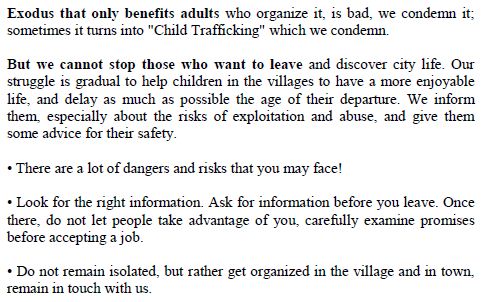
Drawing from the African Movement of Working Children and Youth’s report “Early Exodus and Child Trafficking in West Africa: What progress have working children and youth made?” Sept 2008

‘Children on the Move’

Children migrate and move for a host of reasons. They may move on their own will to seek improved opportunities. They may be escaping violence and abuse in the home or at school or running away from an arranged marriage or other cultural practice. They may move due to a lack of opportunity, reduced resources, conflict, or disaster. They may want to get away from life in a refugee camp, or flee other kinds of hardship. They might migrate together with parents or other adults, or they may go alone or with others their age. The migration decision may be made by children themselves, or they may be encouraged by their parents.

In the past, the phenomenon of child mobility has not been seen in its full scope. Children who migrated were often automatically lumped in with those who were trafficked against their will. Programs to support children on the move have not always addressed the variety of motivations and situations. This lack of understanding of the myriad of reasons for children’s mobility has hindered efforts to support and protect them in their different scenarios. More recently efforts have been made to better understand children’s mobility, for example this fascinating 2008-2010 regional study project, supported by a broad platform of child protection agencies, documented and analyzed the many forms taken by the mobility of children and youths in West and Central Africa.

The term ‘Children on the Move‘ has been suggested to describe this group of children under the age of 18 who have aims, motivations and different life circumstances. This is a group which transcends categories. These children may be in a ‘pre-mobility, mobility or post-mobility’ situation (either having arrived to a destination or having returned home). They may also be ‘children left behind’ by their parents or guardians, who, without abandoning them, have emigrated for work within their country of residence or abroad. They may be stateless children, who also suffer the risks and vulnerabilities of mobility.

Risks Children on the Move face

When children move against their will, and /or in absence of protection services and actors, they become highly vulnerable to the worst forms of child labor, exploitation and other abuses. This vulnerability is present before they move, during their trip, once they reach a new destination or even after they return home, and therefore support and protection need to be considered from the time they are thinking about moving (or others are thinking about moving them), through the actual migration or ‘move’, upon their arrival, and in the case of their return. In addition, some children may be involved in a series of migrations or they may migrate seasonally. “During movement, a child can float from one sub category to the other. For example, an internally displaced child can be recruited by armed forces or moved across borders for the purpose of exploitation. The risks and opportunities differ per trajectory and conditions of movement,” according to the CoM website.

Captured from “Best practices in the fight against early exodus and child trafficking” as printed in the African Movement of Working Children and Youth’s “Early Exodus and Child Trafficking in West Africa: What progress have working children and youth made?” report, Sept 2008.

Children who migrate often face discrimination and marginalization due to beliefs and policies that treat migration as a problem and children who migrate as criminals, and therefore a great deal of work needs to be done to change perceptions and increase societal awareness around the situation of children on the move. Protecting children and reducing their risk of exploitation is a mandate, regardless of the reasons for which they move or migrate.

A systemic approach to protection

In order to improve support for and protection of children on the move, it’s important to look at the situation holistically and systemically and to include the aforementioned different phases of mobility. In addition, several areas need consideration, including children’s own needs and rights; children’s self-protection; community-based protection; government responsibilities and social services; advocacy and public policy and so on. Duty bearers and donors need to improve coordination across silos and borders in order to get better at information exchange, research and data analysis; the creation of prevention and awareness strategies and programs; monitoring actions during all stages; and feedback mechanisms and accountability. (See the proceedings from the CoM Conference for more details.)

How can ICTs help?

Alongside the growth in children’s mobility, access to new technologies, specifically the mobile phone, has exploded. Yet most often, when child protection and ICTs are mentioned in the same sentence, it is with regard to cyber security and protecting children from the Internet or potential on-line predators.

ICTs are playing a huge role in connecting diaspora with those ‘back home.’  The question arises: How are or how could ICTs be enhancing child protection initiatives and supporting children on the move.

The positive and empowering role of ICTs to support children’s self-protection, improve information and communication via new technology tools and enhance systemic approaches to risk reduction has not been fully developed with regard to child protection in its broader sense, or with regard to child mobility and child protection.

The research 

The research will aim to compile a ‘State of the Practice’ report that will include examples and case studies of current ICT use by, with, among and for CoM; applicable cases and lessons learned from other sectors; gaps, challenges, areas where ICTs may pose new or additional risk; and remaining questions and challenges for future exploration and collaboration.

Certainly new questions, frameworks and areas to explore will arise along the way, but at present, questions include:

  • What needs do children have in different categories and stages of mobility and how are these being (or how could they be) enhanced via better use of new ICTs?
  • Which new technologies are already accessible and being used by various stakeholders (e.g. children, parents and caretakers, intermediaries, broader communities, local child protection committees and ‘safe houses’, local institutions, social workers, experts, civil servants, governments, national and international NGOs, local and national law enforcement agencies), especially children, adolescents and youth; during pre-mobility, mobility and post-mobility, and upon return, endogenous or institutional, and for what purpose or to what end?
  • What information and communication systems are currently in use at child and family, community, district, national, transnational /regional and global levels for supporting or protecting children on the move and can these systems be improved, promoted or better accessed using new ICTs such as mobile phones?
  • Are there existing scalable, replicable or adaptable examples of the use of ICTs in this area we can learn from? What were the successes, challenges, failures and lessons/good practices?
  • Can new ICTs support communication for development (C4D) approaches and models to help children on the move protect themselves, inform them of available support, and/or change broader societal attitudes toward migrating children to more positive and supportive ones?
  • What can we learn from how ICTs are being used in other areas (health, human rights monitoring, data gathering / tracking, early warning systems, disasters and emergencies)? Which of these might lend themselves to use with, for, among and by children on the move? Are there relevant evaluations or case studies we can look at and learn from?
  • What are the specific challenges and risks in terms of children on the move that need special attention and exploration when designing programs or eco-systems that integrate ICTs? Security? Privacy? Connectivity? Cost? Context? Sustainability? Feasibility?
  • Where do we take it from here (what needs to happen next)?

Please join us for the Twitter chat on August 14 at 9 a.m. EST.  We’ll be using the hashtag #CoMandICT for the discussion and to keep track of future Twitter conversations on this topic. Stay tuned here at Wait… What? or contact me @meowtree or by email for more information.

Please also consider joining the broader discussion on “Empowering Communities with Technology Tools to Protect Children” the week of October 17-23 hosted by our friends over at New Tactics.

Some related resources:

The excellent 2008 report by the African Movement of Working Children and Youth: Early Exodus and Child Trafficking in West Africa: What progress have working children and youth made? 

The AMWCY’s 2009 report “From the gong gong to ICTs

The fascinating study by a consortium of child protection groups on Child Mobility in West and Central Africa.

****

*This work is supported through a grant from Oak Foundation to Plan International USA.

Read Full Post »

Continue reading on Storify…

Amanda’s workshop was educational, thought-provoking, well-researched and participatory. The youth who participated in the workshop were from Bangladesh, Liberia, Haiti and across the US. They were incredibly savvy and insightful in their thoughts, analysis and comments. I learned a lot about ethical advocacy as well as about what makes a campaign or initiative interesting for well-informed, globally engaged young activists.

The rest of the workshop is captured here, including my favorite part:

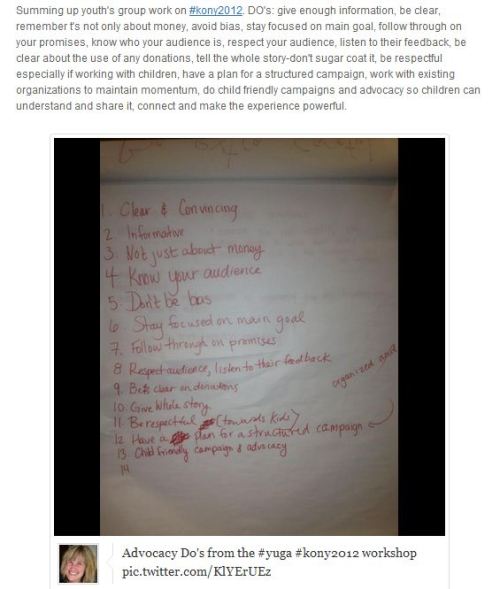
The advocacy Do’s and Don’ts that participants generated during group work:

And a key take-away:

Summary of the full workshop.

Amanda’s ebook “Beyond Kony2012: Atrocity, Awareness and Activism in the Internet Age.

Read Full Post »

« Newer Posts - Older Posts »